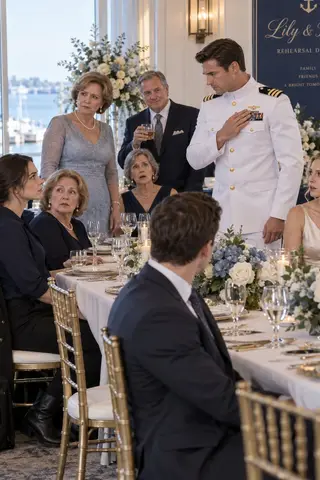
 Scorned by his family for wearing an old military uniform, the naval officer groom snapped to attention and saluted me with a "Yes, Commander!" the moment he saw me
Chapter 22
Trial by Simulated Fire
The Atlantic waters fifty miles southeast of Cape Hatteras churned with whitecaps under a turbulent slate-gray sky. Aboard the Ford, two decks below the flight deck inside the Tactical Flag Command Center (TFCC), there were no windows, no daylight, and no sense of time—only the eerie blue glow of tactical consoles, multi-threat radar displays, and the rapid chatter of communications watchstanders.
We were in the crucible of COMPTUEX—the Composite Training Unit Exercise. It was the grueling, month-long operational exam designed to push an entire carrier strike group to the absolute brink of systemic failure before deployment. The simulated adversary, a peer-state "Red Force" commanded by veteran aggressor captains, had thrown everything at our battle perimeter: subsurface wolfpacks, supersonic cruise missile profiles, and devastating electronic cyber-injections.
Suddenly, the central tactical display board flickered violently. Amber warning lights cascaded across the communications consoles.
"Loss of primary Link-16 tactical data stream!" the flag operations watch officer called out, his voice tinged with rising panic. "Red Force has deployed wide-spectrum electromagnetic jamming across our UHF and satellite relay bands. We've lost radar feeds from our outer cruiser escort, USS Normandy. Strike group air defense common operating picture is completely blacked out!"
In the center of the command hub, Admiral Harrison frowned, leaning over the master tactical plotting table. "Can we re-establish the satellite uplink via the backup transponder?"
"Negative, Admiral!" the communications officer answered frantically. "Adversary is spoofing our transponder frequencies. We are blind to the northeastern sector!"
"Incoming simulated threat profile!" the air defense coordinator yelled. "Acoustic signatures indicate eight low-altitude sea-skimming anti-ship missiles inbound from the blind sector. Time to intercept: four minutes. We can't vector combat air patrol fighters without targeting tracks!"
The room was descending into chaos. Staff officers were talking over one another, debating defensive counter-measures while the simulated missiles closed the distance at nine hundred miles per hour.
"Quiet on the floor!" my voice rang out like a rifle shot, cutting through the panic and freezing every officer in place.
I stepped up to the central plotting terminal, my eyes moving over the analog backup charts and raw telemetry with absolute, razor-sharp focus. In high-stakes crisis situations, panic was a luxury that cost lives.
"Watch supervisor, kill the automated satellite uplink," I ordered with icy precision. "They are anticipating us fighting to restore high-tech data links. We revert to tactical doctrine Zulu-Echo immediately."
Admiral Harrison turned to look at me, his brow furrowed. "Zulu-Echo? That’s an analog contingency protocol from the Cold War, Hayes."
"And that is precisely why their digital jamming will fail against it, Admiral," I countered without looking away from the board. "Watchstander, instruct the Normandy via high-frequency encrypted Morse burst to light up their SPY-1 radar in localized directional sweep mode. We will daisy-chain the targeting coordinates visually using our two airborne E-2D Hawkeye radar planes acting as high-altitude mirror relays. Signal our orbiting combat air patrol to slave their fire-control radars directly to the Hawkeye's analog broadcast."
The operations watchstanders hesitated for half a second before my commanding presence spurred them into violent action. Fingers flew across hardened physical consoles. High-frequency analog bursts crackled through the static-filled radio speakers.
Thirty seconds passed. The silence in the TFCC was suffocating.
"Hawkeye reports contact!" the air defense coordinator shouted, his voice cracking with sheer adrenaline. "Targeting coordinates mirrored successfully! Our F/A-18 Hornets have acquired the inbound simulated missile package! Fox Three! Fox Three!"
On the master board, eight red hostile blips flickered, flashed, and disappeared from the vector lines as our airborne fighters intercepted the threat package sixty miles from the carrier’s outer perimeter.
"Hostile strike package neutralized," the watch officer announced, letting out a ragged, disbelieving breath. "Outer perimeter secured. Red Force jamming vector compromised."
A quiet, stunned stillness swept across the flag command deck. Junior lieutenants and commanders looked at me with wide, awe-struck eyes.
Admiral Harrison slowly took off his headset. He looked at the cleared tactical screen, then turned to face me. He didn't say a word for several seconds; instead, he simply stepped back, brought his hand to his brow, and offered me a sharp, respectful nod of profound operational respect.
"Outstanding tactical audible, Captain Hayes," Harrison said quietly. "You just saved this carrier."
"Just keeping the fleet sharp, Admiral," I replied evenly, adjusting my sleeve cuffs. "Now, let’s find their submarine before they realize their air strike failed."
The End









