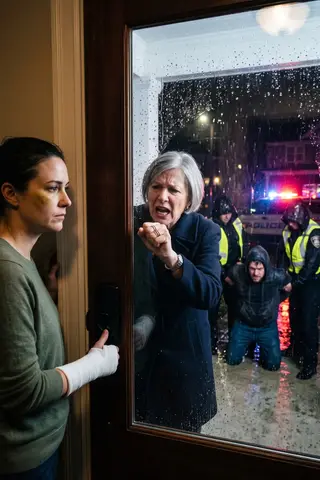
 My SIL Slapped Me at Dinner to "Teach Me the Rules"
Chapter 41
The Upstream Threat
By January, the coastal winter had settled deep into the marrow of the Lowcountry. A biting north wind swept across the Ashley River, whistling through the moss-draped live oaks and frosting the edges of the spartina grass on James Island. Inside our historic cottage, the wood-burning hearth crackled with dry hickory logs that Julian had split, filling our home with a comforting, smoky warmth.
I was seven months pregnant now. My belly was round and high, and beneath my hand, our son moved with rhythmic, steady kicks that constantly reminded me of the life we were protecting. Although Marcus Vance and Deputy Attorney General Tom Henderson had repeatedly insisted that I begin my maternity leave early, I could not pull myself away from the Cumberland Street bureau. The law did not sleep for winter, and in South Carolina, corporate greed rarely took a holiday.
Every morning, Julian would gently lace my boots, kiss my forehead with that tender, grounding reverence that made my soul ache with gratitude, and drive me to my office before heading out to the Wadmalaw boatyard. Lowcountry Timberworks was thriving; Daniel was now managing the design studio in Beaufort, while Julian hand-crafted flat-bottom skiffs and timber beams for community churches. We had found our paradise.
Then, on a gray Thursday morning, the telemetry sensors in the Edisto River basin began to scream.
The Edisto was the longest free-flowing blackwater river in North America, an irreplaceable arterial vein of pure freshwater that fed into the coastal estuaries, nourishing the ACE Basin, the shrimp nurseries, and the municipal drinking reservoirs for two hundred thousand coastal residents.
According to the automated digital readings transmitted to my terminal, the river’s salinity and chemical conductivity had spiked by four hundred percent in forty-eight hours. Simultaneously, commercial crabbers in Colleton County reported thousands of dead blue crabs washing ashore along the riverbanks, their shells coated in an oily, milky residue that smelled of sulfur and industrial ammonia.
I immediately summoned our chief hydrologist, Dr. Douglas Reid, into my office.
"What are we looking at, Douglas?" I asked, zooming in on the satellite thermal imagery.
"A massive upstream discharge, Chief," Douglas said, his face pale as he adjusted his wire-rimmed spectacles. "The epicenter isn't in Charleston County. It’s eighty miles upriver, just past Orangeburg, in the upper Piedmont watershed."
"Who owns the drainage rights along that canal?"
Douglas pulled up the state industrial registry. "A consortium called Piedmont-Palmetto Chemical & Logistics. They operate an industrial chemical transshipment facility adjacent to the railway corridor. They claim to be producing agricultural fertilizers, but this chemical signature isn't fertilizer, Claire. It’s perfluorooctanoic acid—concentrated industrial PFAS. Forever chemicals. They’re dumping millions of gallons of untreated toxic effluent straight into the headwaters of the Edisto."
My knuckles tightened against the armrests of my chair. "Who is behind Piedmont-Palmetto?"
"An Upstate titan," Douglas replied quietly. "Arthur Kincaid."
The name sent a cold shiver through the room. The Kincaid family was the undisputed aristocracy of the South Carolina Upstate—multi-billionaire textile and chemical magnates who owned half the manufacturing plants from Greenville to Spartanburg. For decades, the coastal Lowcountry and the industrial Upstate had lived in an uneasy truce: the coastal families controlled the ports and the banks, while the Upstate barons owned the factories and the political delegations in Columbia.
With Robert Mercer in prison and Senator Charles Montgomery disgraced, Arthur Kincaid had clearly decided that the coastal preserves were ripe for plunder. He was treating our pristine river as his private industrial sewer.
I pushed myself up from my desk, my spine straightening with iron resolve. "Draft an emergency Stop-and-Desist order, Douglas. Notify the EPA Region 4 office and alert SLED. Arthur Kincaid is about to learn that the Lowcountry’s rivers are not his dumping ground."
The End









