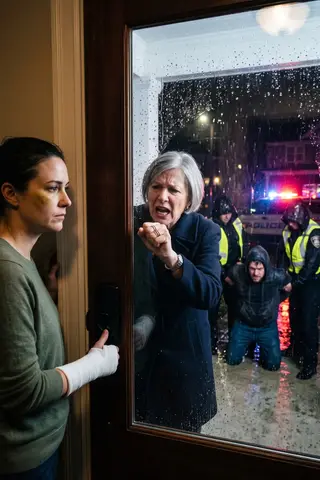
 My SIL Slapped Me at Dinner to "Teach Me the Rules"
Chapter 23
The Savannah Whistleblower
By Wednesday morning, my administrative division in Charleston was operating at full tactical alert.
I had summoned Marcus Vance and two of our top forensic investigators into Conference Room A. Across three whiteboards, we mapped the corporate anatomy of The Palmetto Heritage Alliance. As Judith had warned, the trail led through an intricate web of nominee directors, registered agent offices in Delaware, and real estate partnerships funded through private equity accounts in Atlanta.
"It’s a masterpiece of regulatory evasion," Marcus observed, running his hand over his close-cropped gray hair as he studied the charts. "The environmental permit application claims the parcel consists of ninety percent dry upland pine scrub, completely exempt from the Coastal Zone Management Act. They’ve already secured preliminary sign-offs from the Beaufort County zoning administrator."
"Who conducted the preliminary soil and wetlands survey?" I asked, zooming in on the digitized attachments on my tablet.
"A private engineering firm out of Savannah: Coastal Bio-Tech Assessments," Marcus replied. "They certified that there are no tidal tributaries or freshwater aquifers within two miles of the construction footprint."
I shook my head, tapping the screen. "That’s geographically impossible. Blackwood Bluff sits squarely between two major saltwater creeks feeding into Port Royal Sound. You couldn't dig an eight-foot hole out there without hitting the regional aquifer. Someone buried the real hydrology report."
I pulled up the corporate history of Coastal Bio-Tech. Eighteen months earlier, the firm had experienced a sudden executive shakeup. The original lead environmental toxicologist had been terminated abruptly following an internal dispute over "confidential data integrity."
Her name was Dr. Sarah Linwood.
Julian, who was sitting at the edge of the conference table reviewing the structural land deeds, looked up sharply. The air in the room suddenly felt thin.
"Sarah," Julian murmured, his voice barely audible over the hum of the air conditioning.
I looked at him, recognizing the name instantly. Sarah Linwood was the woman Julian had been engaged to twelve years ago—the nurse-turned-researcher whom Vanessa had humiliated at the Mercer dinner table, the woman whose career Robert had systematically destroyed using trumped-up charges to force her out of the state.
"She went back to graduate school after she left Charleston," Julian said, his voice laced with a mixture of reverence and lingering sorrow. "She earned her doctorate in environmental toxicology at Emory. She moved to Savannah four years ago to lead water quality studies for the coastal estuaries."
"She’s the one who wrote the real report," I said, piecing the puzzle together. "And when she refused to falsify the wetlands data for Montgomery’s syndicate, they fired her and buried her findings."
Julian looked at me, uncertainty flickering in his eyes. "Claire... if we contact her, it’s going to drag up old wounds. Sarah spent ten years rebuilding her life after what my family did to her."
I reached across the table and placed my hand firmly over his. "We’re not dragging her backward, Julian. We’re offering her the chance to finish what Robert Mercer started. She’s the key to bringing down the man who protected Robert for thirty years."
At 3:00 PM, Julian and I crossed the Talmadge Memorial Bridge into Savannah, Georgia.
We met Dr. Sarah Linwood at a quiet outdoor café shaded by weeping willows on the edge of Forsyth Park. She was forty now, elegant and poised, with sharp green eyes and streaks of silver running through her dark chestnut hair. She wore a simple white linen shirt, dark trousers, and an air of quiet, self-made authority that commands respect without shouting.
When she saw Julian approaching with me, she stood up slowly.
For a long moment, neither of them spoke. Twelve years of silence, manufactured shame, and unhealed scars hung suspended in the warm Savannah breeze.
"Julian," Sarah said softly, a small, sad smile touching the corners of her mouth. "You look healthy. Wadmalaw suits you."
"Sarah," Julian swallowed hard, his throat tight. "You look magnificent."
Sarah turned her gaze toward me. Her green eyes were discerning, sharp, and totally devoid of hostility. "And you must be Claire Bennett. The woman who did what none of us could do."
"It's an honor to meet you, Dr. Linwood," I said, offering my hand.
Sarah took it with a firm, warm grasp. "Please, call me Sarah. I’ve followed your division’s work in the press. When I saw Robert Mercer in handcuffs on the news, I poured myself a glass of twenty-year bourbon and cried until dawn."
We sat down, the shade of the live oaks sheltering us from the midday sun.
"You're here about Blackwood Bluff, aren't you?" Sarah asked before we could even order our drinks.
"You knew?" I asked.
Sarah reached down into her leather satchel and pulled out an encrypted hard drive, sliding it across the marble table toward me.
"When Coastal Bio-Tech fired me, they sent private security to clear out my lab," Sarah said, her voice dropping into a razor-sharp clinical cadence. "They thought they deleted all my files from the server. But I was trained in the Mercer school of survival, Julian. I never leave raw data without a redundant backup."
"What’s on this drive, Sarah?" Julian asked.
"Proof that Blackwood Bluff is an environmental disaster," Sarah said. "The soil on that four-hundred-acre parcel is saturated with industrial creosote and heavy arsenic from a chemical treatment plant that operated there in the 1950s. If Montgomery’s syndicate builds their logistics terminal, the construction dredging will breach the clay cap. Within six months, fifty million gallons of toxic runoff will flush into Port Royal Sound, poisoning the coastal oyster beds and the drinking water for sixty thousand residents."
I gripped the cold metal casing of the hard drive. "And Montgomery’s consultants knew this?"
"Senator Montgomery’s family owned the chemical plant that dumped the creosote sixty years ago," Sarah said, her eyes flashing with cold fire. "They aren't just building a terminal, Claire. They’re using state development bonds to bury their family’s toxic liability under five feet of concrete, leaving the taxpayers to absorb the cancer cluster when the water turns brown."
The End









