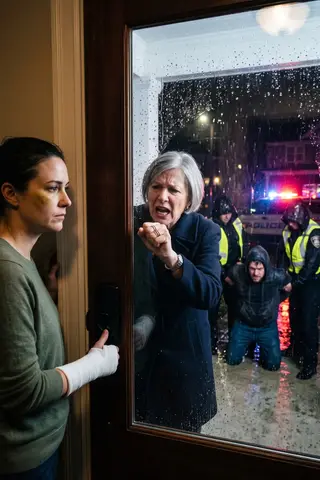
 My SIL Slapped Me at Dinner to "Teach Me the Rules"
Chapter 27
The United Front
At 2:00 PM, the grand Senate Hearing Room on the third floor of the Statehouse in Columbia was packed to overflowing.
Over two hundred spectators, state representatives, environmental advocates, and national journalists were jammed into the mahogany pews beneath the massive oil portraits of South Carolina governors.
At the elevated committee dais sat Senator Charles Montgomery, presiding as Chairman of the Senate Oversight and Ethics Review. He looked supreme, untouchable, wearing an impeccably tailored navy suit with an American flag pin in his lapel, his silver hair neatly combed, his hands resting casually on the marble bench.
Beside him sat four allied state senators, prepared to execute a scripted political execution.
"The committee will come to order," Montgomery proclaimed, striking his heavy brass gavel with a resounding crack. "We are convened to review the gross administrative misconduct and financial weaponization of the State Oversight Bureau under Chief Claire Bennett. Ms. Bennett, you are summoned to the witness stand."
I stood up from the counsel table, smoothing the skirt of my charcoal suit. But I did not walk down the center aisle alone.
Walking beside me, step for step, was Julian Mercer, carrying a heavy leather evidence ledger.
Walking on my right was Daniel Mercer. He had taken a red-eye bus from North Carolina at midnight, wearing a modest, clean suit, his face set with quiet, unwavering courage.
And walking behind us were Dr. Sarah Linwood and Deputy Attorney General Tom Henderson.
A collective murmur swept through the packed chamber like a gust of wind. Replying cameras clicked frantically. Montgomery’s eyes widened slightly, an involuntary twitch pulling at the corner of his thin lips as he saw the two Mercer brothers standing together in the light of day.
"Ms. Bennett," Montgomery sneered through his microphone, leaning forward. "This is an administrative legislative review, not a family reunion. The witnesses at your table have no standing before this committee."
"On the contrary, Mr. Chairman," I said, stepping up to the witness lectern, my voice carrying with absolute, crystalline authority that resonated through every corner of the historic hall. "Every person at this table has direct, sworn standing regarding the criminal conspiracy operating out of your private office."
"That is enough!" Montgomery barked, slamming his gavel down. "You are out of order! You are here to answer for your unethical audit of Blackwood Bluff!"
"I am here to deliver the final audit of Blackwood Bluff, Senator," I replied calmly.
I turned to the chamber's digital multimedia lectern and inserted the encrypted government drive.
"Under South Carolina Code of Laws Section 8-13, I present to this committee Exhibit A: the authenticated forensic video recordings recovered from the private vault of Robert Mercer, detailing the systematic theft of state coastal infrastructure bonds between 2018 and the present day."
Before Montgomery could scream another objection, Tom Henderson signaled the technician.
The high-definition monitors mounted around the chamber flickered to life.
Senator Montgomery’s face appeared in vivid, terrifying clarity, his voice booming through the chamber’s state-of-the-art acoustic system:
"...The Beaufort site has thirty parts per million of arsenic in the topsoil... We skim fifteen percent off the top for our Cayman accounts... In this state, Robert, I am the law..."
The chamber erupted into sheer bedlam.
Reporters sprang from their seats, yelling questions. Two committee senators leaned back in their chairs as if Montgomery had suddenly caught fire, physically distancing themselves from the Chairman.
Montgomery stood up, knocking his leather executive chair backward, his face turning an apocalyptic shade of crimson. "Shut that off! Turn off the projection! I demand the sergeant-at-arms clear this room!"
"The sergeant-at-arms will stand down," a booming voice echoed from the rear double doors.
Every head in the room snapped toward the entrance.
Marching down the center aisle were eight armed special agents from the Federal Bureau of Investigation, flanked by the United States Attorney for the District of South Carolina and four uniformed SLED captains.
The lead federal prosecutor stepped up to the committee dais, unholstering a sealed parchment from his coat.
"Charles Montgomery," the federal prosecutor proclaimed, his voice cutting through the panic like an executioner’s axe. "A federal grand jury sitting in Columbia has returned a thirty-four-count sealed indictment charging you with Hobbs Act extortion, wire fraud, conspiracy to violate the Clean Water Act, and racketeering."
Two FBI agents stepped up behind the legislative bench, taking Montgomery by the arms.
The silver-haired patriarch of South Carolina politics, who had ruled the Lowcountry for forty years through backroom intimidation and bought judges, looked down at his trembling hands as the steel handcuffs ratcheted around his wrists in full view of twelve rolling television cameras.
As they led him down the marble stairs, Montgomery passed the witness lectern.
He looked at me, his eyes burning with venomous, impotent rage. "You destroyed this state, Bennett. You broke our legacy."
I looked straight into his hollow eyes, without fear, without hatred, with only the immovable calm of the Atlantic tide.
"No, Senator," I said softly. "The state was never yours. You just mistook our silence for consent."
The End









