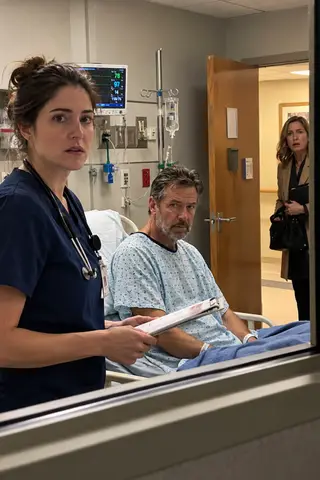
 My Husband Had a Medical Emergency
Chapter 41
The Clinical Return
The automatic pneumatic doors of St. Jude’s fourth-floor cardiac wing parted with a familiar, sterile hiss, welcoming me back into the world of telemetry alarms, antiseptic wipe canisters, and the rhythmic squeak of rubber soles against waxed linoleum. Four months of maternity leave had softened the calluses on my palms, replacing the cold plastic of intravenous tubing with the velvety warmth of Nora’s cheeks, but the muscle memory of eleven years in critical care remained as sharp as surgical steel.
"Look who finally decided to grace us with her presence," Sarah called out from behind the central nursing console, a brilliant grin lighting up her face as she looked up from the telemetry bank. She abandoned her charting tablet, stepped around the curved mahogany desk, and wrapped me in a fierce, floral-scented hug that squeezed the lingering morning chill from my shoulders. "The unit has barely survived without you, Maris. The new float nurses tried to chart ventricular escape beats as simple sinus bradycardia twice last week."
"Then it’s a good thing I’m back," I smiled, stepping behind the console and running my fingertips affectionately along the laminate edge of the desk.
My return wasn't just a resumption of my former routine; I was stepping into the newly created role of Assistant Clinical Nurse Manager for Cardiac Services, splitting my hours between bedside oversight and procedural quality control. It felt good to wear my freshly pressed navy scrubs again, my institutional badge clipped firmly to my lapel, the silver letters reading: Maris Vale, RN, BSN, CCRN.
Before I could log into the hospital workstation, Dr. Vance, our lead electrophysiologist, emerged from the private dictation cubicle at the end of the hall. He carried a heavy manila folder tucked beneath his elbow, his normally jovial features arranged in a tight, solemn line that instantly triggered my clinical radar.
"Maris," Dr. Vance said, motioning toward his office with a slight tilt of his head. "Welcome back. When you have two minutes, step inside. We need to review an urgent safety communication."
I followed him into the quiet, book-lined office. He closed the heavy door, walked behind his desk, and laid a brightly stamped document between us: FDA Class I Medical Device Safety Alert: Urgent Recall of Bi-Ventricular Defibrillation Leads.
"What is this?" I asked, my throat tightening as my eyes scanned the bold serial classifications.
"OmniTrace recalled their Series-7 transvenous ICD leads forty-eight hours ago," Dr. Vance explained quietly, resting his hands flat on the desk. "Post-market surveillance detected a micro-fracture vulnerability in the inner conductor coil, specifically accelerated by subclavicular mechanical compression during shoulder flexion. It affects implants completed between August of last year and January of this year."
The sterile air in the room felt suddenly devoid of oxygen. August of last year.
"Declan’s lead," I whispered, the paper trembling slightly as my fingers gripped the edge of the desk. "He received the OmniTrace Series-7 right here in Lab 2."
"Declan's lead is part of the designated recall cohort," Dr. Vance confirmed solemnly. "The failure rate is low—less than three percent—but when the conductor breaks, it causes intermittent signal oversensing. It can deliver an inappropriate high-energy shock when the patient simply reaches across a table, or worse, fail to deliver therapy during a true ventricular tachyarrhythmia. We need to bring him in for an immediate lead impedance interrogation."
Just when our world had settled into an exquisite, sunlit peace, the ghost of Declan’s cardiac fragility had returned to knock on our door once more.
The End









