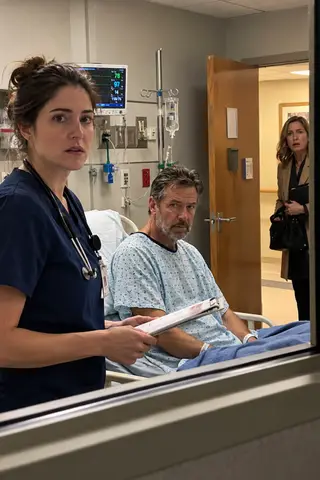
 My Husband Had a Medical Emergency
Chapter 37
The Toco Trace
Room 3 of the Labor and Delivery Pavilion was a haven of warm light, quiet monitors, and clinical readiness. The storm still rattled the heavy double-paned windows, but inside, the atmosphere was controlled, professional, and intimate.
I lay in the birthing bed, propped at a forty-five-degree angle, wearing a hospital gown, two wide elastic belts strapped snugly across my swollen abdomen. One held the tocotransducer measuring uterine contractions; the other held the Doppler ultrasound tracking our baby’s heart rate.
Beside me, Declan sat on a low stool, his suit jacket discarded, his sleeves rolled up, holding my right hand in both of his. On the other side stood Dr. Sarah Vance, our maternal-fetal specialist, reading the continuous paper strip feeding from the diagnostic monitor.
"Cervix is fully effaced, dilated to eight centimeters," Dr. Vance announced after a quick examination, stripping off her sterile gloves. "Station is plus one. You're in the home stretch, Maris. But let’s watch this strip."
I turned my head toward the monitor. My eleven years of critical care nursing made it impossible to simply be a patient. The top line displayed my contractions—tall, symmetrical bell curves peaking every two minutes. But on the lower line, where the fetal heart rate was tracked, a subtle dip appeared right at the peak of each contraction.
140 bpm... dropping to 115... 105... then slowly recovering after the contraction subsided.
"Late decelerations," I whispered, cold fear prickling at the back of my neck.
"Mild lates," Dr. Vance corrected calmly, placing a reassuring hand on my knee. "The umbilical cord is likely experiencing transient compression during peak uterine pressure. Let’s change maternal position. Turn onto your left lateral decubitus, Maris. Let’s maximize uteroplacental blood flow."
Declan immediately sprang into action, supporting my shoulders and hips as we shifted my heavy frame onto my left side, placing a peanut-shaped birthing ball between my knees.
"Sarah, get a non-rebreather mask with eight liters of oxygen," Dr. Vance ordered the bedside nurse.
Within seconds, the clear plastic mask was fitted over my face. I drew deep, cool breaths of enriched oxygen into my lungs, focusing every ounce of my willpower on sending that life-giving flow through my placenta to our daughter.
Declan leaned over the bedrail, his face inches from mine, his eyes locked onto mine with an intensity that anchored my soul. "Breathe with me, Maris. In through the nose. Out through the mouth. Look at the monitor with me."
We watched the green tracing together. The next contraction hit—a towering wave that made my entire body tremble with primal intensity. But this time, on my left side with supplemental oxygen flowing, the baby’s heart rate held firm: 138... 142... 140. No dip. No deceleration.
"Decels resolved," Dr. Vance smiled warmly, reaching for the delivery pack. "Baby tolerated that beautifully. And you, Nurse Vale, are at ten centimeters. Complete and fully dilated."
The room transformed with quiet efficiency. The foot of the bed was detached, sterile drapes were spread, and the neonatal warmer was switched on, its radiant heater casting a golden glow over the bassinet.
"Alright, Maris," Dr. Vance said, positioning herself at the foot of the bed. "On the next contraction, I want you to take a deep breath, tuck your chin to your chest, and give me ten seconds of your best work. It’s time to meet your daughter."
The End









