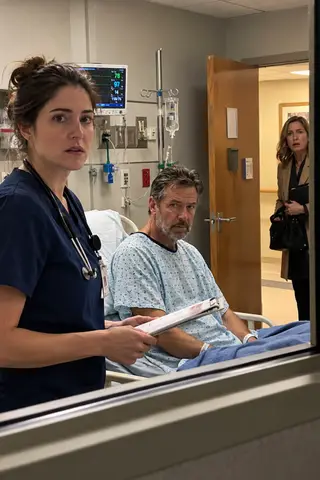
 My Husband Had a Medical Emergency
Chapter 33
A Shift in Step-Down
Two days after the municipal hearing, I was finishing what was intended to be my final twelve-hour shift at St. Jude's Hospital before commencing formal maternity leave. The heat outside had broken into a muggy, suffocating drizzle, keeping the emergency department downstairs backed up with acute respiratory exacerbations and congestive heart failure admissions.
At thirty-five weeks, my mobility was undeniably compromised. Every time I stood up from the charting console, a sharp, electric twinge shot through my lower lumbar spine, accompanied by the hard, tightening sensation of Braxton Hicks contractions that had grown increasingly frequent over the last forty-eight hours.
"Maris, you need to go home," Sarah urged, placing a cold bottle of electrolyte water on my desk. "Your ankles are swollen, you look exhausted, and your blood pressure check an hour ago was 132 over 84. That’s elevated for you."
"I just need to finish handoff documentation for Bed 416," I insisted, tapping my stylus against the electronic medical record screen. "Mr. Alvarez is forty-eight hours post-ablation for refractory atrial flutter. His rhythm needs to be monitored for transient junctional escape beats before he can be discharged tomorrow."
Before Sarah could argue, the telemetry console at the central nursing station emitted a frantic, high-pitched warble.
Bed 418: Asystole Alarm.
The color drained from Sarah’s face. Bed 418 was a fifty-two-year-old post-infarction patient admitted that morning with extensive anteroseptal scarring. Without thinking, pure clinical instinct seized my muscles, overriding the exhaustion and the heavy ache in my pelvis. I kicked back my rolling chair and bolted down the linoleum hallway toward Room 418, snapping on gloves from the wall dispenser as I ran.
"Crash cart! Call a Code Blue!" I shouted down the hall.
I burst into Room 418. The patient was slouched sideways against his pillows, completely unresponsive, his face pale and waxy, his lips turning a terrifying slate gray. On the overhead monitor, the green line had flattened into an ominous, continuous flatline with occasional agonal blips.
I grabbed the bed release lever, dropping the head of the bed flat, and reached for the carotid pulse. Nothing. No carotid pulse, no chest rise.
"Cardiac arrest!" I barked as Sarah rolled the red crash cart through the door.
I locked my elbows, leaned over the siderail, and drove the heel of my palms into the center of the patient’s sternum. One, two, three, four, five...
The physical resistance of human bone and cartilage against my palms sent a violent shudder through my arms, radiating directly down into my abdomen. With every compression, a sharp, tearing cramp gripped my uterus, knocking the breath from my lungs.
"Maris, stop! Let me take over!" Sarah commanded, grabbing my shoulder.
"Charge the defibrillator to 200 joules biphasic!" I gasped through clenched teeth, refusing to stop until another set of hands was in place. Twenty-eight, twenty-nine, thirty! "Switch!"
Sarah slipped seamlessly into my spot, continuing the rhythmic, bone-crushing compressions without losing a single beat. I stumbled back against the metal IV pole, my breath coming in ragged, shallow gasps, my hands clutching the lower swell of my belly as a powerful, unmistakable contraction seized my entire midsection.
The attending physician rushed into the room, taking over the airway with an ambu-bag. "Rhythm check!"
Sarah paused compressions. The monitor showed fine, chaotic ventricular fibrillation.
"Clear!" The defibrillator delivered a sharp, mechanical shock. The patient’s body jolted on the mattress. Two seconds later, a wide QRS complex appeared on the screen, followed by another, and another, settling into a stable, bradycardic rhythm at 54 beats per minute.
"Pulse restored," the doctor called out, checking the femoral artery. "Good catch, team."
I leaned heavily against the doorway, my forehead coated in cold sweat, feeling the deep, rhythmic kicking of our daughter against my ribs. Sarah stepped out of the room, peeling off her gloves, and looked at me with an expression of fierce, sisterly authority.
"That's it, Maris," Sarah said firmly, taking my arm and guiding me toward a wheelchair. "You just helped save another life. But your work here is officially done. Sit down. I am personally wheeling you out to Declan’s car, and you are not stepping foot on this unit again until you're holding your baby."
The End









