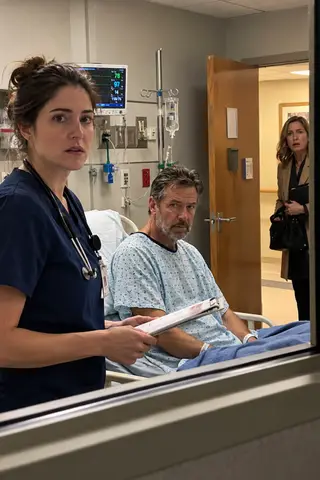
 My Husband Had a Medical Emergency
Chapter 22
The Code in Triage
The rhythmic chirping of the cardiac monitors in the step-down nursing station was a familiar, predictable pulse that usually brought me focus. It was 3:15 AM on a rainy Tuesday. I was reviewing the telemetry strips of a recovering post-CABG patient when the double pneumatic doors of the emergency bay burst open, accompanied by the urgent, piercing wail of an incoming EMS siren.
"Maris! We need you in Trauma 2 right now!" shouted Sarah, the night triage coordinator, her face pale beneath the harsh fluorescent lights. "Squad 14 just rolled in with a thirty-four-year-old female, acute collapse at home, severe pleuritic chest pain, profound dyspnea, and hemodynamically unstable sinus tachycardia!"
I tossed my charting stylus onto the desk and sprinted into the trauma bay, snapping on a pair of purple nitrile gloves in mid-stride. "What’s her baseline? Did EMS establish IV access?"
"Two large-bore lines running normal saline wide open," the paramedic called out, wheeling the gurney into the center of the room. "Blood pressure is 78 over 50. Pulse is 148, irregular, with deep cyanosis around the lips. Oxygen saturation is barely holding at 82 percent on a non-rebreather mask. The roommate found her collapsed on the bathroom floor clutching her chest."
I stepped to the patient’s head, reaching down to stabilize the oxygen mask, and my entire world tilted violently on its axis.
The pale, gasping woman lying beneath the plastic mask, her dark hair soaked with cold perspiration, her lips tinted blue from severe hypoxia, was Declan’s sister.
"Claire?" The name tore from my throat before my clinical detachment could stop it.
Claire’s eyes fluttered open, glassy and terrified, locking onto mine through the haze of acute respiratory failure. "Mar... is..." she wheezed, her chest heaving violently, intercostal retractions pulling sharply beneath her collarbones. "Can't... breathe... hurts..."
"I have you, Claire. Look at me, stay with me!" I yelled, my nurse's voice instantly overpowering the surging panic in my chest. I turned to the attending emergency physician, Dr. Bradley. "Look at the twelve-lead ECG! Prominent S-wave in lead I, deep Q-wave in lead III, inverted T-wave in lead III! That’s an S1Q3T3 pattern!"
Dr. Bradley leaned over the printed paper strip, his eyes widening. "Acute right ventricular strain. She’s throwing a massive pulmonary embolism."
"Bedside ultrasound, now!" I commanded, grabbing the vascular probe and coating it with acoustic gel. I planted the transducer against Claire’s subxiphoid space. On the glowing grayscale screen, the diagnosis was undeniable: her right ventricle was massively dilated, bulging severely into the left ventricle like an over-inflated balloon, barely able to pump blood past a catastrophic clot in her pulmonary tree.
"Her pressure is dropping—68 over 40!" Sarah called out, alarm bells blaring across the bedside vitals monitor.
"She’s arresting from obstructive shock," Dr. Bradley said grimly. "We don't have time for a CT angiogram. Prep the tenecteplase. We have to give systemic thrombolytics right now, or she dies on this table."
The End









