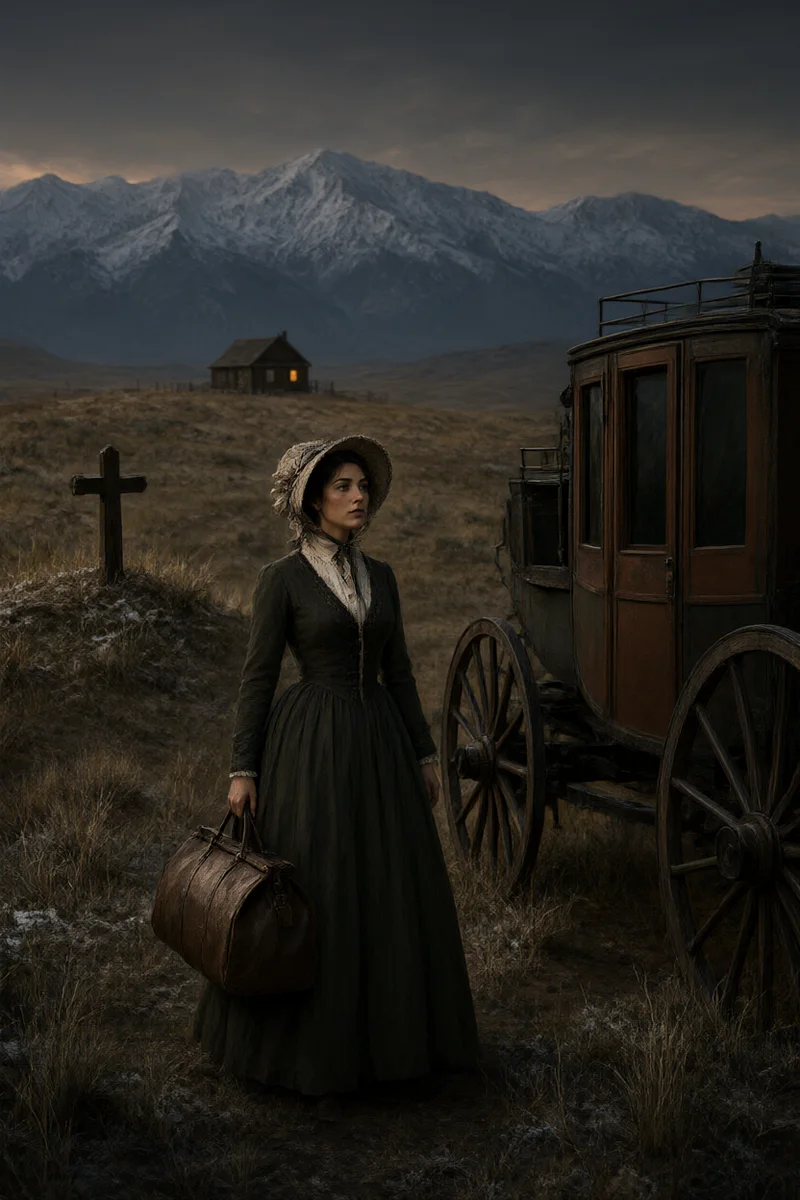
 Bride for a Buried Man
Chapter 5
In His Own Name
The agent refunded thirty-eight dollars and fifty cents and asked no questions, though he plainly had several.
Eben had not driven off. He was sitting on the wagon seat with the lines slack in his hands, facing north, as if the team had forgotten how to start. He turned when he heard her on the gravel, and then looked past her at the stage pulling out with nobody in it.
“You've missed it.”
“I have not. I sent it away.” She stood at the wheel and looked up at him. “I agreed to marry a man on the strength of fourteen letters, Mr. Tarrant. You have not written me one.”
“I'm sat right here.”
“Saying as little as you can manage. Mrs. Sawtell lets a room to respectable women, and Mr. Oakes has not found the bottom of a column since he opened. I shall be in town. The mail goes Thursdays.” Her voice was not as steady as her arithmetic. “If you have anything to say to me, say it the way I am used to. In your own name, this time.”
He was quiet so long the mare shifted her feet. “I write a poor hand.”
“I did not come nineteen hundred miles for penmanship.”
The first Thursday brought nothing. She found eleven dollars Oakes did not know he had and a freight bill he had paid twice, and did not look toward the depot more than was reasonable.
The second Thursday the agent slid a feed-order envelope across the counter with his face held carefully blank. It contained three lines. Miss Aldous. Sold Fitch six more loads at twelve. The mare is well. E. Tarrant.
She wrote back two pages and ended with a question, so that he would have to answer.
He answered. By November he was filling a sheet. He wrote that the pine room had stopped weeping pitch. He wrote that he had found a tin whistle at the bottom of Jonas's trunk, and understood that his brother had spent some part of thirty-four years trying to learn two notes, and that he had sat down on the trunk for a while after.
In the second week of December the letter was short again.
Miss Aldous. I read the catalogue to the stove last night. It had no opinion on the Early Rose. I find I would rather have yours. Eben.
She read it standing at Oakes's desk. Then she capped the ink, took her coat from the nail, and paid Oakes's boy a quarter to drive her six miles in a wind that came down off the mountains with snow in its teeth.
He was at the stack, pitching to forty cows. He saw the buggy and stopped with the fork in the air.
“I couldn't answer by post,” Mina said, climbing down. “It wanted saying. The Early Rose is a poor keeper, whatever your catalogue claims. My mother grew them. I would plant Peachblows.”
Eben considered this with great seriousness. “That's your opinion.”
“You asked for it. I have that in writing.”
He laughed. She had not heard it before; it was rusty, and it startled the mare. He came across the yard still holding the fork, remembered it, and stuck it in the snow.
They were married in Oakes's store on the first Thursday of January, that being mail day, when the whole county was in town regardless. The agent stood witness with the pencil behind his ear. The bride carried no flowers, there being none in Wyoming in January, but the groom had tied the license with a bootlace.
The End









