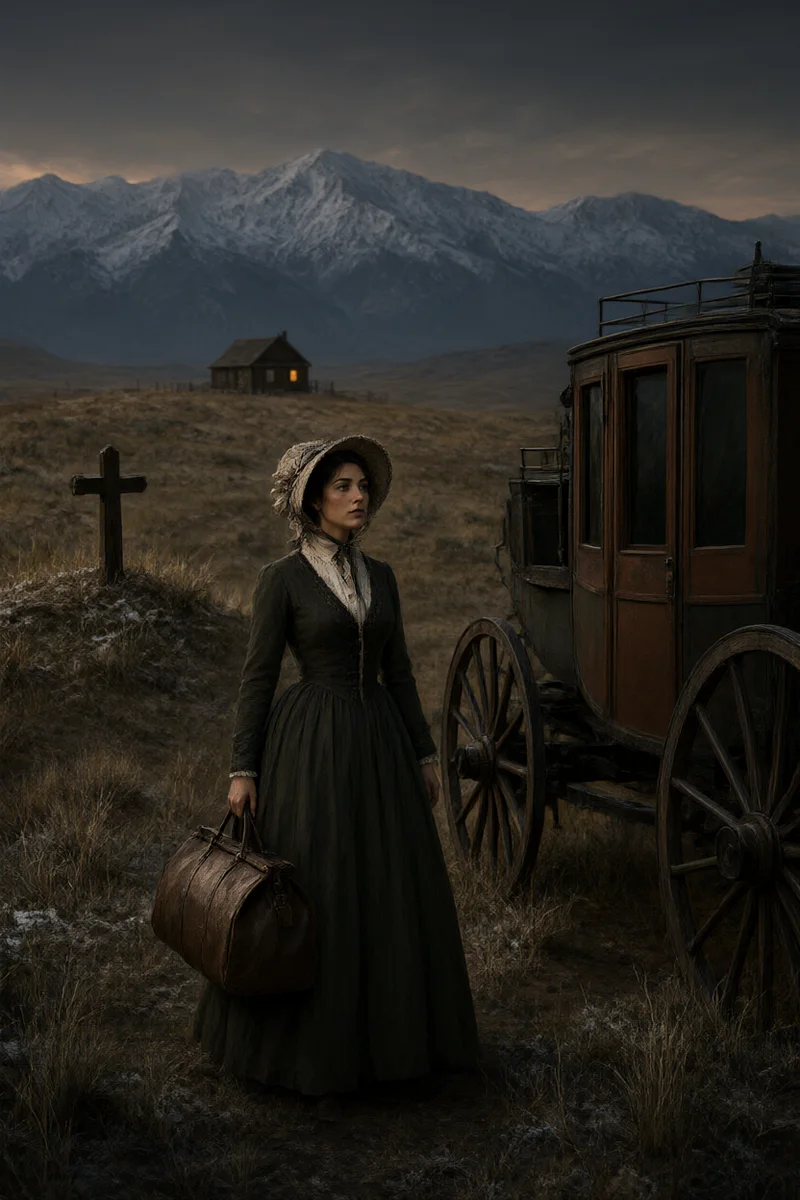
 Bride for a Buried Man
Chapter 1
Thursday's Stage
The driver set Mina Aldous's trunk in the dust of Sorrel Creek and was back on his box before she had finished counting the buildings. There were nine. One was a saloon, and one was on fire in a small, unworried way, a blacksmith's forge with its doors propped wide.
She had a letter in her glove that said he would be standing by the depot in a gray hat. She had read that sentence so often between Lowell and Cheyenne that the fold had gone soft as cloth.
Nobody on the platform wore a gray hat. Nobody was on the platform at all except a station agent with a pencil behind his ear, who looked at her trunk, then at her, then at the trunk again as though it might explain her.
“I am expected,” she said. “By Mr. Jonas Tarrant.”
The agent took the pencil from behind his ear and seemed not to know what to do with it. “Ma'am,” he said. “Jonas Tarrant was buried a week ago today. His heart quit on him in the hay meadow. He was thirty-four.”
Mina had kept the ledgers in the counting room of a cotton mill for eleven years, and had trained herself never to react to a figure until she had checked it twice. She found that she was checking this one. A week ago today she had been on a train in Ohio, eating a boiled egg, rather pleased with herself.
“There's a brother,” the agent said. “Eben. He's over to Oakes's for nails. I'll—well. I'll fetch him.”
The man who crossed the street did not hurry. He was tall and wind-burned, with a band of black crape pinned crooked on his sleeve by someone unused to pins, and he stopped a full six feet off, the way a person stops short of a strange dog.
“Agent says you're asking for my brother.”
“I am Wilhelmina Aldous. Of Lowell, Massachusetts.” She waited. Nothing moved in his face. “He did not mention me.”
“No, ma'am.”
“We have corresponded since March. In June he asked me to marry him, and I said that I would.” She heard how it sounded, out loud, in a street. She took the packet from her bag anyway. Fourteen letters, tied with a bootlace, because he had written that ribbon was not to be had in Sorrel Creek and she had thought that funny.
He did not take them. He read the top envelope where it lay in her hand, and she watched him know the handwriting.
“Every other Thursday,” he said slowly, “Jonas handed me an envelope for the mail and told me it was the seed order. I carried them to this depot myself.” He rubbed his jaw. “I thought we were buying a deal of seed.”
It was very nearly a joke. Neither of them could reach it.
“When is the next stage east?” Mina asked.
“Thursday next,” the agent called from his doorway. “She only runs the once a week, ma'am. And there's no hotel. There's rooms over the Elkhorn, but they're not—no.”
She had nineteen dollars and a trunk of linens hemmed for a house she had never seen. Eben Tarrant looked at the trunk too. Then he looked north, where the road ran out of town into grass the color of a lion, and his jaw worked as if he were pricing something he could not afford.
“It's six miles,” he said at last. “There's a room he built on in the spring. He told me it was for storing oats.” He picked up her trunk by one handle as though it held feathers. “I guess it wasn't for oats.”
He had it in the wagon bed before he spoke again, and then he did not look at her to do it.
“Miss Aldous. Whatever he wrote you about the place. I wouldn't lean on it.”
The End









