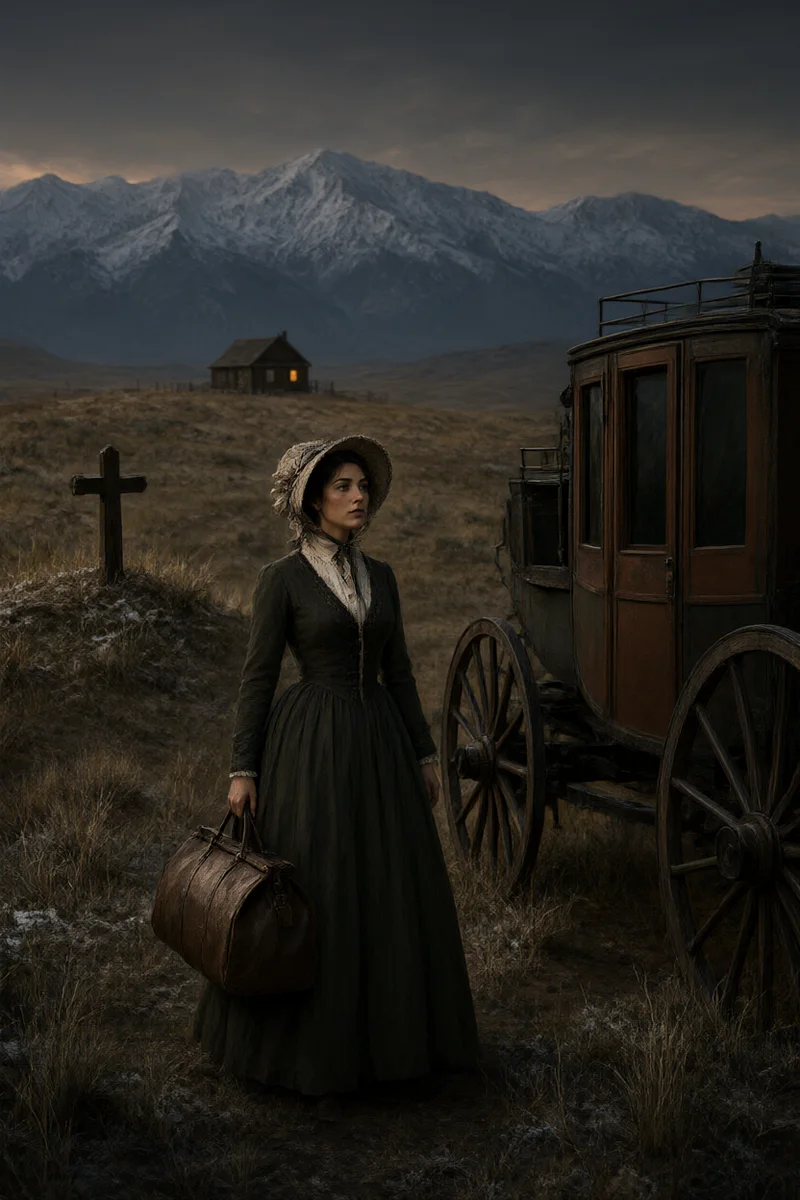
 Bride for a Buried Man
Chapter 3
Eighteen Tons
“He was a grown man and he signed it,” Eben said, and drove the fork into the stack. “It's not on you.”
“I didn't say it was on me. I said it was for me. Those are different columns.” She shaded her eyes at the hay. “What does Mr. Lyde offer you for this?”
“Five dollars the ton. When he's feeling Christian.”
“For two days on the stage I sat across from a commissary man named Fitch. He feeds two hundred mules for the railroad graders at Medicine Cut, and he pays twenty dollars a ton for hay freighted in from Nebraska. He complained of it for sixty miles with his mouth full.”
Eben pulled the fork out again and stood holding it.
She asked how far Medicine Cut was. Twelve miles, he said. She asked what a wagon carried. A ton and a half, with the rack on.
She did it in her head; she had never needed paper under a thousand. “Eighteen tons at twelve dollars is two hundred and sixteen. Twelve loads. You have nineteen days.”
“He'll not give twelve.”
“He'll give twelve to be eight dollars ahead. Hitch the wagon, Mr. Tarrant. I should like to complain at him for a change.”
Fitch gave twelve. He also gave her a look of mournful respect and a tin cup of coffee.
After that the days had one shape. Eben pitched and she tramped the load down, wading in hay to the knee, until her palms opened. On the second morning a pair of buckskin gloves lay on the wagon seat. They had been Jonas's. Neither of them mentioned it. A cracked axle cost them four days, and Thursday's stage went east without her, and neither of them mentioned that either.
She noticed things, because noticing was her trade. He called the mare with two whistled notes, a low one and then a high. He salted his coffee. And after supper, when she had gone to the pine room and he thought the wall was thicker than it was, he sat by the stove and read aloud from the seed catalogue in a slow, private voice. “Early Rose potato. Hardy. A good keeper.”
Mina lay very still on the straw tick.
I have a habit of reading the seed catalogue to the stove of an evening, Jonas had written in May. You may laugh. She had laughed, alone in a boardinghouse in Lowell, and read the line again, and it was that line more than any other that had put her on a train.
Brothers shared habits. She told herself so, and then told herself again.
On the ninth load it rained, a cold slanting rain that smelled of iron. Eben's coat was soaked through by noon. She went to the peg behind the door for something dry and took down the brown town coat that still hung there because nobody had had the heart to move it.
Paper crackled in the breast pocket.
It was an envelope, sealed and never posted, addressed to Miss W. Aldous in the round hopeful hand she knew better than her own. He had dated the corner: August the thirtieth. Beneath the date he had written, To be handed her at the depot.
She opened it standing in the doorway with the rain blowing in.
“Miss Aldous,” it began. “By the time you read this you will have met the man I have been describing to you since March, and you will have noticed that he is not me.”
The End









