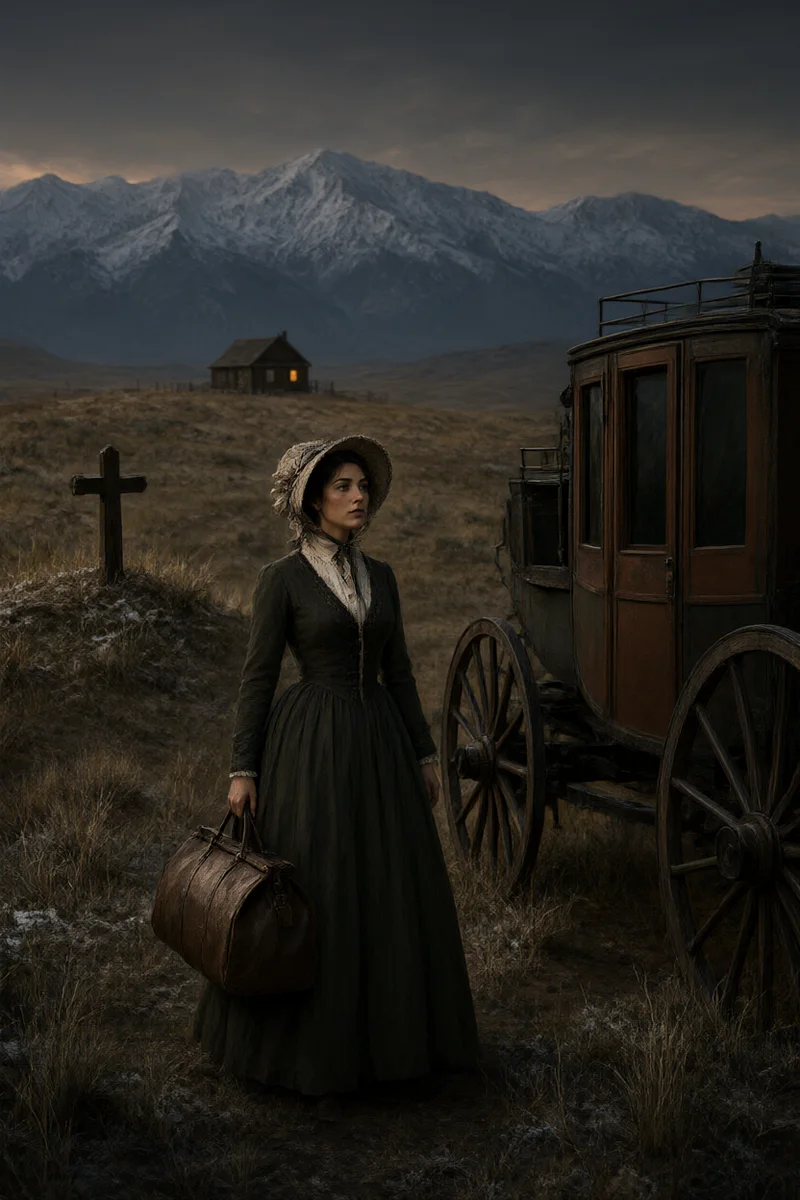
 Bride for a Buried Man
Chapter 2
The Room That Wasn't for Oats
Jonas had written that the house was snug and the creek was good. The creek was good. It ran clear over brown stones forty yards from the door, and Mina gave him that one.
The house was two rooms of cottonwood logs under a sod roof with sunflowers growing out of it. Against its east wall stood a third room of new yellow pine, so raw it still wept pitch, with a real glass window.
Inside, a shelf had been hung at exactly the height of her shoulder. She had told him in April that she stood five feet two and could never reach anything.
“I'll sleep in the barn,” Eben said from the doorway, not crossing the sill. “There's beans. The stove smokes if you feed her from the left.” He seemed to search for a third thing and not find it.
She slept in her traveling dress on a tick that smelled of fresh straw, and woke to a stranger's voice in the yard.
The stranger sat a tall bay horse and had not got down, which Mina understood to be a kind of statement. He had a clean collar and a sorrowful expression that he wore like a watch chain.
“—sorry as I can be, Eben. Jonas was a good neighbor. But the note's the note. Two hundred and twelve dollars, the first of October. That's a Wednesday.”
“I know what day it is, Lyde.”
“I'd take the creek quarter in settlement and tear the paper up. You'd keep the house. I call that friendly.”
“A house with no water. You'll have it in coin.”
“Out of what? Forty cows and a haystack?” Amos Lyde's eye traveled to the pine room, and to the window, and to Mina behind the glass. He touched his hat to her with great interest. “Nineteen days,” he said, and turned the bay.
Eben stood in the yard a while after. Then he came in and found her at the table with her sleeves pinned back.
“Your brother kept an account book. I'd like to see it.”
“It's no trouble of yours.”
“Mr. Tarrant, I kept the ledgers of a cotton mill for eleven years. I am here until Thursday with nothing to do. Give me the book or give me a broom.”
He gave her both, which she thought showed more humor than he would admit to.
Jonas wrote his figures the way he wrote his letters, round and hopeful. She found the third of March. Borrowed of A. Lyde, four hundred dollars. Under it, in a tidy column, where the money had gone: pine lumber, sixty-two. Window glass, nine. One cookstove, thirty-one. Passage, Lowell to Sorrel Creek, eighty-five.
In June he had sold steers and paid back one hundred and eighty-eight. He had been trying.
A pencil bracket ran down the margin beside the whole March column, and at its point he had written two initials. W.A.
Mina sat with her finger on them. Through the open door she could see Eben at a haystack the size of a meetinghouse, forking alone, his crooked band of crape slipping down his arm.
She had come nineteen hundred miles to be a wife, and had arrived as a debt. She shut the book and went out across the yard to tell him so.
The End









