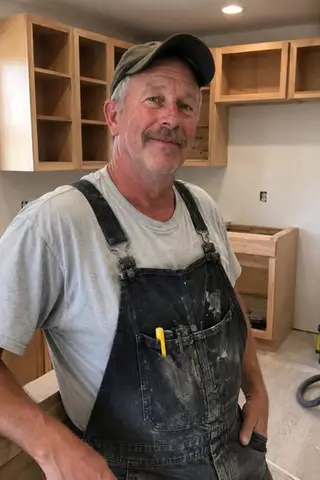
 "You're Just One Old Carpenter"
Chapter 92
The Omega Shaft
We slipped back through the breach, our boots sloshing through the hexagonal standing waves that still vibrated across the slurry floor. The amber lights pulsed in a rhythmic three-second cadence, illuminating an architecture that had nothing to do with modern mining and everything to do with mid-century military paranoia.
The tunnel didn't descend gradually; it dropped into a vertical chamber bored straight down through solid basalt, lined with riveted steel caissons that bore the faded white stenciling of the U.S. Army Corps of Engineers, dated June 1944.
"Look at the plumb lines," Frank muttered, stepping toward the edge of the grated catwalk that ringed the central void. He ran a gloved finger along a brass guide wire that stretched down into the abyss, held taut by a sixty-pound lead counterweight suspended hundreds of feet below. "Look at the tension on that wire. The mountain isn't settling down. It’s lifting up."
Gabe shone his high-powered cruiser spotlight down the center of the shaft. The beam pierced three hundred feet of subterranean mist before hitting a massive, hemispherical dome of bronze and structural steel. It looked like the intake manifold of a battleship, submerged in a subterranean lake that boiled with slow, rhythmic surges of pressurized water.
"Borehole Omega," Gabe read from a corroded brass placard bolted to the catwalk rail. *"Project Aquifer Siphon. Emergency Runoff Diversion Unit 4."* He lowered the light, his jaw slack. "Frank... this isn't a silver mine. It’s an engineered siphon. It connects the upper mountain reservoir to the subterranean fault line."
"Not just connects it," Frank said, kneeling to inspect the massive white-oak shoring timbers that supported the steel decking. He touched a series of chisel marks gouged into the wood. "It controls it. Look here. Three diagonal score marks followed by a half-inch counter-bore. That’s my dad’s timber mark."
A chill ran down my spine that had nothing to do with the freezing draft of the shaft. "Your father built this?"
"My dad was the master timberwright for the civilian labor battalion stationed here during the war," Frank said quietly, his thumb tracing the eighty-year-old scribe lines. "He never spoke a word about what they built under Blackwood Ridge. Not on his deathbed, not to my mother, not to anyone. He just told me once: *'Frank, if you ever take a contract on the north ridge, you check the level twice. If the floor is level but the plumb line leans north, you drop your hammer and walk away.'*"
Frank stood up, his face hardening like seasoned hickory. "Mercer Sterling’s grandfather didn't buy this land for timber or gravel. He bought it because whoever controls this siphon controls every drop of water that feeds the county farms below—or drowns them if they don't sell out."
***
The End









