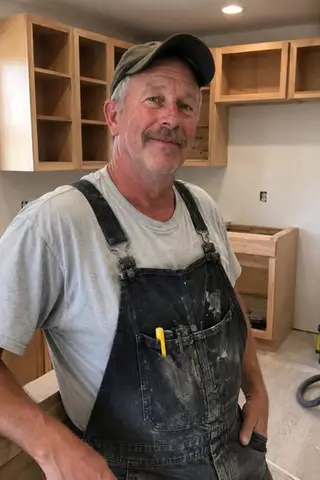
 "You're Just One Old Carpenter"
Chapter 41
The Echo in the Bedrock
The water vanished into the earth like bathwater down an open drain, leaving behind a yawning chasm lined with jagged limestone and pulverized gravel. A damp, frigid updraft burst from the opening, smelling of stale machine oil, oxidized copper, and centuries-old damp concrete. The mechanical hum that had started as a quiet vibration in our teeth grew into a steady, subterranean drone that set the puddle surfaces rippling in concentric circles.
Director Ross dropped to one knee, clutching her field tablet. Her fingers flew across the glass, pulling up low-frequency sonar scans that were updating in real time.
"The drainage rate is impossible for natural karst topography," she said, her voice strained against the rising wind. "That isn’t an underground cavern network. It’s an open-cycle ballast chamber. Vance’s drill bit punched straight through the ceiling of Sector Four."
Richard Vance stood fifty yards back, clutching his soaking trench coat around his shoulders, his face an ashen mask of denial. "Sector Four? What are you talking about? I bought this land fair and square from the county development board! The title was clean! There’s nothing under this mountain except granite and my geothermal easement!"
"Your title was clean because the Department of Defense sealed the records under the National Security Act of 1957, Mr. Vance," Ross fired back, not even looking at him. "Project Iron Keystone. Two hundred thousand square feet of subterranean fortification built to house regional command operations during the early atomic era. It was decommissioned when seismic faults proved the limestone strata unstable. But they never emptied the counter-balance cisterns."
Frank Miller didn't look at the tablet, nor did he look at Vance. His work boots crunching softly on the wet aggregate, he walked right to the edge of the newly exposed drop-off. He pulled his six-foot folding wooden ruler from his back pocket, snapped open three sections, and held it out over the abyss like a dowsing rod.
"Listen to the timber," Frank muttered.
I hurried to his side, careful to keep my footing on the slick clay. "What timber, Grandpa? Ross just said it’s a concrete bunker."
"You don't pour forty thousand tons of reinforced aggregate into deep mountain bedrock without wooden formwork, boy," Frank replied quietly, his sharp blue eyes fixed on the darkness below. "Thomas told me about it in the winter of seventy-two over a pot of black coffee. He was twenty years old when they drafted him into the Army Corps of Engineers. They didn't tell him where they were trucking him, just gave him a framing square, an eight-pound sledge, and three boxcars of virgin old-growth Douglas fir."
Frank pointed down into the swirling mist. Far below, illuminated by the floodlights of the drilling rigs, massive, squared-off beams of darkened wood crisscrossed the concrete shafts—timbers sixteen inches thick, pinned with hand-forged iron trunnels.
"The concrete took the blast rating," Frank said, his thumb running over the brass joints of his ruler. "But the fir was put there to breathe with the mountain. And right now, that wood is taking every pound of the ridge’s weight because the water pressure that was holding up the ceiling just dropped to zero."
As if to confirm his words, a sound like a rifle shot echoed from the depths. A massive timber somewhere in the shaft had just snapped under the sudden hydraulic collapse.
***
The End









