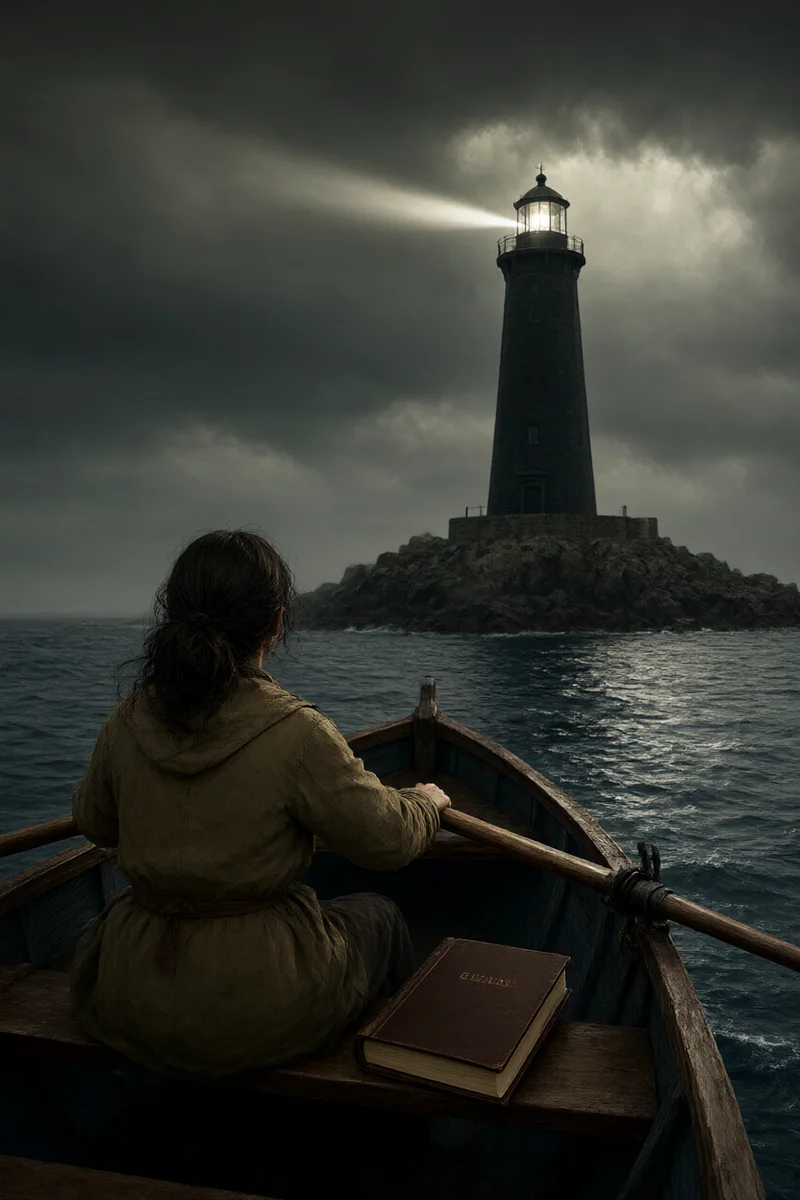
 The Lighthouse Keeper's Ledger
Chapter 5
Whoever Keeps It
They crossed with the water at their ankles and the wind shoving at their backs. Her mother took the hundred and nineteen steps without resting, and at the top went straight to a tin behind the stove that Odile had taken for a tea caddy.
There was a third tread on the stairs, slow, with a stick in it. Tobias Renn came up into the lamp room wet to the knee and held the door frame until he had his wind.
“The buoy's dragged, or drowned. I saw from the office, and I knew what Corwin's granddaughter would do about it.” He straightened. “As chairman of the Board I'm bound to tell you that it's a false light, and an offence.”
“Then you've told me,” Odile said.
“I have.” He lowered himself onto the keeper's stool. “It also struck me that a lamp lit in the chairman's presence would be the harder to call false.”
Her mother had not turned round. She was trimming the wick with her father's scissors, in small quick cuts. “You have your answer to that letter, Tobias. We're not selling.”
“Hester. I meant it kindly.”
“I know. You've meant it kindly for thirty-one years, to the wrong Corwin.” She held the taper out to Odile, thought better of it, and kept it. “My father was sitting on the sea wall in town that night. Ask Sallow; he'll tell you now. The keeper did run the stairs. She was eleven.”
Renn looked at the lamp, and at the woman, and at the pale stripe where her cuff rode up. He took off his hat, slowly, and held it against his chest.
The lamp was not due until dusk, a full hour off. Old habits, Odile thought, and then: not mine. Hers.
The flame caught. The lens gathered it, turned it, and threw it out over the water in a long white arm that swept the rocks, the causeway, the mouth of the bay.
And out past the bar, small and low and badly off her course, a set of running lamps swung slowly, slowly to starboard, and came about.
“Not one of mine,” Renn said at the glass. “Mine were in by three. I counted them at the dock.”
They watched until the boat was safe inside the channel. Nobody knew whose it was. It did not matter; Odile understood that now, the way the old man must have understood it every night for fifty years, and the child one night before him.
“The note on your house is cancelled, and not in exchange for any tower,” Renn said. “The lamp wants five signatures, and I have one. But I am stranded until the ebb in an unlawful lighthouse, and the whole town can see that it's lit. I think four gentlemen will find that awkward to vote against.”
Her mother took the pen from the desk. She opened the ledger at the last page and wrote in the space before the dash, in an upright hand nothing like his: Hester Corwin.
She did not cross it through. “Not yet,” she said. “Let it burn a winter first.”
Odile turned to the first blank page. At the top she wrote the date, and under it, in a hand that was beginning to slant like his: “Unknown vessel — one night, December.”
Then she left the line beside it empty, and sat down to keep the light.
The End









