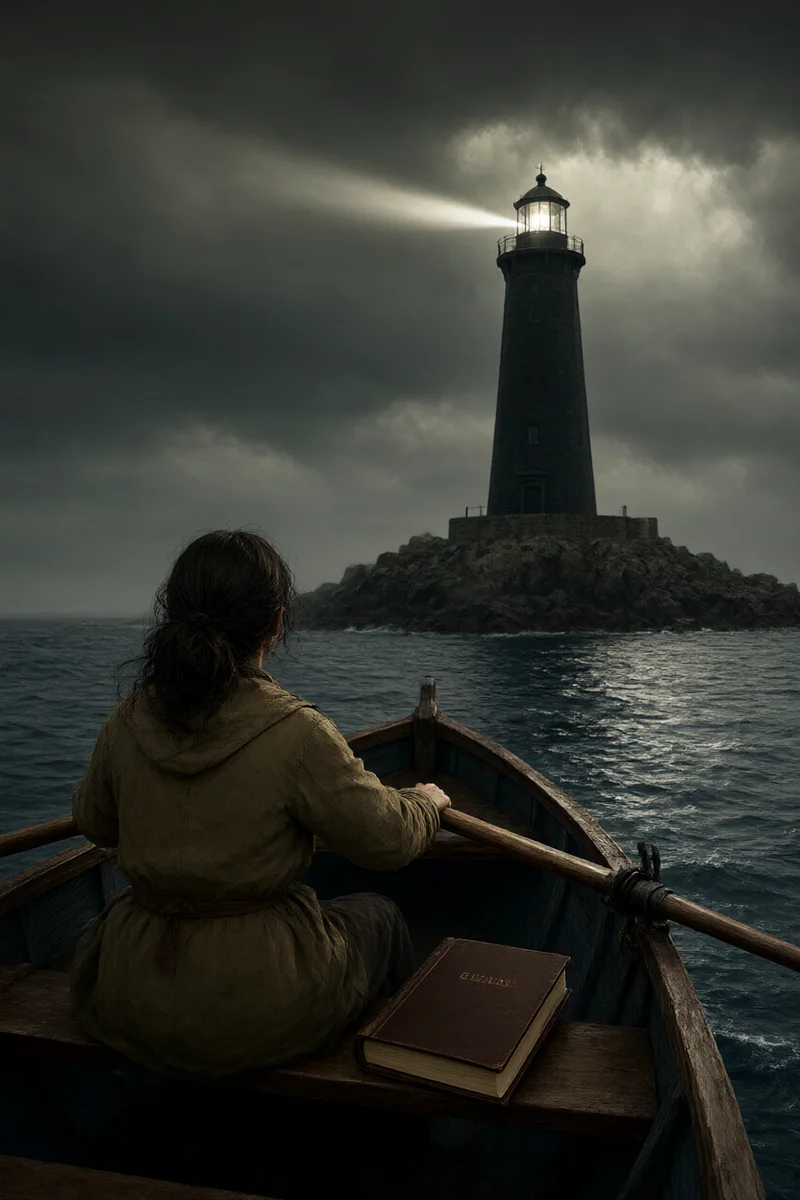
 The Lighthouse Keeper's Ledger
Chapter 2
The First Name on the List
The boat floated. It also leaked, slowly and with what felt like opinion, so that by the time Odile tied up at the cannery dock her boots were wet to the ankle and her temper was already short.
A clerk with ink on his cuffs told her that Mr. Renn saw people on Thursdays. She unwrapped one corner of the oilcloth and said that Mr. Renn would see this, and something in the way she said it sent him up the stairs ahead of her.
Tobias Renn received her in an office that smelled of brine and money. He was older than the portrait in the bank made him look, a horn-handled stick leaned against his desk, and he did not stand.
“Corwin's granddaughter,” he said. “You have his chin. I'm sorry for your loss. If this is about the note on your mother's place, my clerk handles extensions.”
“It isn't about the note.” She set the ledger on his desk, open to the first page, and turned it to face him. “It's about one night in November.”
She had prepared for anger, or for laughter. She had not prepared for the way the color left his face all at once, like water out of a basin.
He read the line twice. His hand came up, hovered over the page, and went back down to the arm of his chair without touching it.
“He told me he never wrote it down,” Renn said quietly.
“What was the Marguerite?”
“My father's ship. My ship, that night. I was nineteen and I had the wheel when I should have been in my bunk.” He looked past her, out the window, toward the point where the tower stood dark against the afternoon. “There was fog you could have carved. I had her aimed straight at the Harrow rocks and I didn't know it. Then the light came on. It wasn't due to be lit for another hour. Your grandfather had seen our lamps from the gallery and run every one of those stairs.”
“Was there anyone else that night? Someone whose name he'd have a reason not to write?”
Renn frowned at that. “I can't think who. There was nobody on that sea but us, and nobody on that rock but him.”
“And you never paid him.”
“He never asked. That was the worst of it.” Renn finally closed the ledger, gently, and pushed it back across the desk. “Thirty-one years I've waited for him to ask. What does the light want, Miss Corwin?”
Odile had rowed across the bay without an answer to that question. She found, to her own surprise, that she had one now.
“Oil,” she said. “Enough for the winter. And a man who can mend a lens.”
He laughed, once, without any pleasure in it. Then he opened a drawer and laid a paper beside the ledger: the Board's order of April, with five signatures at the foot. The first and largest was his own.
“You'll have your oil by Friday, and Yann Le Goff, who is the best lens man north of Brest and dislikes everybody. That much I owe, and I'll pay it.” He tapped his own name. “But you had better know who put that lamp out before you thank me. Show a light from Harrow Point without the Board's leave and the law calls it a false light. Somebody would have to send the constable.” He took up his stick at last, and stood. “I am the chairman, Miss Corwin. It would be me.”
The End









