 The Lighthouse Keeper's Ledger
Chapter 3
Thirty Names
By the first week of December, the ledger had thirty names crossed through, and the lamp room no longer smelled of dust.
She had not lit the lamp. Renn's oil filled the cellar, and each dusk the Board's buoy winked on the bar, and Odile trimmed a wick that nobody was permitted to see burn. She told herself she was only putting the place in order for a buyer.
The Widow Achterberg had paid in rope, two hundred fathoms of it, new, delivered by a grandson who would not meet Odile's eye. The lens man, a taciturn Breton, spent four days on the gallery with a chamois and a jar of rouge and declared the great glass fit to be seen from France. “If anyone were let to look,” Yann added, and screwed the lid on his jar.
No one refused her. That was the part she could not get used to. She would knock, and open the book, and watch a grown fisherman or a banker's wife go still, and then nod, as though a bill they had been expecting for half their lives had at last arrived in the post.
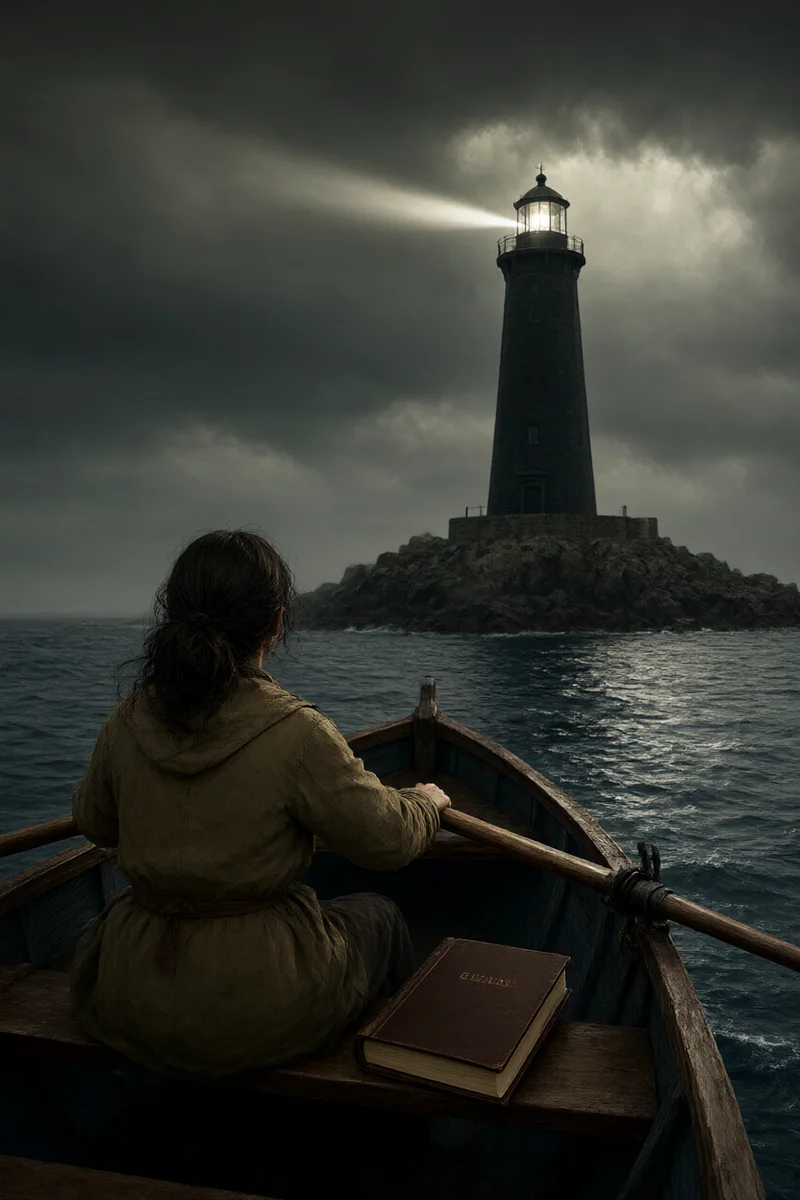
Each evening she rowed home with the ledger in its oilcloth on the seat beside her and the tower standing dark ahead, and one name fewer to ask.
Her mother would not hear them read. “I know who's in it,” she said, and bit off her twine.
Dr. Sallow had paid in silence, and then in window glass, and then, on his third visit, in the whole story, which Odile wrote on a clean sheet and burned as he asked.
He was past eighty. He rested on every landing, and when he reached the top he sat in the keeper's chair with his hat on his knee and looked at the desk and not at her.
“He came to my door at four in the afternoon, wet to the thigh. He had crossed with the tide already making. Your grandmother had a fever he didn't like the sound of.” The doctor turned his hat a quarter turn. “I looked at the fog, and I looked at the water, and I told him I would come at the morning ebb.”
“So he went back without you.”
“He could not go back. The causeway had shut behind him. He sat on the sea wall below my surgery the whole of that night, facing the point.”
Odile's pen had stopped moving.
“I came at the ebb, as I'd promised. She died on the Thursday. I have never known whether twelve hours were the difference, and nor did he. He never told the Board that I would not come. I never told them that he was off his station, which would have cost him the post and the roof with it.” He turned the hat again. “You'll see that it was not kindness, on either side.”
“Which night was it, Doctor?”
He seemed surprised to be asked. “The night of the great fog. The night the Renn boat all but went on the rocks. The town talked for a month about the keeper's sharp eyes.”
She burned the sheet in the grate while he watched, and saw him down the stairs, landing by landing, and over the causeway before the water came.
Then she climbed back up and stood in the lamp room with her hand flat on the cold brass. Her grandfather had sat on a sea wall across the bay and watched his own light come on an hour early. He had not run the stairs. He could not have.
There had been two other people in the tower that night. One of them could not lift her head from the pillow. The other was eleven years old, and was Odile's mother.
The End









