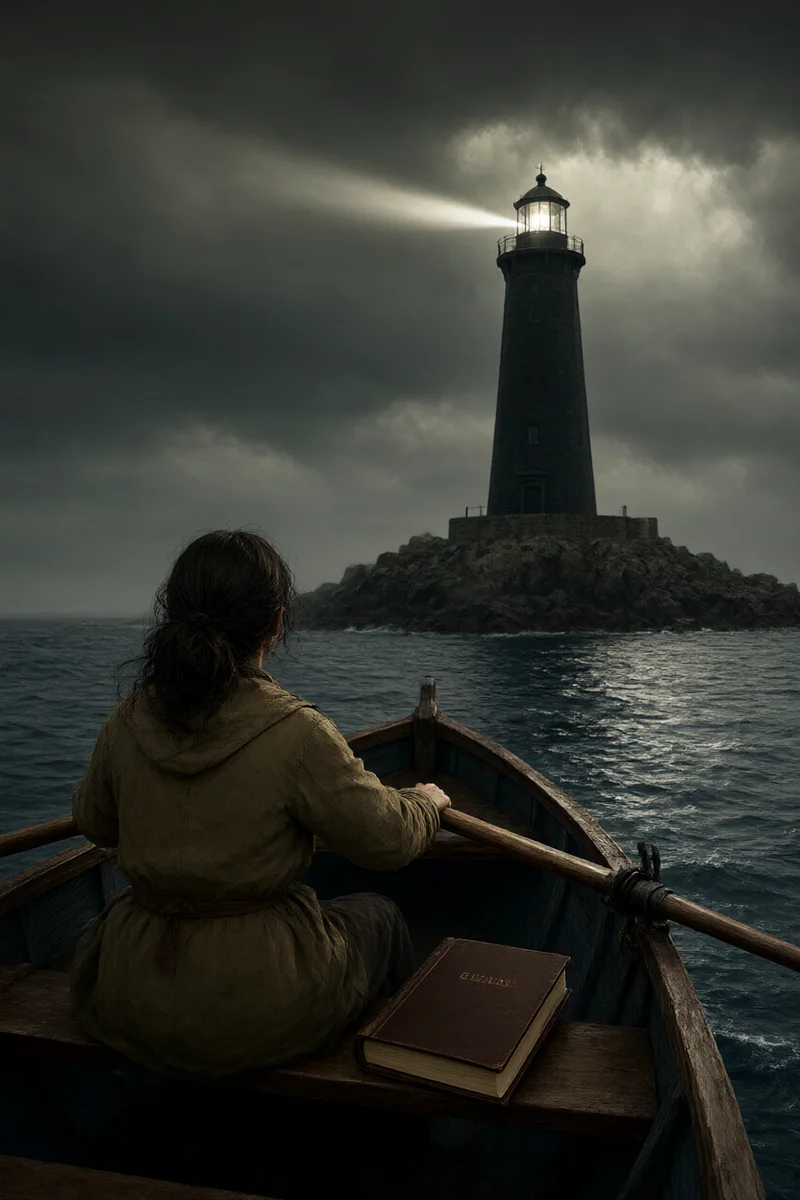
 The Lighthouse Keeper's Ledger
Chapter 4
The Nameless Line
She crossed at the next low water, on foot, with the ledger under her arm and the bladderwrack popping under her boots.
Her mother's kitchen on Net Loft Row smelled of tarred twine and stewed tea. A letter on the cannery's blue paper lay on the table, pinned under the sugar bowl.
“Read it,” her mother said. “His clerk brought it.”
Renn wrote a short letter. He would buy the tower, the point, the boat and the book, for a sum equal to the note on the house, the note to be cancelled on the day Odile signed. I cannot pay the light what it asks, he had written. Allow me to pay what the law allows.
“That's this roof, free and clear,” her mother said, “for a heap of stone and a book of other people's gratitude. Sign it.”
Odile laid the ledger on the table, open at the last page, and turned it to face her, as she had done for thirty others. “Where was Grandfather on the night of the Marguerite?”
The netting needle stopped. Her mother looked at the dash where a name should have been, and did not touch the page.
“Who told you?”
“Nobody. Somebody told me where he wasn't.”
Her mother set the needle down. “I was eleven. He'd shown me the lamp the way you show a child a gun, so I'd know not to touch it. Mother wanted water. I went up for the big kettle he kept on the lamp-room stove, and from the gallery I saw lamps, low down, under the fog. Red and green together. You only see both when a boat is pointed straight at you.”
She pushed back her cuff. There was a pale stripe across the inside of her wrist, old and smooth.
“I lit it. I caught myself on the chimney. Then I sat on the floor and counted the turns, because I didn't know what else a keeper did.”
“And when he came home?”
“He wasn't angry. I'd have liked angry. He went grey and knelt down on the boards and told me that if the Board ever heard the keeper had been off his station, they would put us out, and the tower was the only house we had. So I was to say nothing. I was good at it. I said nothing for thirty-one years, and every Michaelmas Tobias Renn shook my father's hand on the quay.”
“He never asked Renn for a penny.”
“No. He had that much shame.” She put one finger, finally, on the dash. “And he couldn't even write my name.”
“He left room for it,” Odile said.
Her mother made a short sound through her nose and turned to the window. The afternoon had gone the color of pewter. Along the ridge of the net lofts the gulls sat in a row, every one of them facing northeast.
Past the cannery chimney, on the bar, where the Board's buoy had winked green every four seconds since April, there was nothing. Odile counted to twenty. Nothing.
“Tide's over the causeway in an hour.” Her mother was already taking her coat down from its nail. “And you don't know where he kept the tapers.”
The End









