 The Janitor Was a Surgeon
Chapter 5
Grade 2
“Mrs. Okafor,” said the woman from the board. “Why did you file it?”
“Because I've worked nights for twenty-two years, and I know what happens to a thing nobody writes down.” Dee opened her handbag and took out her reading glasses. “It turns into a story. A janitor got in the way during a disaster. A janitor panicked and grabbed a knife. Give it a month and that's what was true. So I wrote down what was true while I still had it on my shoes.”
She nodded at the six pages in front of Tolliver.
“Read them. I timed every procedure. I recorded that Dr. Menon gave the order for each one and stood over it. I recorded that Dr. Prentiss inspected the work and asked whose it was because it was better than his own. And I attached the outcomes. All four of his patients are alive. Three have gone home.”
“You people needed transcripts from a medical school that's been knocked flat,” Dee said. “Fine. That's six pages of transcript. I'd like to see the school that sets a harder exam.”
Tolliver looked as though he had been handed a baby in a meeting.
Finch spoke next, though nobody had asked him. He said he had frozen. He said that if the janitor had stayed back as instructed, a sixteen-year-old named Maya Lindqvist would have died in a hallway with a yellow tag on her wrist, four feet from a doctor. He said he would put that in writing too, and that they could refer him to whoever they liked.
Menon said less. “I gave the orders. I'd give them again. If the board wants my license for it, it knows my address.”
The board did not want her license. It issued a letter of concern, which she framed and hung in the staff toilet. The prosecutor's office looked at four living patients, a bridge closed by catastrophe, and an attending physician's direct supervision, and declined to bring charges.
The hospital could not be so graceful. Tolliver telephoned Ilyas himself. “We can't have you back in Environmental Services,” he said. “You understand. The liability of a cleaner who—it's impossible.” He cleared his throat. “Dr. Prentiss would like a word about something else.”
The something else took fourteen months. The board had a provision, seldom used, for physicians whose records had been destroyed: sworn statements from three licensed doctors who had directly observed the applicant's work, and then the examinations, all of them, from the beginning. Prentiss, Menon and Finch signed the statements. Dee's report went in as an exhibit.
He studied in the room above the tailor's, at fifty-two, with flash cards, relearning biochemistry he had last looked at before Finch was born. The tailor's daughter quizzed him. He failed nothing.
He could not simply be a surgeon again. This country wanted its own residency first, every year of it. So on the first of July Ilyas Rahmani reported to Calder Street General in a short white coat, the most junior doctor in the building, assigned to a senior resident named Finch.
“This is going to be so strange,” Finch said.
“Hold the instrument loosely, Doctor,” said Ilyas, “and it will be fine.”
In October a girl in a school blazer walked into the department on her own two feet, with her mother and a tin of shortbread, and asked at the desk for the janitor. Dee pointed with her pen.
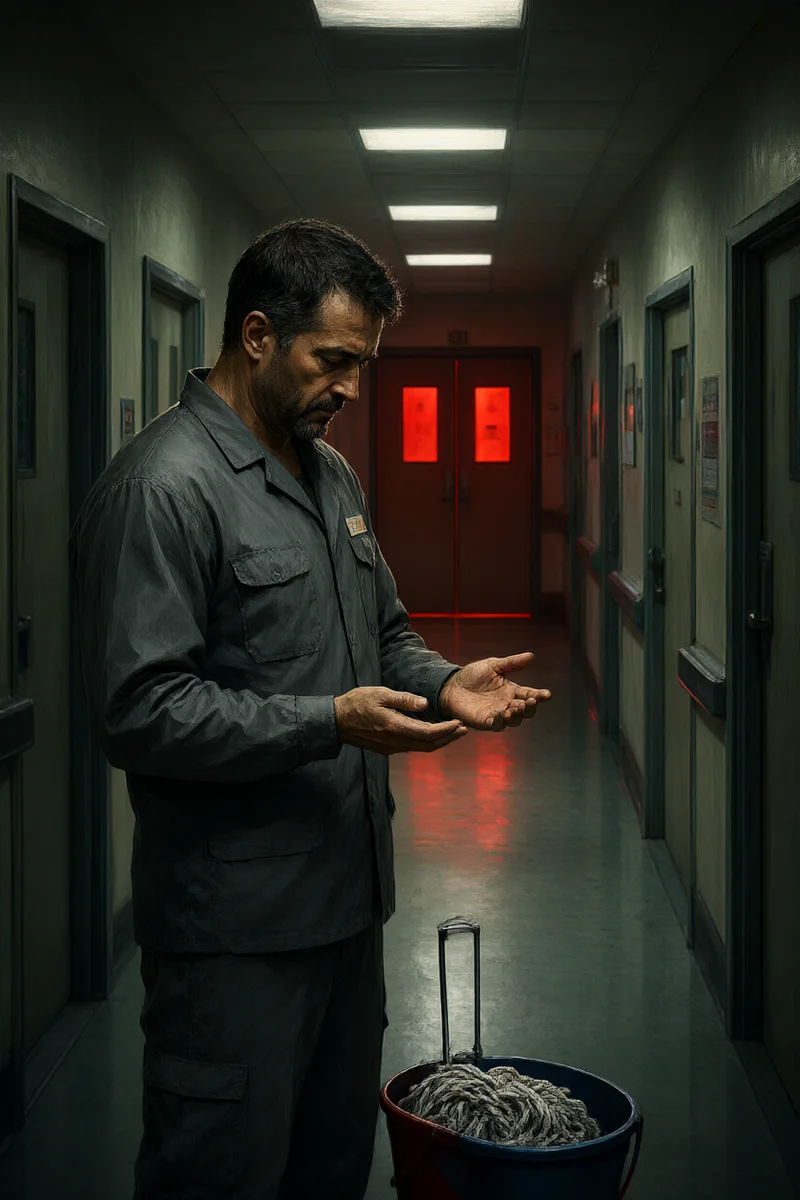
He was on nights that week. Near two, crossing the hallway where the stretchers had stood, he passed a man in a gray uniform mopping backward toward the doors. The man was perhaps forty. He stepped aside for the doctor without looking up, as he had been taught.
Ilyas stopped.
“Excuse me,” he said. “I am sorry, I do not know your name. Would you tell me? And what you did before?”
The End









