 The Janitor Was a Surgeon
Chapter 1
Code Triage
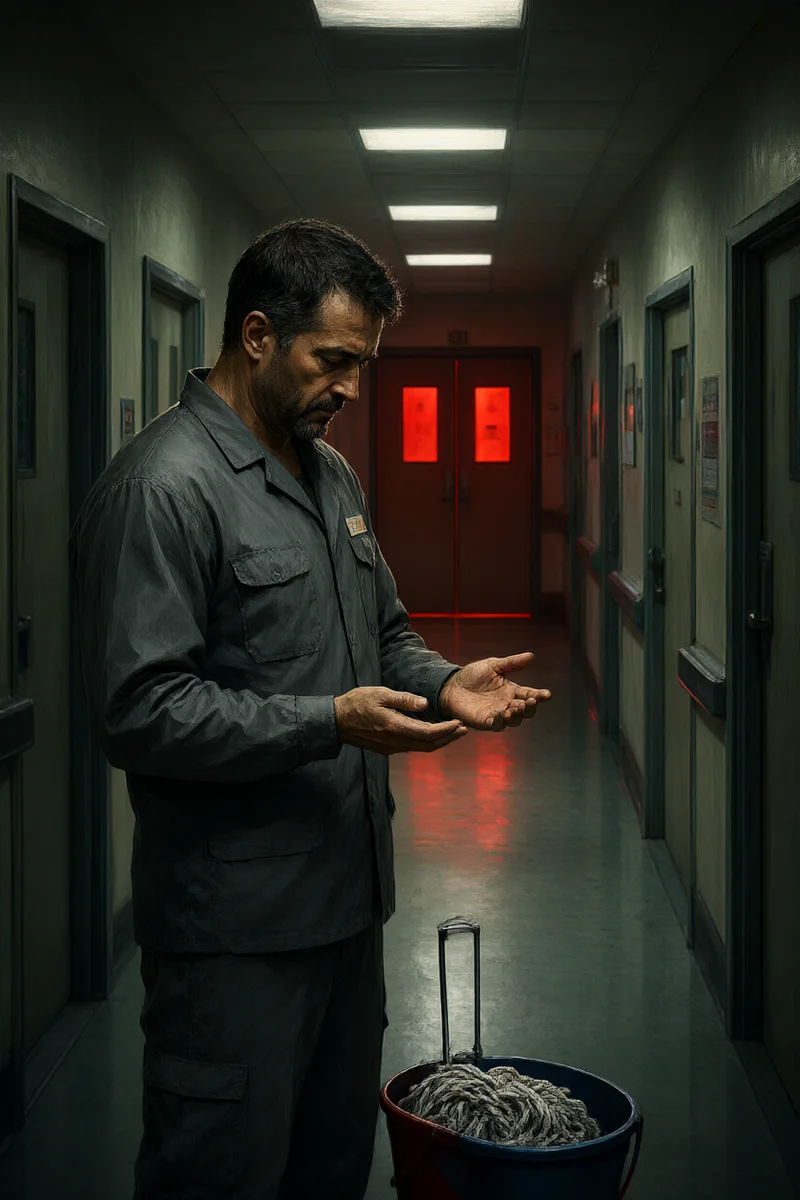
At ten past two in the morning Ilyas Rahmani was mopping bay six, working backward toward the door the way he had every night for six years, so as never to step on his own wet floor.
He liked bay six. It had the good drain. He noticed things like drains now. He also noticed that the second-year resident, Finch, held a laryngoscope too tightly, and that the new monitors alarmed four seconds late, and that Dr. Menon, who ran nights, drank her coffee cold because she never once got to it hot. He noticed, and he wrung the mop, and he said nothing. Saying nothing was the job.
The overhead speaker clicked.
“Code Triage, external. Code Triage, external. All available staff to the emergency department.”
Dee Okafor, the charge nurse, was already on the red phone. Ilyas watched her write on her hand because there was no paper near. She hung up and spoke to the room in the voice of someone reading a grocery list, which was how he knew it was bad.
“Commuter train's come off the Fenner Street viaduct. Two cars down the embankment. They're sending us thirty, maybe more, first units in six minutes. The Larch Bridge is shut for the wreck, so surgery's backup is sitting on the wrong side of the river looking at us.” She pointed. “Menon, you're it. Finch, Abara, you're with her. Everybody else, I want every bed that can be empty, empty.” Her eyes landed on Ilyas. “Mr. Rahmani. Hallway. I need it clear enough to park stretchers nose to tail.”
“Yes,” he said.
He cleared it. He moved the linen carts, the broken wheelchair, the vending company's pallet. He had done this before, in another building, where the hallway had been longer and the lights had failed twice a night. He had been the one pointing, then.
The doors opened at two-nineteen and did not properly close again for four hours.
They came in on backboards, on stretchers, walking, holding parts of themselves. Paramedics called out ages and pressures. Colored tags fluttered from wrists. Ilyas flattened himself to the wall with his mop and bucket and watched the department fill like a basin.
Dr. Menon took a man with a crushed pelvis into bay two and did not come out. Abara disappeared behind a curtain. Finch stood at the desk with three charts in his hands and the expression of a boy who has been told to carry all the plates at once.
Nobody was looking at the hallway. That was nobody's fault. There were nine stretchers in it now and one nurse.
The fourth stretcher held a girl of sixteen or so in a school blazer, yellow tag, awake. A paramedic had written “L ribs, stable” on tape across her blanket. She had been stable eleven minutes ago.
Ilyas looked at her the way he looked at drains, because he could not help it. Her lips were the wrong color. The veins in her neck stood up like cords. She was breathing fast and only the right side of her chest was rising, and her windpipe, in the hollow of her throat, had begun to lean.
He knew what it was before he had finished looking. He knew how long she had: minutes, and not many.
He also knew what the paper in his locker said. Environmental Services, Grade 2. He knew what the laws of this country called a man with his job who put his hands on a patient.
The girl's eyes found him. She could not get enough air to speak, so she just looked, the way people do at anyone standing still.
Ilyas leaned the mop against the wall, carefully, so it would not fall and trip someone.
The End









