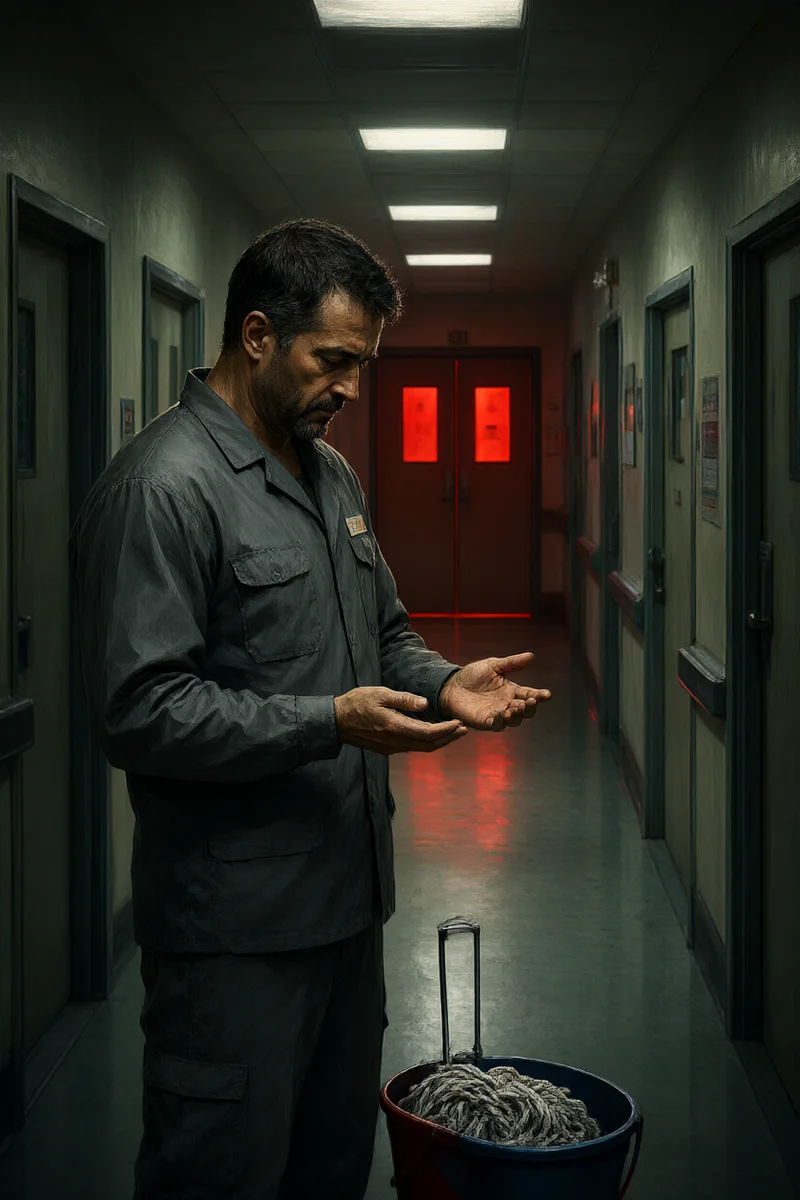
 The Janitor Was a Surgeon
Chapter 4
Practicing Without
They did not arrest him. Tolliver explained, in a windowless room with a box of tissues on the table, that this was not his decision to make.
“The practice of medicine without a license is a felony in this state, Mr. Rahmani. Four counts that we know of. The hospital is obliged to report it. What the prosecutor does with it is up to the prosecutor.” He squared a folder. “You're suspended without pay pending an inquiry. Dr. Menon has been referred to the medical board. I'd advise you to get a lawyer.”
“With which pay?” Ilyas asked. It was not a joke, and Tolliver, to his credit, did not smile.
He went home on the first bus. Home was one room above a tailor's, with a hot plate and a window onto a brick wall. On the shelf above the bed stood the only thing he had carried out besides clothes: a photograph of twelve people in green scrubs, squinting in the sun on a hospital roof.
Five of the twelve were dead. He did not know about three.
He had tried, the first year. He had gone to the licensing office with his diploma folded in a plastic sleeve. The woman there had been kind. She had explained that the board needed his transcripts sent directly from his medical school, sealed, and verification from his last hospital.
His medical school was a field of concrete. His last hospital had a new director, appointed by the men who had put Ilyas in a cell for nine weeks.
That was the part he had never told anyone at Calder Street. He had not fled a war, exactly. He had fled a sentence. Soldiers had brought a wounded boy to his table, and a colonel had explained which side the boy was on and that he was not to be treated. Ilyas had treated him. He had been tired, and the boy had been perhaps seventeen, and it had seemed at the time the only possible thing.
He had lost everything he had for putting his hands on someone he was forbidden to touch. He had crossed two borders and learned to buff a floor. And he had done it again, at the first opportunity, in front of witnesses.
He sat on the bed and laughed until the tailor below thumped the ceiling with a broom.
The inquiry was nine days later, in a conference room with a view of the parking structure. Tolliver sat at the center. There was a hospital lawyer, a woman from the board, a man who wrote everything down. Menon was there in a gray suit instead of scrubs, and looked smaller in it. Finch was there, and could not stop bouncing his knee.
Ilyas had no lawyer. He had ironed his shirt.
“For the record,” Tolliver said, “the hospital did not learn of this through rumor. We acted on a formal incident report, filed through the proper system at 7:02 on the morning in question. That report names Mr. Rahmani. It lists each procedure he performed, the bed, the time, and who was present.” He turned a page. “It runs to six pages. It is extremely thorough.”
Seven-oh-two. Ilyas had been filling his bucket at seven-oh-two. Someone had gone straight from that night to a keyboard, with the blood still on the floor, to write him up.
He looked at Finch, and Finch looked back in honest confusion and shook his head.
“The report was filed,” Tolliver said, “by the charge nurse on duty.”
Dee Okafor sat by the window in her good church coat with her handbag on her knees. She had brought him soup once, when he had the flu. She had called him Mr. Rahmani for six years when half the staff said “hey.”
She met his eyes and did not look away, and did not look sorry.
The End









