 The Janitor Was a Surgeon
Chapter 3
Whose Hands
He said the sentence he had ready, in careful English: I am not licensed here. Menon did not even slow down.
“I know you're not. I am. Listen, because I'll only have breath to say it once. You don't decide anything tonight. I decide. You do what I tell you, where I can see you, and every stitch you put in is mine, on my license and my name. Dee, you heard that.”
“I heard it,” Dee said. She was looking at Ilyas with an expression he could not read, and then she was gone, because someone was calling for blood.
So for four hours he was a pair of hands. Menon stood across from him and spoke in a flat quick murmur, and he found he could do what she said almost before she had said it, the way you can finish a sentence in a language you thought you had lost.
The man in bay four was a transit conductor named Osei with a torn spleen. They could not send him upstairs; with the surgeons across the river, there was no upstairs. Nobody opens a belly in an emergency bay. Menon said, “Open him. Pack it and hold it,” and Ilyas did, and held it for thirty-five minutes, not moving, until the pressure on the monitor stopped falling.
A woman needed an airway made through the front of her throat. A boy of nine needed a chest tube half the size of the girl's. Menon gave him that one without being asked, then stood behind him and watched his hands the whole time, and at the end said only, “Where did you train?”
He told her the name of the city. She knew it from the news as a place where things fell down.
Once, near five, he looked up and saw Finch watching from the next bed. The young man was suturing a scalp, and he was holding the needle driver loosely now, in his fingertips, the way Ilyas held his.
Not everyone lived. A man with a gray tag was wheeled to the quiet room at the end of the hall, and a woman Menon worked on for twenty minutes went there after him. Thirty-four had come through the doors. In the hospital where he had learned his trade, on a night like this, they would have lost ten.
The Larch Bridge reopened at six. At six-thirty-one the trauma chief, Prentiss, came through the doors at a run with two surgeons behind him and his coat on inside out.
He went from bed to bed with Menon, fast, lifting dressings. At the conductor's bed he stopped. At the nine-year-old's he stopped longer.
“Who placed these?” he said. “This is nicer work than mine.”
Menon said, “I'll tell you in my office.”
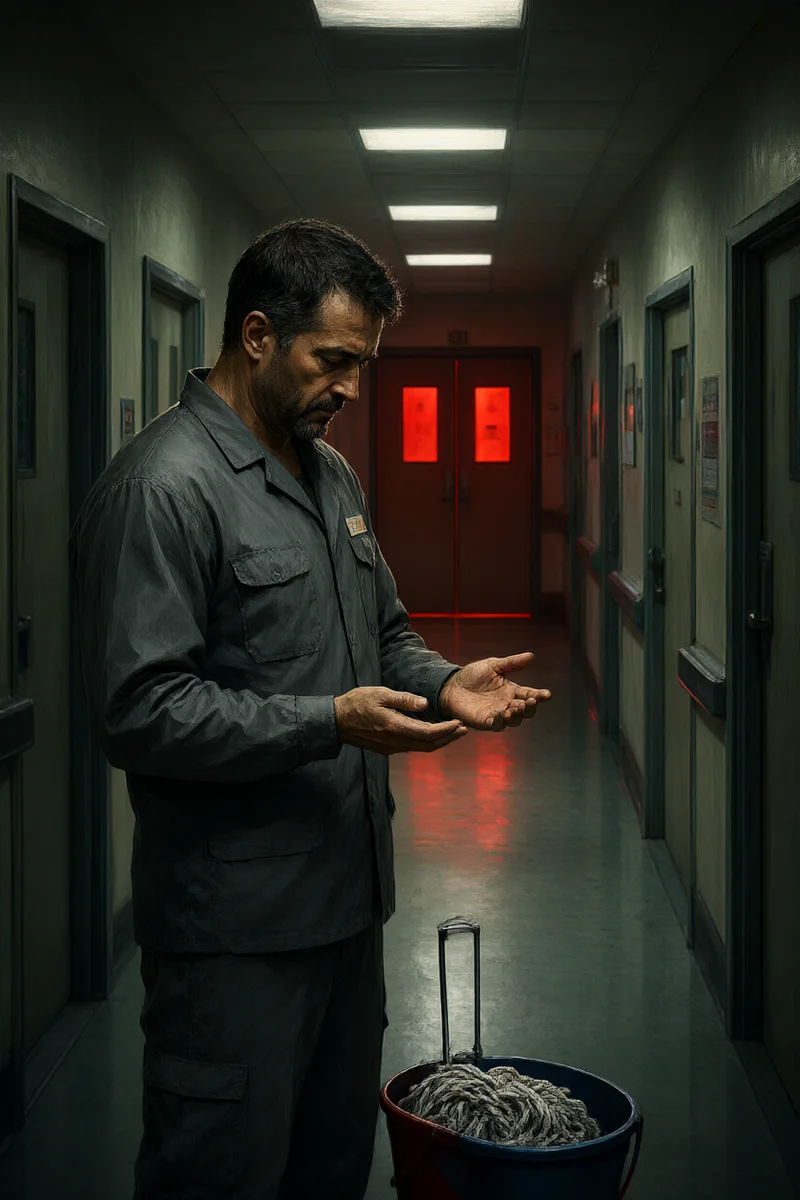
Ilyas did not hear the rest. He had taken off the gown and the gloves and washed to the elbow, out of a habit that had outlived everything else, and he had gone to find his bucket.
The hallway floor was a disgrace. Tape, wrappers, a single child's shoe, and long drying streaks he preferred not to name. It was his floor. He filled the bucket with hot water and started at the far end and worked backward toward the doors.
He had got as far as the fourth stretcher's place when two pairs of shoes stopped on the wet tile in front of him. One pair was polished. The other belonged to a security guard he had shared a break table with for six years, who now would not look at him.
“Mr. Rahmani,” said the man in the polished shoes. He wore a suit and a lanyard that said Risk Management. It was seven-fifteen. “I'm Gerald Tolliver. I'm going to need your badge, and then I'm going to need you to come with me.”
The End









