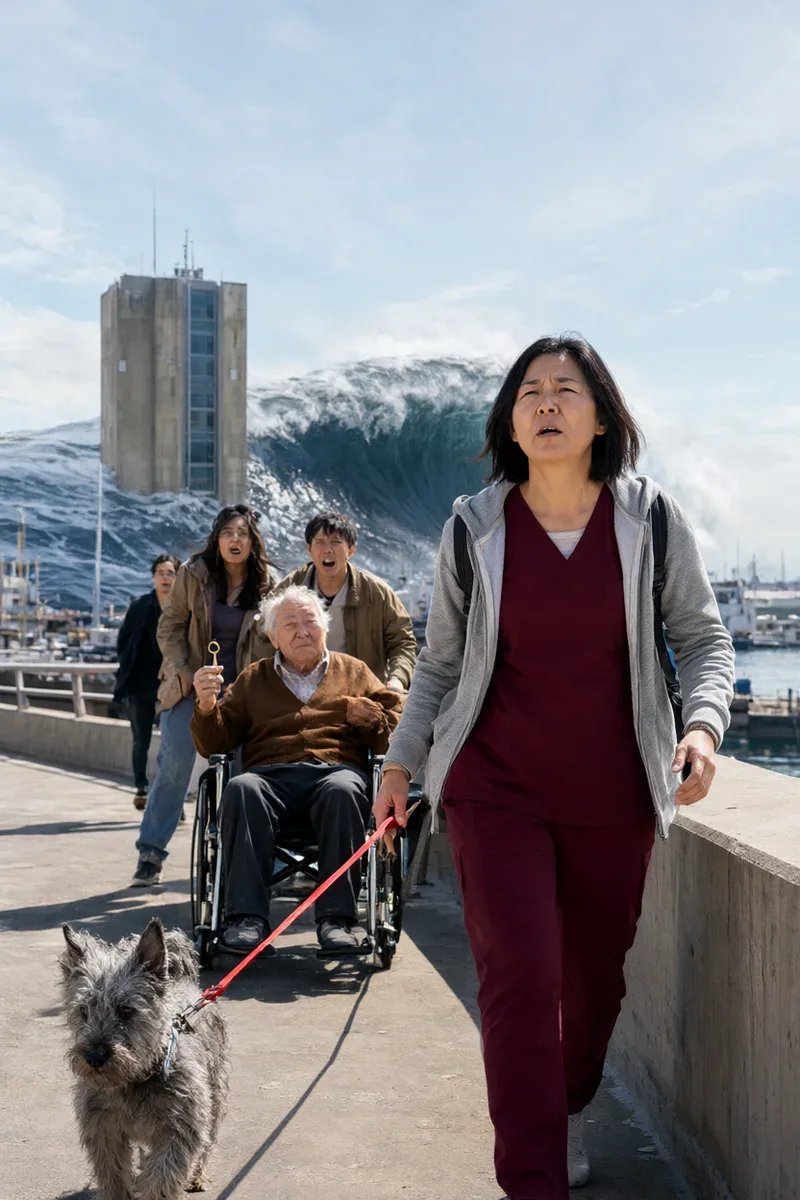
 The Ice Tower
Chapter 8
September Fourth
There were nine of those sheets. Under them she found the thing they had been copied from, his own admission agreement, his real signature circled in pencil.
She laid the rest out on the table one piece at a time. His bank statements, slit open. Eight checks from his account to the home since February, $1,900 each, marked supplemental care, signed by the hand that had practiced on the ruled paper. The title report he had seen at breakfast. A purchase agreement: Northhead Resorts to buy four acres from Seaholm Holdings LLC for $2,400,000. A cashier's check for $120,000, earnest money, not yet deposited. That was the thing that slid.
“That is why she stopped the van,” Gunnar said.
Last came a copy of a deed, stamped by the county clerk. Gunnar T. Skovgaard to Seaholm Holdings LLC, the cannery parcel, for the sum of ten dollars. Under his name was a notary's block with a rectangular seal.
Signed and acknowledged before me on September 4. Clete J. Tomasek, Notary Public, State of Oregon.
She read it twice. Then she sat down on the floor.
Clete, who brought her coffee at six when the night had been bad. Clete, who had driven forty miles at three one winter morning to jump her dead car, and refused gas money.
“The fourth,” she said. Her voice sounded odd to her. “Gunnar. September fourth is my mother's birthday.”
He waited.
“You fell at twenty to six that morning. I rode with you. I called her from the emergency room in Newport. They kept you two nights.” She put her finger on the date. “You weren't in the building on the fourth. You weren't in the town.”
“Then I never stood in front of him.”
“No.”
“A notary keeps a journal,” Gunnar said. “The law requires it. The date, the document, and in a careful man's book the signature of the person who appeared. If he kept his, then on that line there is either my name in her handwriting, or nothing at all. The hospital will have its own record of where I was.”
“He told me he was sorry.” She was looking at the seal. “Yesterday. At the window.”
“People generally are, afterward.”
She thought about it for the time it took the lantern to dim another notch. Then she folded the deed and the nine ruled sheets inside the admission agreement and slid them under her scrub top, flat against her stomach, and zipped the hoodie over them. The napkin was still in her pocket. She put the drawings and the check back in the box and set the lid on it so that it looked whole.
His pulse at four was 104. At five he slept, finally, with his hand on the dog.
She stood at the hoist door and watched the fog go grey and then thin. At ten to seven it lifted off the town like a sheet off furniture. The first three streets were gone. Beyond them, houses stood in mud to their windowsills. The harbor was full again, brown, quiet, covered in lumber.
On Cannery Road something white was moving.
The van came down through the alders, slowly, and stopped where the pavement ended and the wreckage began. One door opened. A man got out in a tan canvas jacket and a navy ball cap, and from behind the seat he took a steel pry bar as long as his leg.
He stood looking up at the tower. She had known him five years, and from seventy feet she could not tell what he had come to do.
The End