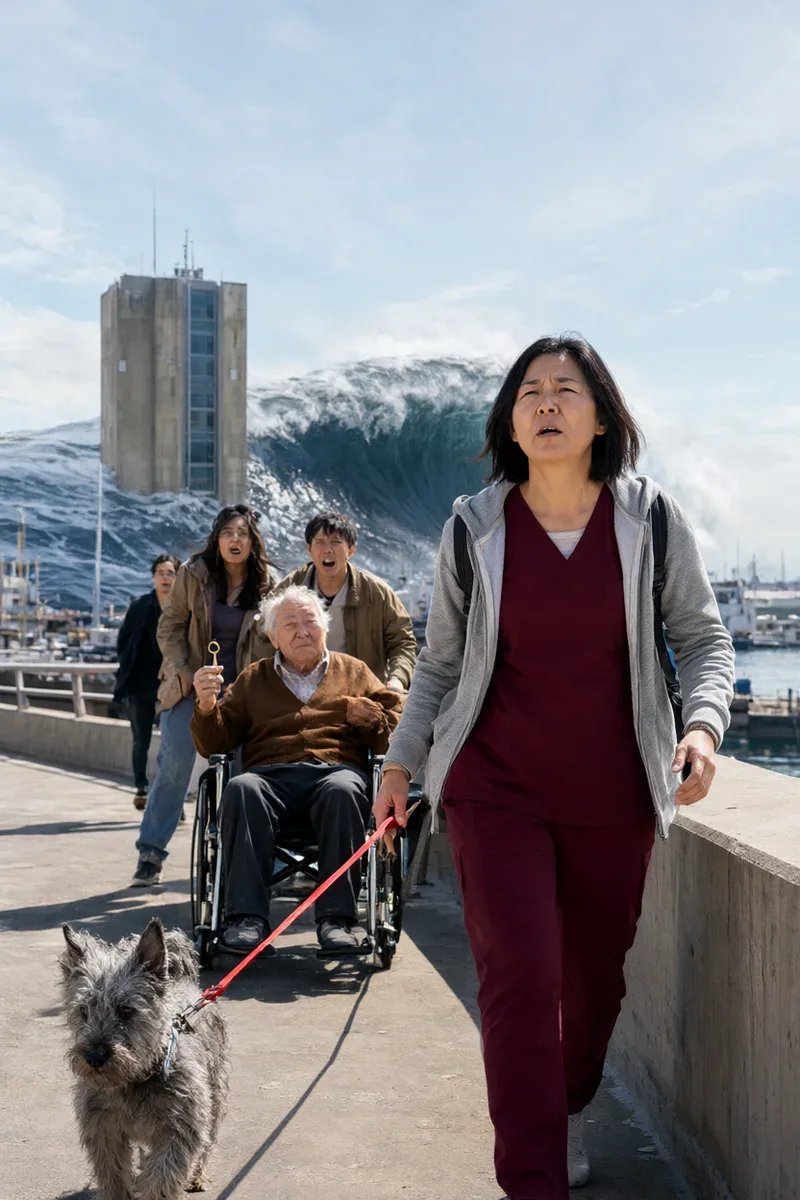
 The Ice Tower
Chapter 6
What the Water Left
It stopped four steps below the seventh landing. She watched it hold there, turning slowly, for nine minutes by her watch. Then a step showed, wet and brown, and another.
At 9:15, between waves, she went down. The stairs were slick with silt and strung with kelp. A crab pot sat on the fourth landing as though somebody had carried it up. On the third she found the crack, a line as wide as her finger running across the wall, with daylight in it.
The bottom flight was under three feet of standing water. She waded in to her thighs. The steel door had been driven inward at the top corner, and the bar had bent in its bracket and jammed there. Through the gap at the frame she could see what held it shut from outside: dock timbers, a mat of green net, and mud packed to shoulder height.
She put her whole body against the bar. It did not move the width of a hair.
“We're shut in,” she told him at the top, when she had her breath.
“Then so is everyone else shut out,” he said. “I did not like that crack, though. Tell me again how wide.”
The waves kept coming. 9:31, 10:12, 10:58, each one lower, each one written on the wall. A propane tank burned on the far side of town and laid black smoke across the hill. At two she heard a helicopter working north along the coast and never saw it. At four the fog came in off the water and took the hill, the town and the harbor, in that order, and after that the hoist door showed only white.
By then his hands had started. At noon it was a tremor in the fingers. By dusk he could not hold the cup, and his pajama shirt was soaked through under the cardigan, and his pulse under her fingers was 128 and all over the place.
She knew what it was. Six weeks of lorazepam and then nothing, cold, on top of an old heart with no pills to steady it. He had not slept in four nights. On the floor at Seaholm she would have had a doctor on the phone inside two minutes. Here she had a wristwatch, a pencil, and water that tasted of the jug.
She propped him half upright on the cot against the blanket bags, wrapped him to the chin, and lifted Gasket in against his ribs, where the dog lay down as if he had been given an order. She wrote the pulse on the wall under the wave times. 128. Then 136.
At seven she turned her phone on to try once more. It searched. Four percent. It was still searching when the screen went grey and then black, and the photograph of the chart went with it.
She sat holding the dead phone in the lantern light.
“Astrid,” he said. “The forms on the north face are not stripped yet. Tell them not to load it.”
“It's Tansy, Mr. Skovgaard. You're in the tower.”
“Tell them it wants another week.”
His wife had been dead six years. Tansy had read it in his file. She took his wrist again and counted against the second hand: 148, a run, a gap, a run. His eyes had closed.
“Mr. Skovgaard. Tell me how many steps there are.”
The dog lifted his head and looked at her. The old man did not answer.
The End