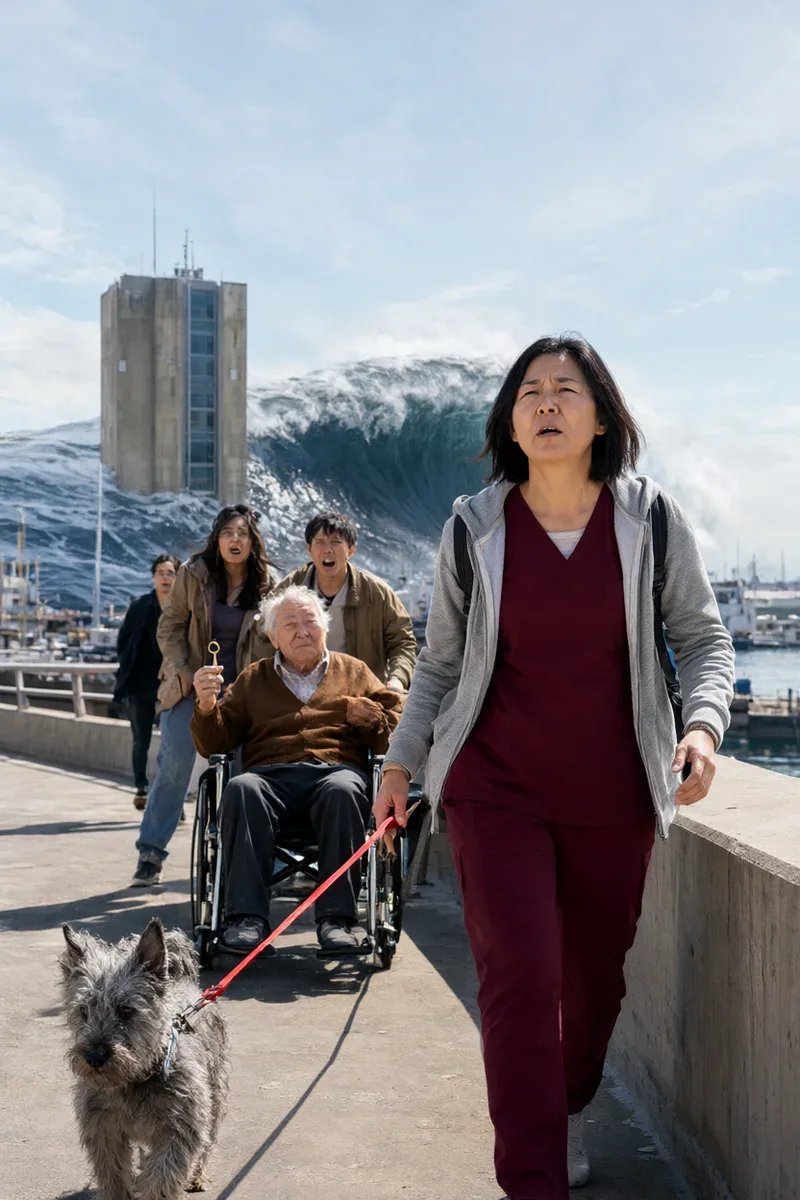
 The Ice Tower
Chapter 3
The Bar
The sound came up eight flights of concrete: a key working in the lock, then steel meeting steel as the door hit the bar. It hit again. Then pounding, and then a voice the stairwell made larger and stranger.
“Tansy. His chair is sitting right here. Open this door.”
Tansy stood at the head of the stairs. The dog pressed against her ankle.
“I need something from upstairs,” Georgina called. “Then I'll take you both. There's room now.”
“How many seats has that van grown since breakfast?” Mr. Skovgaard said quietly.
Tansy leaned over the rail. “What do you need?”
Nothing came up for a second or two. “The grey box on the table. Bring it down and you ride up the hill with us.”
Eight flights down with a steel box and back up for an old man who had needed her shoulder on every step. Her watch said 7:37. Nettie was in that van, in the second seat, with her backpack on her knees.
“No,” Tansy shouted. “Go. Get those people up the hill.”
The pounding began again. Then the van's horn cut across it, one unbroken blast, and when she ran to the hoist door the van was rolling, slowly, up Cannery Road with the passenger door hanging open. Georgina came out from the foot of the tower running with her blazer flying. She caught the door and got in. The van went into the alders and came out again above them on the switchback, small and white and climbing.
“She stopped six residents and a child for a box,” Tansy said.
“Yes. I would like to know what is in it.”
The horizon had changed. The flat silver line beyond the jetty had thickened to a dark band, and the band was coming. It was not a curling wave. It was the sea arriving all at once, grey and fast, and the boats on the harbor floor did not float on it. They went under its front edge like toys under a broom.
It reached the cannery sheds and they came apart. The tower took it a second later, a blow she felt through her shoes, and dust sifted down from the ceiling onto the clean table.
Up the waterfront, the care home rose off its foundation with every window intact. It turned a slow quarter circle, the porch swing still swinging, and went up Harbor Street on the flood until it broke against the brick front of the bank. Her car went past it. On Front Street the water closed over the laundromat, and over the one-room apartment above the laundromat where everything she owned was.
She did not say anything. Mr. Skovgaard, on the cot she had unfolded for him, watched her and did not say anything either.
Below them the stairwell had begun to slap and gurgle. She shone the penlight down. Black water turned on the second landing with a fish tote spinning in it.
It stayed eleven minutes. Then it went out the way it had come, faster, dragging roofs and trucks and half a dock toward the jetty, and the harbor floor showed again with a different town lying on it.
“Is that it?” she asked.
He was looking at her wristwatch, not at the window. “That was the small one,” he said. “There's a carpenter's pencil in the tool roll. Write the time on the wall. We will want to know how long we have before the next.”
The End