 The Ice Tower
Chapter 2
Ninety-Six Steps
“Drop the bar,” he said. “Water pushes doors.”
A steel bar hung on a pivot inside the frame. She swung it down into its bracket, left the wheelchair outside because there was no way to bring it, and took the penlight out of her scrub pocket.
Eight flights of twelve. He told her the number at the bottom and counted them under his breath, leaning on her and the rail. His left hip had been bad since the fall in September. She had ridden in the ambulance with him that morning and phoned her mother from the emergency room to say happy birthday. Gasket went ahead, hopping, waiting at each landing.
On the fifth landing he stopped to breathe.
“Last Wednesday night you asked me if I knew what they gave me at eight o'clock,” he said. “Nobody had asked me a question since August. I have swallowed nothing since Thursday. They're in a napkin in my pocket.”
“You've been pretending.”
“I have been listening. People say a great deal in front of a confused man.”
The door at the top stood unlocked. Her light crossed a room twenty feet square. Along one wall ran a plank shelf: plastic water jugs with 2012 written on them in grease pencil, wool blankets in sealed bags, a hand-crank radio, a folded canvas cot, a leather tool roll. All of it was furred with dust.
The folding table in the middle was not. It was clean. On it sat a new battery lantern, two paper cups from the Dockside Cafe, a stack of rolled drawings, and a grey steel file box with a lock.
“The shelf is mine,” he said. “I stocked it the year after Japan. The table is not.”
“Who else has a key?”
“There were two. One was in my coat pocket the day I moved into your establishment.”
She thought of the brass key on Georgina's lanyard. She thought of last Friday at three in the morning, Gasket growling on the windowsill of Room 6, and a light moving at the cannery where no light had any business being. She had put it down to kids.
He showed her the hoist door, a steel slab on rollers in the north wall, pinned top and bottom. She pulled the pins and put her weight on it, and daylight came in like water.
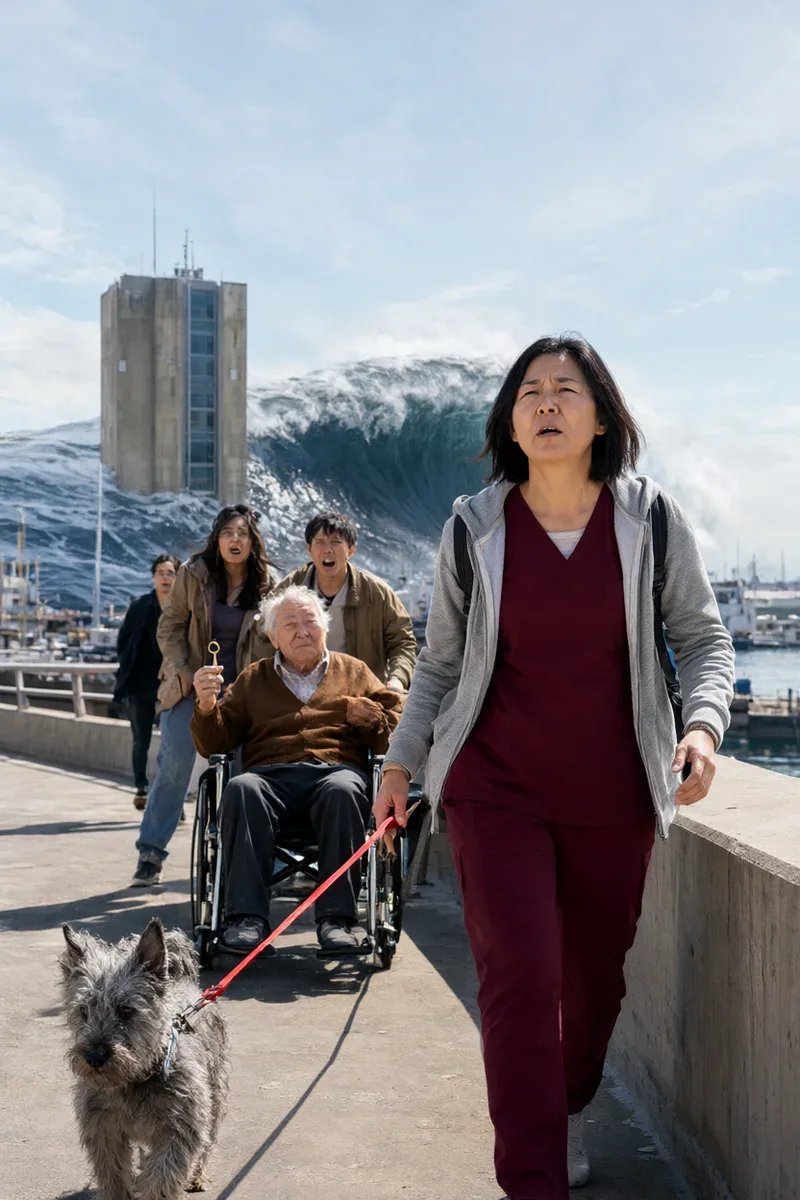
The whole waterfront lay below them. The harbor floor was bare, a brown plain of mud and kelp with the fleet lying on it, crab pots lost for fifty years sitting in rows. Gulls walked where the channel had been. Past the jetty the sea stood back from the land, flat and silver, waiting.
Inland, Harbor Street was a line of stopped cars. She followed it to the slough and saw why. The bridge deck had dropped at one end, and people were leaving their cars and running for the hill on foot.
“The van,” she said.
It was coming back. It had turned around at the bridge and was heading south on Cannery Road, the long way to the hill, the only other way. That road ran right past the cannery gate. She checked her watch: 7:36.
“He'll make it,” Mr. Skovgaard said. “Three minutes to the top if he doesn't stop.”
The van stopped.
It stopped at the cannery gate, seventy feet below her shoes. The passenger door opened. A woman in a sea-green blazer got out and ran, not up the road, but across the yard toward the foot of the tower with her lanyard wrapped around her fist.
The End