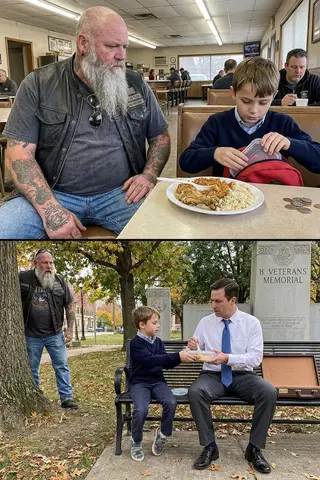
 The Biggest Biker in Town Thought a 10-Year-Old Was Feeding a Stray Dog
Chapter 5
The Ambush at Riverside Park
At twelve-thirty-five the next afternoon, the autumn sun was fighting a losing battle against a thick blanket of grey clouds over Riverside Park.
Daniel Bennett sat on the exact same wooden bench near the war memorial. He wore his crisp white shirt, his conservative navy tie, and his pressed trousers, his polished briefcase resting upright between his shoes. His shoulders were slumped forward slightly more than they had been yesterday, the weight of another morning of ghost-hunting in the public library pressing down on his spine.
He checked his watch. Twelve-thirty-seven.
Three minutes until Noah arrived with the plastic container.
Daniel closed his eyes, taking a deep, shuddering breath, trying to summon the strength to put on his fatherly smile—the mask he wore every single day to convince his ten-year-old boy that everything was going to be fine.
Then, the deep, rumbling bass of multiple heavy-duty engines began to vibrate through the pavement beneath his shoes.
It wasn't the sound of passing commuter traffic. It was a rhythmic, bone-shaking thunder that grew louder and more intense with every passing second, echoing off the stone walls of the county courthouse and rattling the golden leaves on the weeping willows.
Daniel opened his eyes and sat up straight.
From around the corner of Elm Street, a single massive black motorcycle rolled into view. Then another. Then another.
One by one, eleven pristine, chrome-gleaning Harley-Davidson choppers turned into the park's paved walking path, moving at a slow, deliberate crawl. Their engines purred like caged panthers. At the lead was me—Grizzly—my broad shoulders cutting through the cold air, followed closely by Dean Mercer and the rest of the Iron Harbor crew.
Pedestrians scattered onto the grass in sheer panic, grabbing their children and pulling their dogs close as a veritable army of leather-clad bikers rolled directly toward the war memorial.
Daniel froze. His breath caught in his throat. He clutched his briefcase handle so hard his knuckles turned stark white. In a small town like Oakridge, eleven members of a riding club rolling into a public park meant only one thing: trouble. Big trouble.
The bikes came to a synchronized halt ten feet from his bench. The engines died one by one, leaving behind an abrupt, heavy silence broken only by the ticking of cooling exhaust pipes.
I cut my ignition, swung my massive leg over the saddle of my Fat Boy, and planted both boots firmly on the gravel. My leather cut creaked loudly as I stood up to my full six-foot-four height. Beside me, ten other broad-shouldered men dismounted, forming a silent, imposing semi-circle around Daniel’s bench.
Daniel stood up slowly, his knees shaking slightly beneath his trousers. He looked like a cornered animal facing a pack of wolves.
"Can... can I help you gentlemen?" Daniel stammered, his voice cracking slightly as he tried to keep his posture rigid. "I... I don't want any trouble."
I took three slow, deliberate steps forward, my heavy boots crunching on the gravel path. I stopped three feet away from him, tower-like, casting a massive shadow over his polished shoes.
Daniel swallowed hard, bracing himself for whatever was coming.
Instead of raising a fist, I reached up with my scarred, tattooed hand, grabbed the lapel of my heavy leather cut, and pulled it back. Then, slowly, deliberately, I reached into my inner vest pocket, pulled out a thick, heavy manila envelope, and held it out toward him.
Daniel blinked, staring blankly at the envelope. "What... what is this?"
"Open it," I commanded, my voice deep and unwavering.
With trembling fingers, Daniel reached out and took the envelope. He slid his thumb beneath the heavy wax seal, pulled out a stack of documents, and began to read.
The color drained entirely from his face. His eyes widened in absolute shock as he stared at the words printed on the top page.
It wasn't a threat. It wasn't a collection notice.
It was a commercial property deed and a fully executed corporate service contract, granting Iron Harbor Garage’s permanent, exclusive maintenance and fleet-servicing contract to a newly formed financial consultancy firm bearing a very specific, familiar name: Bennett & Associates Financial Solutions.
Attached to the contract was a cashier's check written out for an amount that would clear every single outstanding mortgage payment on his home and fund a full year of operating capital.
Daniel’s hands shook so violently the papers fluttered in the autumn wind. He dropped his gaze from the documents, looking up at my heavily bearded face with tears welling openly in his eyes.
"I don't... I don't understand," Daniel whispered, his voice breaking. "I... I didn't apply for this. I don't work for a firm."
"You do now," Dean Mercer said, stepping forward with a broad, genuine smile cutting through his white beard. He reached out and placed a heavy, reassuring hand on Daniel’s rigid shoulder. "Every business needs a sharp financial mind to keep the books straight. And Iron Harbor Garage just happens to be expanding into commercial fleet management across three counties. We needed a managing director who knows how to spot a solid investment when he sees one."
Daniel stared at Dean, then back at me, the terrible weight of the last three months crashing down around him—not as a burden, but as an overwhelming wave of grace.
"Grizzly... I... I can't accept this," Daniel choked out, a tear finally spilling over his lower eyelid and cutting a clean path through the dust on his cheek. "This is... this is charity. I'm just... I lost my job months ago. I've been sitting in the park pretending I still had a place to go..."
"It’s not charity, Daniel," I said softly, stepping in close and placing my heavy hand over his trembling fingers holding the contract. "It’s a debt paid in full. Six years ago, you looked past our leather vests and signed a paper that saved our lives when nobody else would give us the time of day. You kept our lights on."
I paused, pointing a scarred thumb down the path where ten-year-old Noah was just then rounding the corner of the park, clutching his scratched plastic container tightly to his chest as he hurried toward his father's bench.
"And besides," I grinned, my rough features softening into a warm laugh, "any man whose ten-year-old boy is smart enough to run a covert lunch-delivery operation right under our noses is clearly overqualified to manage our corporate ledger."
The End









