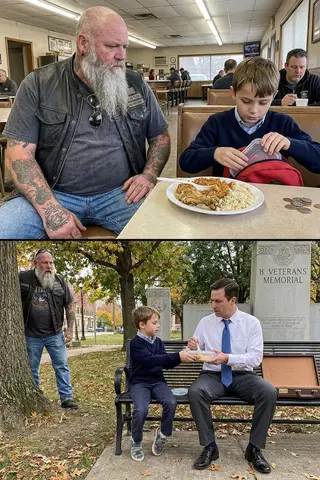
 The Biggest Biker in Town Thought a 10-Year-Old Was Feeding a Stray Dog
Chapter 3
The Ghost from the Ledger
Daniel Bennett hadn't worked at First Valley Bank for three months.
I pieced it together as I stood behind the oak tree, watching him break the dinner roll in half and hand the larger piece to his son. Daniel was the kind of quiet, unassuming man who blended into the wallpaper of Oakridge—a mortgage officer who wore thrift-store suits, drove a ten-year-old sedan, and coached Little League on Tuesday nights without ever making a fuss.
When the bank had undergone a massive corporate restructuring back in July, Daniel had been quietly let go with a modest severance package designed to keep a family afloat for exactly sixty days. To protect his wife—who was working herself to exhaustion on the night shift at the hospital—and to preserve what little dignity he had left, Daniel continued to put on his suit every single morning. He kissed his wife goodbye, packed an empty briefcase, and drove to the public library downtown.
He spent his days sitting at the back computer terminals, filling out dozens of online job applications for positions that never responded, reading financial journals, and printing out resumes he handed to a silent void. Then, when the afternoon arrived, he drove to Riverside Park and sat on a bench, pretending he was on a lunch break from a job that no longer existed.
His savings were entirely gone. His final severance check had barely covered the previous month's mortgage payment and the utility bills.
And Noah? Noah had found the official termination letter hidden beneath a stack of old tax returns in the garage weeks ago.
The boy never confronted his father. He didn't cry, he didn't scream, and he didn't tell his mother. Instead, he looked at his own shrinking world and made a silent, devastating choice: he started skipping half his own lunch every single day so his father could have a hot meal at noon without having to spend the last of their grocery money.
I stood behind that oak tree, my heavy leather cut pressing against the rough bark, and felt a wave of historic guilt wash over me that made my knees shake.
Six years earlier, Iron Harbor Garage had been drowning in a sea of red ink. Our original business partner—a slick-talking accountant from Knoxville—had vanished overnight into the night, draining our operational accounts and leaving us with twelve thousand dollars in unpaid back taxes and a mountain of defaulted supply loans.
Every single bank in Anderson County laughed us out of their offices. Local lenders took one look at our greasy jeans, our long hair, and our leather cuts and slammed their doors shut. They saw a bunch of grease-monkey bikers heading straight for bankruptcy court.
Except for one man.
A quiet, middle-aged mortgage officer at First Valley Bank named Daniel Bennett took our file home over the weekend, stayed up until three in the morning auditing our work orders, and walked into the loan committee meeting on Monday morning ready to fight for us. He argued that our people, our contracts, and our sweat mattered infinitely more than the leather vests we wore in our loan interview. He staked his own professional reputation on our garage.
Because of Daniel Bennett, Iron Harbor Garage survived. We paid back every single dime with interest, hired four more mechanics, and turned our shop into the most reliable service center in East Tennessee.
Daniel had saved our livelihood.
Now, his ten-year-old son was sitting on a park bench, dividing a five-dollar diner lunch into a plastic container because his father was too proud to beg and too broken to find a way out.
My jaw clamped shut so hard my teeth ached.
I pulled my heavy smartphone from the inner pocket of my leather vest, my scarred thumb punching the speed dial for the only man in Oakridge who could mobilize our entire world in under twenty minutes.
The phone rang twice before a gravelly, authoritative voice answered on the other end.
"Talk to me, Grizzly," said Dean Mercer, our club president.
"Drop everything, Dean," I said, my voice dropping into a harsh, dangerous growl that made the distant squirrels scatter up the branches. "Get the brothers down to the garage right now."
There was a brief pause on the line. Dean knew my tone. He knew the difference between a routine bike rally and a code-red emergency.
"You sound angry, brother," Dean said, his tone instantly shifting from casual to razor-sharp.
"I am."
"At who?"
I peeked around the side of the oak tree. Across the grass, Daniel Bennett was smiling weakly as Noah showed him a drawing in a school notebook, both of them sharing a fleeting, fragile moment of joy beneath the autumn leaves.
"At every single one of us," I whispered into the receiver, my chest burning with a fierce, protective fire, "who completely forgot the name of the man who kept our lights on when the dark was closing in."
The End









