 The Biggest Biker in Town Thought a 10-Year-Old Was Feeding a Stray Dog
Chapter 1
The Weight of a Ten-Year-Old’s Coins
The air inside Miller’s Diner smelled of hot grease, cheap coffee, and the stale dust of Oakridge, Tennessee. Outside, the midday October wind rattled the neon 'Open' sign, but inside, the heavy warmth of the fryers offered a brief shield against the biting chill of the Appalachian autumn.
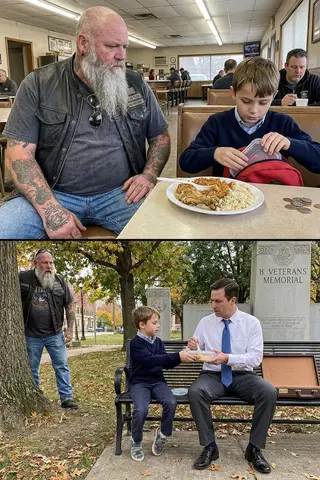
People called me Grizzly. It wasn’t a nickname given with malice; it was simply a statement of biological fact. Standing six-foot-four and tipping the scales at close to three hundred pounds, I was the service manager at Iron Harbor Garage and the broadest man in our riding club. My beard cascaded nearly to my chest in thick, iron-grey waves. My knuckles were permanently scarred from wrenches slipping in tight engine blocks, faded tattoos curled from both of my thick wrists all the way up to my heavy neck, and my black leather riding cut—creaking loudly every time I shifted my massive frame over a laminate booth—announced my presence before I ever spoke a word.
In a small town like Oakridge, guys who looked like me usually made folks reach for their car keys or pull their children a little closer. But Miller’s Diner was my second home, and Jenny, the waitress who had been running plates here since the local textile mill closed down in the nineties, knew I wouldn't hurt a fly unless he was threatening a dog or a child.
That was why my eyes kept drifting away from my plate of bacon and eggs and locking onto Booth Four.
The boy’s name was Noah.
He was ten years old, though the tired, hyper-vigilant care with which he handled his money made him seem decades older. Each afternoon precisely at twelve-fifteen, he pushed open the squeaky glass door alone, slid into the corner booth, and ordered the exact same thing: the five-dollar-and-twenty-five-cent lunch special.
He never ordered a soda. Water was free, and water was what he drank.
He never asked for dessert, not even when the pie case glowed right beside his table with fresh apple and pecan slices dripping in syrup.
What caught my attention wasn’t his quiet demeanor or his oversized school backpack that slumped against the faux-leather bench like a wet sack of flour. It was the way he paid. When Jenny brought the check, Noah reached into his pocket and poured a small, meticulous mountain of coins onto the laminate table. Nickels, dimes, quarters, and copper pennies—counted out with the terrifying precision of an accountant balancing a failing ledger.
He watched every single coin disappear into the waitress’s palm, his small jaw tight, as though each individual piece of change had been assigned a specific job before it was allowed to leave his pocket.
Then came the ritual that broke my heart.
Once the plate of food arrived—a modest portion of grilled chicken, a scoop of white rice, steamed green beans, and a single buttered dinner roll—Noah did not dig in like a normal ten-year-old boy. Instead, he opened his backpack, pulled out a scratched, clear plastic container with a faded blue lid, and began to divide the meal.
Not roughly. Not haphazardly. Precisely.
Half of the rice stayed neatly on his restaurant plate. The other half was scraped with surgical care into the plastic container. He split the green beans with the edge of his fork, counted out the chicken strips, and picked up the lone dinner roll, wrapping it tightly in a clean paper napkin before tucking it beside the meat. Only after the container was snapped shut and safely zipped away did he pick up his fork and begin eating his own diminished share.
I watched him do it on Monday.
I watched him do it again on Tuesday.
By Wednesday, the hair on the back of my thick neck was standing on end. I signaled Jenny over while she was wiping down the counter with a bleach-soaked rag.
"Hey, Jen," I murmured, my voice a low rumble that vibrated through the diner's front booth. "That kid over there, Noah. Is his family struggling? Does his old man have work?"
Jenny stopped wiping, her eyes flickering toward the boy before dropping to the linoleum floor. She shook her head, her face softening with maternal pity. "I don't know much, Grizzly. His mother works double shifts down at the county hospital down on Maple Street. His father used to work up at First Valley Bank—middle management or something steady like that. Their house over on Elm is modest, but it’s always clean. Nobody’s asked for charity. Mr. Miller likes to keep prices low for kids, but I don't think they're on hard times. At least, they never showed it."
"Maybe he’s feeding a stray dog behind his house," I muttered, taking a slow sip of my black coffee.
"Maybe," Jenny sighed, walking away to drop off a ticket.
Maybe. But dogs don't eat white rice and carefully wrapped dinner rolls out of a Tupperware container.
When Thursday rolled around, Noah took his usual seat. He ordered the exact same special. He ate his exact half, packed the other half away, and then reached into his blue cloth pouch to pull out his collection of coins. His fingers brushed against a collection of pennies, sliding them back and forth across the table as if trying to find one more coin that wasn't there.
I didn't think. I stood up, my leather cut groaning, dropped a ten-dollar bill onto my own table, and walked over to Jenny.
"Put his check on my tab," I told her quietly.
Jenny nodded, understanding without a word. She walked over to Noah’s table, smiled warmly, and slid the plastic check folder away before he could empty his pouch. "On the house today, buddy," she said. "Miller’s started a new promotion. Kids eat free on Thursdays."
It was a terribly constructed lie. The diner had never run a promotion in the twenty years I’d lived in Oakridge.
Noah glanced down at the empty menu holder, then slowly raised his dark, intelligent eyes to meet Jenny’s. Then his gaze shifted past her shoulder, landing squarely on me—towering over the room in my black leather, covered in garage grease and tattoos.
He knew. He knew it was charity, and he knew why.
A flash of painful, burning pride crossed the ten-year-old's face—an expression far too heavy for a child. But he didn't throw a fit. He swallowed hard, nodded politely, placed his untouched coins back into his blue cloth pouch, zipped his oversized backpack, and left the diner with half his lunch tucked securely against his spine.
I didn't finish my coffee. I stood up, threw another ten on the table for Jenny, and walked out the glass door right behind him.
The End









