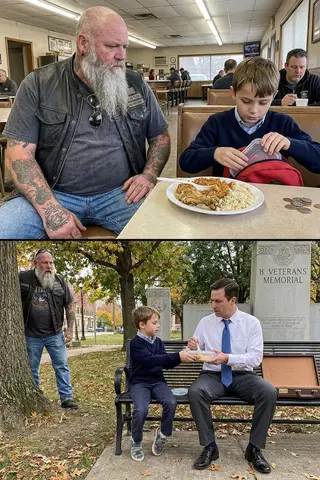
 The Biggest Biker in Town Thought a 10-Year-Old Was Feeding a Stray Dog
Chapter 2
Riverside Park and the Ghost in a Tie
The crisp autumn air hit me like a slap as I stepped onto the sidewalk. Oakridge was a town built around the old manufacturing plants and the winding bends of the Clinch River—a place where everyone knew your granddad’s name, your vehicle’s make, and whether you owed money at the hardware store.
Noah was walking briskly down Oak Street, his shoulders squared against the wind. I kept a half-block distance, moving quietly despite my size, using the parked pickup trucks and oak trees as cover.
He wasn't walking toward Elm Street, where the houses were. He was walking toward Riverside Park.
As he approached the iron archway of the park entrance, he glanced over his shoulder twice. At first, I thought he had spotted me stalking him like a grizzly bear trailing a deer. But his eyes were scanning higher—checking the imposing brick face of the county courthouse clock tower rising above the tree line.
He was watching the time.
At exactly twelve-thirty-eight, Noah reached the far side of the park, near the old stone war memorial where the weeping willows dropped yellowing leaves onto empty wooden benches.
Sitting on the second bench was a man.
Even from fifty yards away, the man looked completely out of place in the rustic, leaf-strewn park. He was in his early forties, wearing a crisp, blindingly white button-down shirt with the sleeves neatly rolled up to his forearms, a conservative navy-blue silk tie, and dark, sharply pressed business trousers. His black leather briefcase stood perfectly upright on the gravel path between his freshly polished dress shoes.
He looked like a man waiting for a multi-million-dollar corporate merger to close. Except he was sitting beneath a crumbling stone monument dedicated to the veterans of Korea, staring intensely at a blank smartphone screen.
Noah quickened his pace, breaking into a light jog as he reached the bench.
"Long meeting?" the boy asked, his voice ringing out clear and bright across the empty grass.
The man snapped out of his trance. The tight, stressed lines around his eyes melted instantly into a brilliant, practiced fatherly smile—a smile that didn't quite reach his hollow, exhausted eyes.
"Very," the man replied, his voice smooth and professional. "The board of directors is giving me a run for my money today."
"How’s the bank?" Noah asked, sliding onto the wooden bench right beside him and dropping his heavy backpack to the ground.
"Busy," the man said, adjusting his tie with fingers that trembled just a fraction of an inch. "Very busy. Lots of loans to process, lots of numbers to crunch."
He smiled too quickly. It was the kind of smile people wear when they are standing on the edge of a cliff and trying to convince themselves they are standing on solid ground.
I stepped behind a thick oak tree thirty feet away, holding my breath so the autumn wind wouldn't carry the sound of my lungs.
Noah didn't say anything to challenge the lie. Instead, he unzipped his backpack, reached deep inside, and pulled out the scratched plastic container with the faded blue lid.
The moment the container appeared in the open air, the father's forced smile vanished. His face fell, the illusion of the high-powered executive cracking completely under the weight of the plastic box.
"Noah," the man said softly, his voice dropping an octave, filled with a crushing, unbearable shame. "You shouldn't keep bringing food down here."
"I couldn't finish it," Noah replied instantly, his voice steady, practicing a script they had clearly rehearsed before.
"Again?"
"Yeah. They give massive portions at Miller’s on Thursdays. The special is huge."
Miller’s did not give massive portions. Everyone in town knew Jenny served food on small plates to keep costs down.
The father stared at the plastic container resting between them on the slat of the bench. He looked at it for a long, agonizing moment, his throat working as he swallowed hard against the lump of humiliation rising in his chest. He knew the truth. Noah knew he knew the truth. Yet, the father accepted the box because refusing it would mean turning his ten-year-old son’s quiet, desperate act of mercy into an outright humiliation for both of them.
They opened the lid together. Inside was half a portion of chicken, a scoop of cold white rice, and a dinner roll wrapped in a napkin.
They ate side by side, sitting in the crisp October wind, each of them pretending not to understand the other’s lie.
My chest tightened until my ribs felt like they were going to crack.
I knew that man.
His name was Daniel Bennett.
The End









