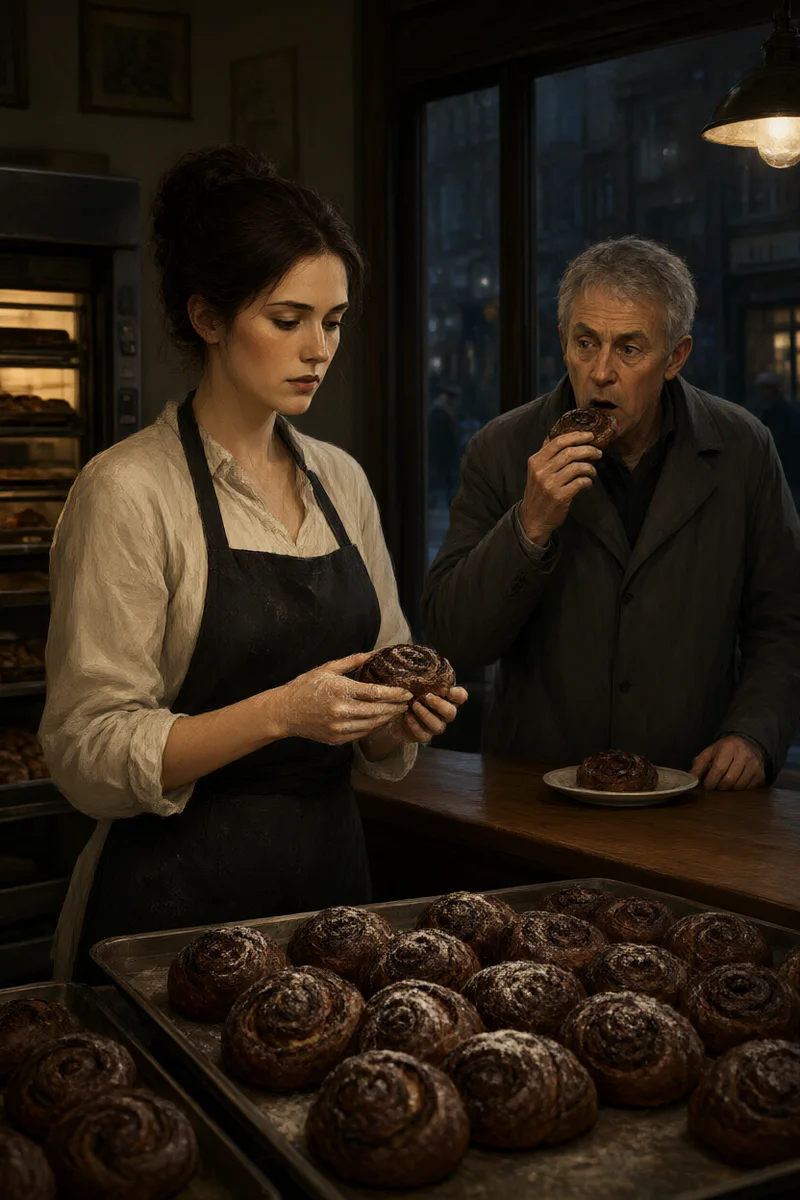
 The Bakery on Marrow Lane
Chapter 4
Burnt Sugar
Burnt sugar is not difficult. It is only frightening. You melt sugar dry in a heavy pan and take it past amber, past the color of strong tea, past the point where every instinct says stop, until it smokes and turns the red-black of old varnish. Then you throw in boiling water and stand well back.
Wren set off the smoke alarm twice on the first night. By the third she had a jar of syrup as thin as ink that tasted of coffee grounds and scorched toffee.
The rolls were another matter. Made her mother's way, with the syrup where the molasses went, they came out dark and harsh and nothing else. Mr. Adeyemi, offered one at six in the morning, chewed it loyally to the end and said that it was very historical.
Emil did not come. Six mornings went by without him. On the seventh, with fourteen days left, he knocked at the yard door at half past four with a cardboard folder under his arm.
“I haven't come to shape. I've been at the numbers, and I wanted you to see them before you started packing—” He stopped, and breathed in. The whole bakery smelled like the day after a fire.
She gave him the exercise book, open at the third page, and watched him read the margin three times.
“Near black,” he said.
“Your mother was right. So were you. It's the same roll, and my mother sweetened it.” She put one of the failures in front of him. “That's as close as I can get, and it isn't good. It's bitter, and that's all it is. There's a thing missing, and it's not on my page.”
He ate it, and did not argue. Then he took the card from against the till and read down it aloud. “Rye flour, wheat flour, caraway, salt, lard, burnt sugar.”
“I have all that.”
“You use butter. I've watched you.”
“Everybody uses butter. Lard is what you used when—” She stopped. She looked at the oven.
Lard was what a kitchen girl used, because butter was for the lodgers. And a kitchen girl did not get the oven at four in the morning, when it was fierce. She got it last, after the house bread was out, when the bricks were only giving back what they had left.
Her mother had baked these rolls first and fast, for the six o'clock trade. Twenty minutes.
The butcher at the corner sold them lard at seven. They made the sponge that night and left it till morning, and Emil shaped all forty; his were round now, most of them. At noon, when the loaves were long gone and she could hold her hand in the oven mouth for a slow count of ten, she slid the tray to the back and shut the door for an hour.
It took six days and six trays to learn how long. With eight days left, the rolls came out near black, with a crust that rang when she knocked it, and the smell had changed. It was not sweet. It was closer to a struck match and wet rye.
She broke one and gave him half.
He chewed slowly, and this time his face told her nothing.
“Well?”
“I don't know.” He set the half roll down with great care. “I was nine. She let me put butter on them. I've wanted this for thirty years, and a fortnight ago I would have sworn in a court that yours was it. I'm the last person alive who can tell you.”
Wren looked at the tray, and at his folder of numbers, still shut on the flour bin. Tomorrow at ten the pharmacy's surveyor was coming, and Mrs. Kasten with him.
“Then we need someone who never liked them,” she said.
The End









