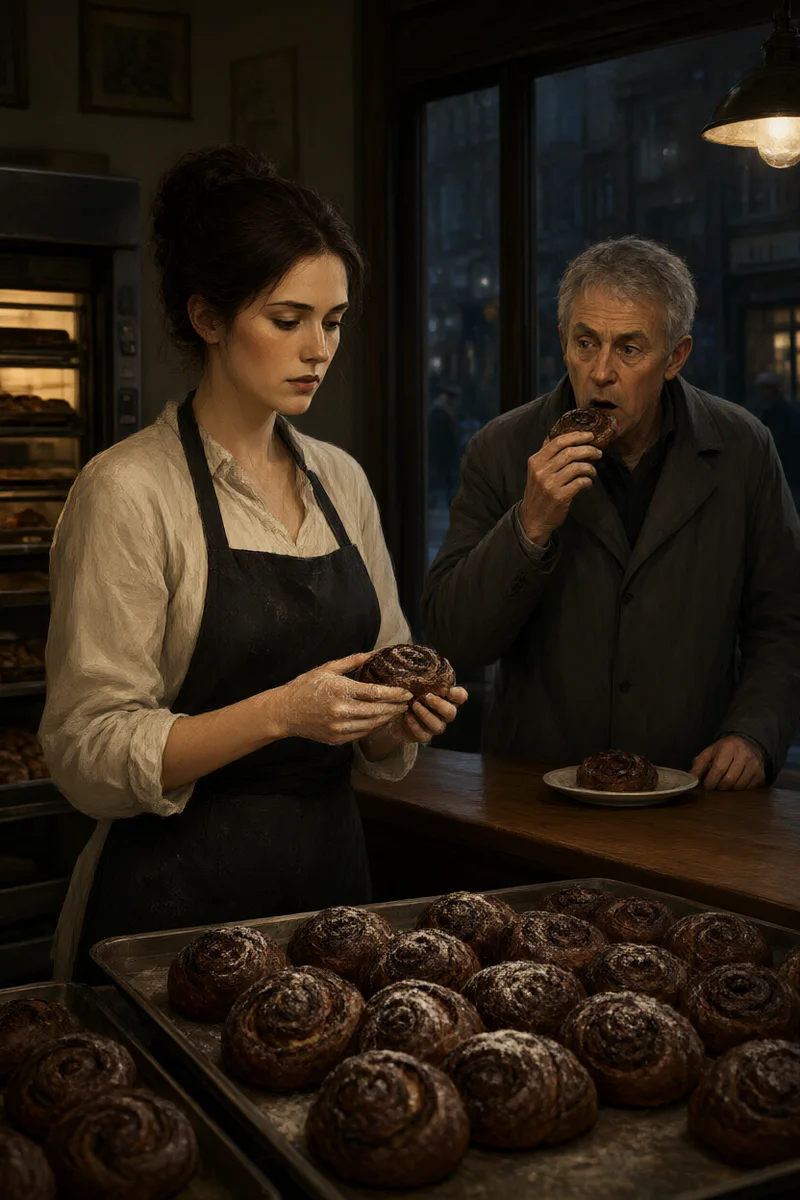
 The Bakery on Marrow Lane
Chapter 2
The Recipe Card
He came back the next morning, and the one after that. He queued, bought two of the caraway rolls, and ate one at the window shelf with his eyes shut. Wren, who had twenty-nine days and then twenty-eight, did not help him.
On the fourth day he waited until the shop emptied and put a recipe card on the counter between them, soft at the corners, written in pencil.
“My grandmother made these,” he said. “She died when I was nine. Nobody wrote down where she learned it. I have been trying to find this roll for thirty years, Miss Abbott, in four countries.”
“Four.”
“She had an accent nobody could place, and she wouldn't say whose it was. So I guessed. I guessed wrong four times.”
Wren turned the card over. On the back, in faded ink, was the name of a boarding house on Marrow Lane and a date from before the war. It was a printed tariff card, the kind that would have stood in a rack in the hall: beds by the week, breakfast extra.
“That's this building,” she said slowly. “That's upstairs. My mother rented the kitchen from the woman who ran it.”
“I know. I had the deed history pulled last night.” He pressed finger and thumb into his eyes. “I bought the one place on earth I've been looking for, and the first thing I did was try to close it.”
Wren looked at the card, then at the man, then at the notice still folded in her apron pocket. She took it out and set it beside the recipe. “Then I'd say you have twenty-six days,” she told him, “to come up with a better idea.”
He was already taking off his coat. “Show me how you shape them,” he said.
His name was Emil Kasten, and he shaped dough like a man folding a road map. She put him at the end of the bench with forty pieces and corrected his hands twice. “You're not wringing its neck. Cup it. Let the bench do the work.”
While he fought with it she read the card properly. Rye flour, wheat flour. Caraway. Salt. Lard. Burnt sugar, two spoons. There were no weights and no times, and not one verb.
“This isn't a recipe. It's a shopping list.”
“That is the conclusion I reached in the fourth country.”
“It's wrong, too. There's no burnt sugar in mine. It's molasses.”
“Then she wrote it down wrong.”
“Or she'd no need to write the rest. Nobody writes down how to tie their shoes.”
His phone went off on the bench, buzzing itself in a slow circle through the flour. The screen said RUTH. He looked at it and turned it face down, and it started again.
“You can answer that. I've heard people being evicted before.”
“It'll be about the pharmacy. They want to send a man to measure.” He said it to the dough.
Wren put the card down. “What pharmacy?”
“The ground floor is let, Miss Abbott. Agreed, not signed. It was agreed before I ever walked in here; it's how the purchase was made to add up.” He wiped his hands on the borrowed apron, one finger at a time. “And it isn't mine to un-agree. You read the notice. Kasten and Son.” The phone buzzed a third time. “I'm the son.”
The End









