 The Bakery on Marrow Lane
Chapter 3
Mrs. Kasten
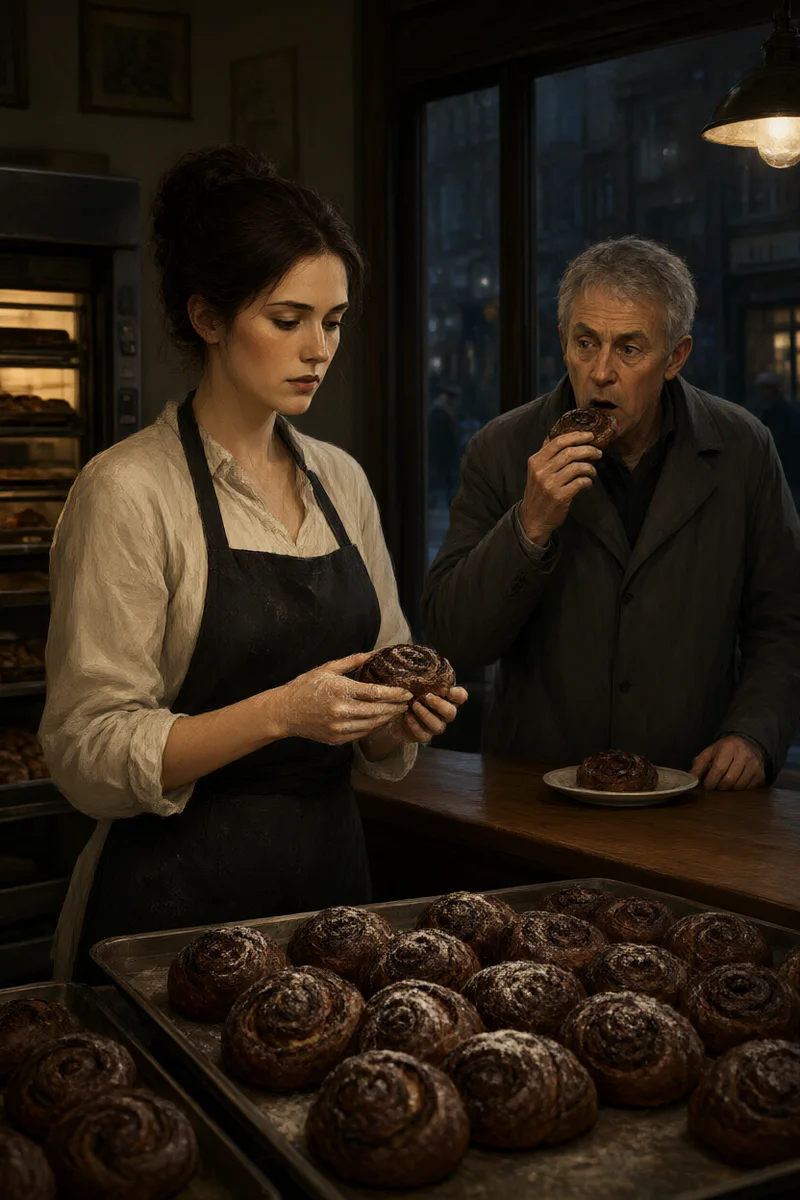
Ruth Kasten came herself, five mornings later, with twenty-one days left on the notice. She came at ten, when the shop was quiet, in a camel coat with a tape measure in the pocket, and she looked at the ceiling before she looked at the bread.
She was seventy or close to it, a small woman with her son's long hands. The son was at the end of the bench with dough to his wrists. She took that in without remark, as a person takes in a figure she means to query later.
“Eleven buildings,” she said to Wren, by way of introduction. “My husband left me two and a debt. I didn't come by the other nine through being sentimental. I gather you've been working on my son.”
“He's been working on my rolls. He's spoiled about two hundred.”
“Mother,” Emil said. “Before anything else. Eat one.”
He put it on a plate for her. Wren saw that the plate was not quite steady.
Mrs. Kasten ate the roll. She ate all of it, standing, unhurried, and dusted her fingers over the plate afterwards.
“That is a very good roll,” she said. “It isn't hers.”
“It's the same. It's exactly—”
“You were nine, and she let you put butter on them. Hers were bitter, Emil. Nearly black. Your uncle wouldn't touch them. This one is sweet.” She said it without malice, like a surveyor reading out a crack.
“It's the same house. It's printed on the card. She learned it upstairs.”
“She scrubbed upstairs.” Mrs. Kasten drew her gloves through one hand. “She came to this house at fourteen with a dozen words of the language and worked for her bed. The woman docked her wages for burnt crusts. I know that much because she told me once, when she was ill, and never again. In fifty years my mother did not say the name of this street in my hearing. I don't suppose that was an oversight.”
“Then why did she keep the card?”
“I have no idea. It was in her tea tin. I took it for a shopping list.”
Nobody spoke. Behind them the oven ticked as it gave up its heat.
“You went looking for a shrine,” his mother said, more gently, “in the one place she would have crossed the road to avoid. I'm sorry for it. But a building pays or it goes, and this floor pays a third of what the pharmacy will.” She turned to Wren. “Three weeks, Miss Abbott. Their surveyor will want an hour in here, two weeks from today, and I'll come with him. You'll have a reference from me, and your deposit with interest. It is a very good roll.”
The bell jumped on its spring. Through the window Wren watched her stop on the pavement and look up at the first-floor windows, once, before she walked on.
Emil untied the apron, folded it in four and laid it on the bench. “I'm sorry. I've cost you five of your thirty.” He left the card where it was, propped against the till. She could not tell whether he had forgotten it or could not carry it.
At two she locked the door and reached down a book she had not opened in years, because her hands knew it: her mother's, a school exercise book gone brown, every recipe dated.
The caraway rolls were on the third page. Beside the molasses, in the margin, in her mother's upright ballpoint, was a note Wren must have read at sixteen and never once thought about.
“Mrs. Pell says the girl who made these first burned her sugar near black. Too bitter to sell. I use molasses.”
The End









