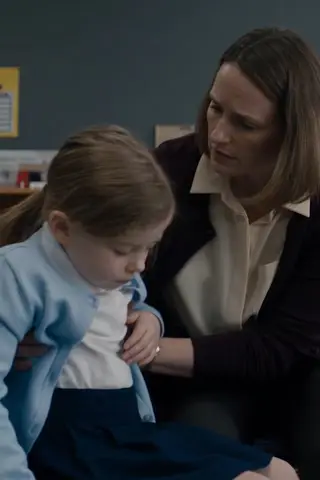
 : She Thought It Was Just a Normal School Morning
Chapter 2
The Cot in the Corner
By 9:03 a.m., the fluorescent lights of the nurse’s office were buzzing with that same sterile, headache-inducing frequency, though the room smelled distinctly of rubbing alcohol, plastic band-aids, and laundry detergent. Lila was lying flat on the narrow vinyl cot, her legs encased in a crisp paper sheet that crinkled every time she so much as twitched.
Nurse Helen Miller stood beside the bed, wrapping a pediatric blood pressure cuff around Lila’s thin, bird-like arm. The digital monitor hummed, beeped twice, and displayed a set of numbers that Helen jotted down onto the official health office log with a red ballpoint pen.
“Her blood pressure is running a bit low,” Helen murmured, peering over the rim of her wire-rimmed glasses. “She might just be dehydrated. Did she eat breakfast this morning, do you think?”
It was a reasonable, mundane explanation. In an elementary school, low blood pressure and dehydration were practically seasonal occurrences, usually solved by a dixie cup of warm water and a package of saltines. I desperately wanted to nod, to accept Helen’s diagnosis, to let the machinery of routine swallow the whole incident up and return us both to Room 204.
Then my eyes dropped to Lila’s hands.
The little girl was gripping the edge of the blue disposable blanket so fiercely that her knuckles had lost all color, translucent little bumps stretched tightly over bone. Her pale blue cardigan—the one that had looked so neat from a distance—was buttoned entirely wrong. At the bottom, one button had skipped its designated hole entirely, leaving a loose flap of fabric dangling crookedly. Another button pulled so tight across her middle that a strange, rigid crease cut horizontally through the knit wool, as though something stiff and unnatural was strapped underneath her clothes.
I looked back and forth between the ordinary paperwork scattered on Helen’s desk—the attendance register, the immunization logs, the color-coded pass cards—and the trembling child on the cot.
Nothing about this felt ordinary anymore. My instincts, honed by years of listening to what children didn't say, were screaming at me.
I pulled a metal folding chair close to the cot, sat down so my eyes were level with Lila’s, and rested my hands gently on my knees.
“Lila, sweetheart,” I whispered, keeping my tone as soft as falling snow. “Can you tell me what hurts? Just between you and me.”
Lila stared straight up at the white acoustic ceiling tiles, her chest rising and falling in shallow, jagged rhythms. For several long seconds, the room was so quiet we could hear the muffled sound of fourth graders stomping down the hallway toward the gymnasium.
Then, very slowly, Lila turned her face on the paper pillow. Her dark eyes met mine, filled with an exhaustion no seven-year-old should ever have to carry.
“My dad said it wouldn’t hurt… but it does.”
Helen’s red pen stopped dead against the clipboard. The ink bled into a tiny, dark dot on the white paper.
I felt the temperature in the tiny room plummet. The innocent explanation of dehydration dissolved into ash. Lila hadn't simply come to school feeling sick or tired. Something had happened inside her house before the sun even came up. And whatever it was, the little girl was too terrified to explain the full horror of it.
The End









