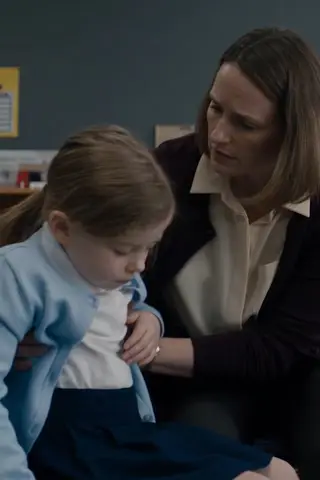
 : She Thought It Was Just a Normal School Morning
Chapter 1
The Weight of a Quiet Child
The fluorescent lights in Room 204 hummed with a steady, clinical drone that seemed to bleed the color right out of the room. It was a gray Thursday morning in early October, the kind of day that made western Pennsylvania feel washed clean, cold, and heavy with damp earth. Outside the double-paned windows, bare branches scraped against the brick facade of Westmont Elementary, mirroring the quiet tension that always settled into my bones as the bell rang. I was holding a stack of attendance sheets and early math worksheets when my eyes drifted to the third row by the window.
There sat Lila Mercer.
Seven years old, wearing a pale blue cardigan buttoned with meticulous precision, her hands folded neatly over her laminate desktop. She wasn’t making a sound. She wasn’t dropping pencils, whispering to her neighbor, or squirming like the other nineteen second graders who were currently shifting, clicking, and scraping their plastic chairs across the tiled floor.
I had been teaching for over a decade, and in that time, I had learned a quiet truth about classrooms: the loud kids are easy. They take up space, they demand correction, and their struggles are laid out loud for everyone to see. But the quiet kids—the ones who never interrupted, never grabbed, and never asked for an extra moment of attention—they required an entirely different kind of attention.
Lila was the definition of well-behaved on paper. But as I watched her, I realized she wasn’t just calm; she was careful.
She shifted her weight slightly in her seat, and a micro-expression of pure agony crossed her pale face for half a second before she clamped her teeth together and forced her features back into a smooth, blank mask. Her knees were pressed tightly together beneath the desk. Her shoulders were pulled up toward her ears, rigid as wire.
Every tiny movement looked like it cost her an immense amount of physical effort.
The morning routine rolled forward around her with the relentless momentum of a factory assembly line. At 8:17 a.m., I marked her present. At 8:42, the class bent over their double-digit addition worksheets, pencils scratching against cheap paper. By 8:56, the first children began turning their work in at my podium.
Lila waited. She waited until every single child had cleared the aisle.
When she finally stood up to walk toward my desk, she paused. She pressed her small, pale hand hard against the laminate edge of her desk, her knuckles turning translucent white under the pressure, before she dared to take a single step.
One foot forward. A long, agonizing pause.
Then the other.
Around her, the ordinary life of the classroom thundered on. A boy two rows over whispered loudly about a loose tooth he was wiggling with his thumb. Two girls traded a pink crayon back and forth. A stray pencil rolled off the edge of a reading table, hit the tile floor with a sharp plastic click, and bounced against a chair leg before coming to rest.
No one else noticed. To the rest of the room, Lila was just walking across the floor. To me, it looked like she was walking across broken glass.
“Lila, are you feeling okay this morning?” I asked, keeping my voice low and casual as she finally reached my podium to drop off her paper.
Lila looked up. For a fraction of a second, something deeply frightened flickered in her dark eyes—a wild, trapped look that didn't belong on the face of a seven-year-old. Then, as if she had flipped an internal switch, a small, rehearsed, perfectly polished smile appeared on her lips.
“I’m fine, Ms. Kincaid,” she chirped, the tone a little too bright, a little too rhythmic. “I just need to sit up straight.”
The words didn't sound like they came from a child. They sounded like a script. A script she had practiced, memorized, and recited whenever someone looked too closely at her.
I opened my mouth to ask another question, to probe past the fragile wall she had built, but before the words could leave my tongue, the color vanished completely from her face. Her lips parted in a silent gasp. The math worksheet slid from her limp fingers, fluttering down to scatter across the tiles.
Then her knees simply gave way beneath her.
I lunged forward from behind the podium, diving across the floor just in time to catch her small frame under the arms before her head could strike the sharp corner of the teacher's desk.
The entire room went dead silent. The noise of twenty children evaporated instantly. One boy stood frozen with his worksheet held up in both hands halfway across the aisle. Another child was halfway out of her chair, her mouth forming a silent O. The boy with the loose tooth forgot to wiggle it, his finger stuck pressing against his gum.
“Class, stay in your seats,” I said, my voice sharp and steady as adrenaline flooded my veins. I looked toward the open classroom door where Mrs. Gable, the instructional aide, was walking past in the hallway. “Carol! Get in here right now and call the nurse!”
The End









