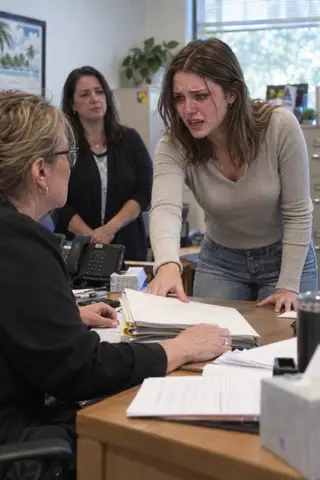
 She Thought Her 20th DCF Report Would Die Quietly
Chapter 5
Shadows of the Past
The following weeks at Beach House blurred into a strange, structured rhythm of group therapy sessions, case management meetings, and quiet afternoons spent sitting under the sprawling oak trees in the courtyard with Maya. For the first time in my life, my days weren't dictated by hyper-vigilance, walking on eggshells, or calculating the exact trajectory of my mother’s unpredictable moods.
Yet, physical safety did not magically erase the psychological ghosts lingering in the corners of my mind.
Trauma has a peculiar way of haunting you precisely when you think you are safe. On a quiet Tuesday afternoon, while sitting in the facility's common room reading a battered copy of a paperback novel, a staff member walked down the hallway carrying a heavy ring of metal keys that jingled sharply against one another.
The moment that metallic jingle echoed down the corridor, my body reacted before my conscious mind had time to process the environment. My heart slammed against my ribs like a trapped bird, my breath hitched, and my hands flew up instinctively to protect the back of my head. I curled inward on the floral couch, muscles locked in rigid, defensive anticipation of a blow that wasn't coming.
It took nearly a full minute of slow, forced breathing—staring at the linoleum floor and reminding myself over and over that I was in Daytona Beach, miles away from my bedroom—for my nervous system to finally stand down.
Brenda, who happened to be walking past the common room, noticed my rigid posture and stopped in the doorway. She didn't make a big production out of it, nor did she treat me like a fragile piece of glassware that might shatter at any moment. She simply walked over, sat down on the opposite end of the couch, and set a paper cup of ice water on the low wooden coffee table.
“Keys get you every time, huh?” she asked gently, her voice steady and grounded.
I swallowed hard, wiping a thin layer of cold sweat from my forehead, and nodded. “It’s stupid. I know I’m safe here. But my body didn't get the memo.”
“Your body isn't stupid, Chloe; it’s brilliant,” Brenda corrected me firmly, looking straight into my eyes. “Your nervous system spent a decade adapting to an environment where a jingle of keys meant danger was walking through the door. It was trying to keep you alive. You can't expect an alarm system that worked overtime for years to just switch off overnight simply because the scenery changed.”
Her words offered a profound, unexpected validation. For years, I had beaten myself up for being anxious, broken, or hyper-sensitive. Hearing an adult explain that my trauma responses were actually logical evolutionary adaptations to an impossible situation felt like lifting a massive boulder off my shoulders.
Meanwhile, behind the scenes, the legal machinery of the Florida family court system was grinding forward with relentless, unstoppable momentum. Investigator Miller kept us updated through weekly briefings. My mother, accustomed to gliding effortlessly through DCF investigations by deploying charm, financial resources, and coordinated family lies, had finally hit a brick wall she couldn't charm her way around.
Faced with nineteen historical case files, undeniable physical evidence of a severe assault, and corroborating testimony from my younger sister Lily, the state attorney’s office had officially filed criminal charges against my mother for felony child abuse and false imprisonment.
The illusion of suburban perfection that my mother had spent a decade meticulously constructing was crumbling into dust. Neighbors who had politely waved across manicured lawns were suddenly forced to reckon with the horrifying reality of what had been happening behind closed doors. Family members and acquaintances who had blindly accepted her narrative of the "troubled, rebellious teenager" were left scrambling as the court records made their way into the public domain.
One afternoon, during a scheduled check-in with Investigator Miller, I asked the question that had been gnawing at the back of my mind for days.
“Is she going to jail?” I asked, my voice barely above a whisper.
Miller leaned back in her chair, folding her hands neatly across her clipboard. “The evidence against her is exceptionally strong, Chloe. Between the medical documentation, the physical evidence gathered from the house, and the corroborating statements from your siblings, the prosecution is pushing for a substantial prison sentence. She won’t be able to talk her way out of this one with a clever smile and a clean house.”
A strange, complex mixture of emotions washed over me. I felt a deep, undeniable surge of vindication—the profound satisfaction of knowing that truth had finally triumphed over deception. But alongside that vindication lingered a dull, persistent ache in my chest.
Even now, after everything she had put me through, the broken part of my heart that still longed for a mother’s unconditional love couldn't completely sever the tie. I didn't hate her with blind, consuming rage; rather, I felt a profound, aching pity for the hollow, broken person she was, and a deep, permanent grief for the childhood I was never going to get back.
“You don't have to forgive her to heal, Chloe,” Miller said gently, reading the complicated emotions written plainly across my face. “And you certainly don't have to understand her. Your only job right now is to figure out who you are when you aren't fighting just to survive.”
That evening, Maya and I sat out on the wooden patio behind Beach House, watching the Florida sun dip below the horizon, painting the sky in brilliant shades of violet and gold.
“So,” Maya said, nudging my shoulder playfully with her own. “Word on the street is you’re getting transferred out of emergency intake next week. Moving up in the world to a semi-independent foster placement down in St. Augustine with an awesome state-vetted family.”
I turned to look at her, a genuine smile spreading across my face. “St. Augustine? Really?”
“Really,” Maya grinned, bumping her fist against mine. “Turns out the state actually got something right for once. You get a nice coastal town, a quiet high school where nobody knows your history unless you want them to, and a real shot at a normal teenage existence.”
I looked out past the security fence toward the distant horizon, letting the warm evening breeze wash over my face. The ghosts of my past weren't entirely gone, and the scars—both visible and invisible—would undoubtedly take years to fully fade. But for the first time in my fourteen years of life, the horizon didn't look like a prison wall.
It looked like an open road.
The End









