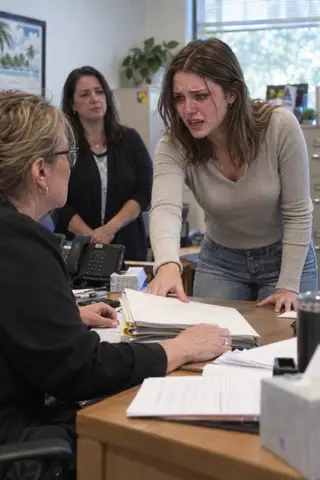
 She Thought Her 20th DCF Report Would Die Quietly
Chapter 1
The Mirror and the Black Eye
The morning light filtering through the small bathroom window of our upscale suburban Florida home did nothing to soften the brutal reality staring back at me from the glass. I was fourteen years old, and my face was a canvas of physical abuse. One eye was swollen shut, dark purple and blue blooming across the socket, while my scalp throbbed with a dull, sickening ache where my mother’s fingers had ripped through my hair the night before. I stood there, clutching the edge of the sink, desperately trying to calculate if there was any angle, any lighting, any magical combination of excuses that would make a teacher or classmate look at me and think, Oh, she just bumped into a door.
It sounds profoundly ridiculous now, looking back from my apartment in St. Augustine, Florida, where I am twenty-one and finally building a life of my own. But trauma has a way of warping your perception of normal. When something catastrophic and violent has been your baseline for nearly half your childhood, even the morning your entire world is set to detonate begins with mundane tasks like brushing your teeth and wondering if you should wear your hair down to cover the bruises.
The catalyst for the night before had been absurdly trivial: a pack of mint gum and a confiscated vape. I know how that sounds to anyone who has raised a teenager. If you are a parent reading this, you are probably rolling your eyes at the mention of the vape, and honestly, fair enough. Fourteen-year-old me was far from a saint. I lied sometimes, hid things from my parents, made stupid rebellious choices, talked back, and possessed that quintessential teenage superpower of interpreting basic household rules as cruel and unusual punishment.
However, there is an infinite, unbridgeable chasm between being a difficult, rebellious teenager and being a child who deserved to be physically battered, locked away, and systematically terrorized. I just didn't understand that distinction yet. To a kid trapped inside an abusive environment, every punishment feels earned because the abuser constantly reinforces the narrative that you are the architect of your own misery.
The argument had escalated with terrifying speed. My mother, a woman who maintained a pristine, respectable public facade that fooled our entire neighborhood, snapped. She dragged me across my bedroom floor by my hair, raining blows down upon my head and face in a frenzy that felt entirely devoid of human empathy. When it finally stopped, I didn't scream or fight back. I didn't even cry anymore. I just sat on the cold floor in total, suffocating silence.
There is a precise moment in an abused child's mind when fear becomes so deafeningly loud that the exterior world goes dead quiet. In that stillness, sitting amidst the wreckage of my bedroom, a single, crystal-clear thought crystallized in my mind: I can't do this anymore.
It wasn't even the first time I had been terrified of her. My earliest memories of this targeted cruelty stretched back to when I was roughly six years old. I had begun to notice a glaring discrepancy in our household: whatever patience, grace, or parental warmth existed in my mother seemed to evaporate entirely the moment it reached me. My younger siblings, who occupied rooms down the hall, lived in a completely different reality. They were mothered, protected, and nurtured, while I was treated like an unwelcome intruder in my own home.
From the outside looking in, our family was the epitome of suburban success. We lived in a spacious, beautifully decorated house in a quiet neighborhood. We had nice clothes, upscale cars, and financial stability. No casual observer walking past our house would ever have guessed that psychological torture and physical deprivation were happening behind closed doors. That stark contrast deeply confused me for years. I had internalized the societal myth that abused children only come from chaotic, impoverished, visibly broken homes. I thought that because our lawn was manicured and our pantry was full, my suffering must somehow be illegitimate—or worse, my own fault.
And then there was my room. During the worst periods, my bedroom functioned as a domestic prison cell. I experienced stretches of time where I was locked inside with none of the basic comforts society assumes every child is entitled to. No proper mattress—sometimes just a thin, scratchy blanket thrown directly onto the hardwood floor. No reliable access to artificial lighting. Long hours, sometimes entire days, stretching out without easy access to food, water, or the bathroom.
Those cruel bouts of isolation taught me a bizarre, hyper-vigilant set of survival mechanisms. I learned the agonizing physics of time dilation—how excruciatingly slow an afternoon crawls when your stomach is hollow with hunger and your throat is dry. I learned that hearing the muffled sounds of normal life—voices, laughter, television—echoing from another part of the house was infinitely more agonizing than absolute silence. Hearing them live on reminded me of everything I was being excluded from, casting me out into a desolate wasteland of total isolation while the rest of the world kept spinning.
The psychological toll of being the family scapegoat is profound. Because my siblings were treated with relative kindness, I fell into the trap of believing that I was fundamentally broken. I convinced myself that I was simply the toxic element in our family dynamic. Maybe I talk too much, I would tell myself late at night in the dark. Maybe I'm just inherently unlovable. Maybe my brothers and sisters instinctively know how to behave to keep the peace, and I'm just too defective to figure it out.
Children possess an astonishing, heartbreaking capacity for self-blame. We will bend our logic into impossible pretzels, inventing elaborate theories about our own wickedness, simply to avoid confronting the terrifying alternative: The adult entrusted with my protection is profoundly, dangerously wrong. Admitting that my mother was abusive meant admitting that the world was fundamentally unsafe. Blaming myself, on the other hand, offered a sliver of false hope. If I was the problem, then theoretically, I could fix myself. If I could just become quieter, more obedient, more invisible, maybe the violence would stop.
So I tried it all. I tried being a ghost. I tiptoed through the hallways, memorized which floorboards creaked so I could avoid them, swallowed my opinions, and forced myself into compliance. But inevitably, I would slip up. I would act like a normal, imperfect fourteen-year-old child, and the illusion of safety would shatter instantly. The cycle would begin anew.
What made my situation uniquely hopeless, however, wasn't just my mother's wrath—it was the impenetrable armor she had built around her abuse through the Florida Department of Children and Families (DCF). By the time I stood in front of that bathroom mirror with a bruised eye, DCF had already been called to our house roughly twenty times over the course of my childhood.
Twenty separate investigations. Think about that number. Twenty times, trained professionals had crossed our threshold. Twenty times, questions had been asked, stern looks had been exchanged, and clipboard-wielding caseworkers had surveyed our clean house and comfortable lifestyle. And every single time, the case had eventually been closed with zero protective action taken.
How did my mother pull it off? She was a master manipulator. She knew how to turn on the charm for caseworkers, presenting herself as an exhausted, well-meaning mother dealing with a "defiant, troubled teenager." More than that, I came to realize over the years that she had systematically manipulated, pressured, and likely bribed or coached my younger siblings into backing up her version of reality during private interviews. When investigators spoke to them, they parroted the script my mother had engineered.
To a fourteen-year-old girl, watching twenty investigations evaporate into thin air taught me a chilling, definitive lesson: Telling the truth is entirely useless.
The system was broken, adults were easily fooled, and my mother was untouchable. After the tenth or fifteenth closed case, I stopped expecting rescue altogether. I abandoned any fantasy of intervention. My strategy shifted entirely from seeking help to pure, unadulterated endurance. My only job in life was to keep my head down, survive the remaining four years until my eighteenth birthday, and run as far away as humanly possible the second I became legally emancipated.
And then came the gum, the vape, and the black eye.
Something inside my psyche snapped that night. The resignation I had spent years constructing like a concrete bunker finally fractured under the weight of the physical violence. I wasn't sitting on that bedroom floor plotting elaborate acts of revenge. I wasn't dreaming of seeing my mother dragged away in handcuffs, nor was I fantasizing about a dramatic courtroom scene where everyone finally stood up and applauded because I had been proven right all along.
I wanted one thing, and one thing only: distance.
I didn't care where they put me if things finally blew up. Foster care, a chaotic group home, a sterile residential placement facility with plastic mattresses, institutional fluorescent lighting that buzzed monotonously through the night—take your pick. The terrifying unknown of the outside world had officially become infinitely less frightening than staying another second under my mother's roof.
That realization terrified me almost as much as the beating itself, because of a deeply complicated, universally misunderstood truth of abuse: I still loved my mother.
That is the element of these stories that outsiders struggle to comprehend. Abuse is rarely black-and-white. There wasn't an internal switch labeled "LOVE MOM" that could be flipped off permanently every time she terrified or degraded me. I still craved her approval with every fiber of my being. I still longed for those rare, unpredictable moments when she would soften, stroke my hair, and make me feel cherished. Deep down, despite all the evidence to the contrary, I still held onto a pathetic, flickering hope that some future version of us would emerge where all the pain could be explained away, forgiven, and repaired.
Even on that dark morning, standing in front of the mirror with a swollen face, my internal monologue wasn't I never want a mother again. It was simply, I just want my mother to stop hurting me. Those two wishes, in the mind of an abused child, are agonizingly, heartbreakingly distinct.
I barely slept a wink that night. The adrenaline humming through my veins kept me wide awake, a toxic cocktail of terror, grief, and a newly minted, fragile spark of resolve. As dawn broke, I got dressed for school, my eyes repeatedly darting back to the mirror to inspect the damage. I briefly debated staying home from school to hide my face, but logic quickly intervened. Staying home would trap me in the house with her, blowing up the fragile momentum of my desperation.
So, I grabbed my backpack, walked out the front door into the crisp morning air, and felt my heart hammer against my ribs with enough force to make me physically nauseous.
Arriving at school felt like landing on an alien planet. To everyone else around me, the morning was offensively, excruciatingly normal. Kids clustered near the lockers, complaining loudly about upcoming algebra assignments or laughing over weekend gossip. A group of girls stood near the courtyard entrance, digging through backpacks while gossiping about lunch plans.
I stood paralyzed on the edge of the concrete walkway, seized by a profound, jarring contradiction that would echo through my life for years: How can none of these people tell what my life is like? followed immediately by an overwhelming wave of panic: Please, God, don't let a single one of them notice.
I wanted someone to see me. I was utterly terrified that someone actually would.
And then, cutting through the morning noise, a tall figure in a crisp uniform stepped into my field of vision. It was the school deputy. His sharp, trained eyes scanned the courtyard, paused instantly, and locked onto my face. The color of my skin around my right eye seemed to flash like a neon sign under the Florida sun.
He walked straight toward me, his expression hardening into professional alertness.
“What happened to your face?” he asked, his voice low, steady, and entirely devoid of the casual chatter filling the rest of the courtyard.
I froze. Years of muscle memory kicked in instantly, bypassing my brain and firing off the automated, rehearsed script I had used to deflect suspicion a hundred times before. I opened my mouth to deliver some vague, useless lie about walking into a door handle or tripping over a dog.
He didn't blink. He didn't nod and walk away. He simply closed the distance between us, looked me dead in the eyes with an unyielding intensity, and asked the question a second time, slower and with absolute authority:
“What happened to your eye?”
Something inside my soul gave way. Maybe it was sheer exhaustion. Maybe I had mentally rehearsed telling the truth a thousand times during the long, sleepless night. Or maybe, just maybe, I had finally crossed the threshold where the part of me desperate to survive outweighed the instinct to protect everyone else's dirty secrets.
I swallowed hard, the words tasting like ash in my mouth.
“My mom did it.”
The End









