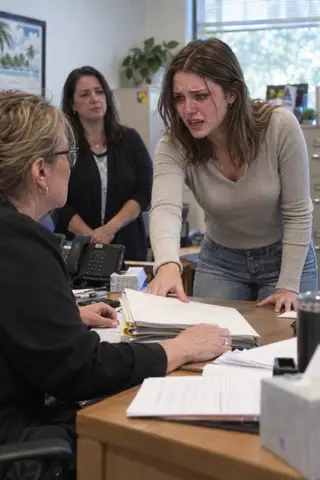
 She Thought Her 20th DCF Report Would Die Quietly
Chapter 4
The Ghost in the System
The morning sun filtered through the reinforced glass of Room 14, casting a pale, geometric grid across the linoleum floor. I woke up not to the shrill, terrifying sound of my mother pounding on my bedroom door, but to the soft, rhythmic click-clack of heavy keys turning in the hallway locks.
Breakfast at Beach House was a predictable affair—scrambled eggs that tasted distinctly of powdered mix, toasted white bread, and coffee that smelled like roasted asphalt. I sat at the same corner table with Maya, who slid a carton of chocolate milk across the laminate surface without a word of greeting. We ate in comfortable silence, a tacit understanding developing between us that neither of us was obligated to pretend everything was fine.
Midway through breakfast, the heavy double doors of the dining hall swung open, and Brenda appeared with a yellow clipboard tucked firmly under her arm. She scanned the room, spotted my messy brown hair across the table, and gave me a sharp nod.
“Morning, kiddo,” Brenda announced as she approached our table. “Finish up your tray. You’ve got a visitor waiting in Interview Room A. Case coordinator from DCF wants to touch base.”
My stomach gave a violent, involuntary lurch. The word DCF had been burned into my nervous system like a branding iron. For years, the Department of Children and Families had represented an empty promise—a revolving door of well-dressed strangers who came, asked uncomfortable questions, wrote cryptic notes on clipboards, and ultimately packed up their briefcases and left me right back where I started.
“Am I in trouble?” I asked, my voice tightening defensively as I pushed my half-eaten eggs away.
Brenda stopped, her expression softening into a sympathetic look that softened the harsh lines of her uniform. “No, sweetheart, you’re not in trouble. But this is where the real work starts. Take a deep breath. You’ve got an advocate this time around.”
I stood up, wiping my palms nervously against my jeans, and followed her down the labyrinthine corridors of the facility. The air inside Interview Room A was frigid, smelling strongly of commercial lemon cleaner and damp carpet. Sitting at a small metal table was a woman in her late thirties with sharp, intelligent eyes behind wire-rimmed glasses and a neat blazer. Stacks of manila folders towered beside her—folders bearing my last name, thick with years of bureaucratic history.
“Have a seat, Chloe,” she said, her voice smooth and professional, indicating the metal chair opposite her. “My name is Investigator Sarah Miller. I’m assigned to your case file moving forward.”
I sat down slowly, keeping my hands clenched tightly in my lap to hide my shaking fingers. “Is my mom here?”
“No, your mother is not here,” Investigator Miller replied evenly, opening the topmost folder to reveal a dizzying maze of typed reports, handwritten interview transcripts, and polaroid photographs. “And based on the emergency injunction filed late last night by the juvenile court judge, she won’t be dropping by anytime soon. You are officially under state protective custody.”
The words hung in the air, dense and heavy. State protective custody. It sounded like something out of a crime thriller, entirely divorced from my actual life.
“How many cases?” I blurted out suddenly, unable to stop myself.
Investigator Miller paused, looking up from her papers with a quizzical frown. “Pardon?”
“How many DCF cases are in those files?” I gestured toward the towering stack of manila folders with a flick of my chin. “My mother always bragged—well, not bragged, but made it clear—that there were tons of them. I remember counting roughly twenty over the years. Are they all in there?”
Miller let out a long, slow breath, running a hand across her forehead as she looked at the towering stack of documentation. She didn't offer a sugarcoated corporate denial. She didn't try to protect the agency's institutional pride. She looked me straight in the eye with brutal, unvarnished honesty.
“Nineteen, to be exact,” Miller said quietly. “Nineteen separate investigations, spanning back nearly eight years. Reports called in by neighbors, anonymous tips, a couple flagged by middle school guidance counselors when you were younger. You have one of the most thoroughly documented, chronically mishandled paper trails this district has seen in a decade.”
A cold spike of vindication shot through my chest, instantly followed by a wave of crushing despair. “Nineteen,” I whispered. “And every single one of them got closed. Nothing ever changed. Why should I believe this time is any different?”
It was a fair question, and Miller knew it. She closed the folder deliberately, clasping her hands on the table and leaning forward so she was entirely within my field of vision.
“You shouldn't just take my word for it,” Miller said firmly. “Systems fail children every single day. Caseworkers get overloaded, parents learn how to game the system, and kids fall through the cracks because it's easier to close a file than to fight an uphill legal battle against a wealthy, articulate parent who knows how to play the respectability game.”
She paused, letting her words sink in before continuing.
“What makes this time different, Chloe, is two things. First, you finally walked out of that house and gave a law enforcement officer physical evidence he couldn't ignore—a fresh, unmistakable black eye that completely destroys the illusion of a happy, perfect household. Second, you are old enough now, and articulate enough, that the court can no longer pretend your testimony is just the product of a 'defiant teenager' acting out.”
I stared down at the metal table, tracing the faint scratches in the paint with my fingernail. “What about my siblings?” I asked, my voice dropping to a vulnerable whisper. “My brothers and sisters are still in that house. What happens to them now that I’m gone?”
Miller’s expression shifted, hardening slightly with professional resolve. “When we took you into emergency protective custody yesterday afternoon, protocol required us to dispatch a secondary welfare check team to your family home. They spoke with your mother, inspected the premises, and conducted brief wellness interviews with your siblings.”
My heart skipped a beat, stalling entirely in my chest. “And? What did they say? Did my mother lie to them again? Did my siblings cover for her?”
Miller let out a heavy sigh, flipping open a secondary, much thinner folder. “Your mother tried her usual routine—played the grieving, misunderstood parent whose rebellious daughter ran away and fabricated stories for attention. But this time, things didn't go according to her script.”
I leaned forward, my knuckles turning white as I gripped the edge of the table. “What do you mean?”
“When our investigators interviewed your younger sister Maya—wait, sorry, your sister Lily—alone in the kitchen away from your mother's direct line of sight,” Miller explained carefully, “she didn't recite the usual rehearsed talking points. She broke down crying. She told our team about the locked doors, the screaming, and the terrifying atmosphere that settled over the house every single time your mother targeted you.”
The room seemed to tilt on its axis. A rush of hot tears pricked the backs of my eyes, blurring the sharp lines of the metal table.
“She... she told the truth?” I choked out, a sob catching painfully in my throat.
“She did,” Miller confirmed softly. “And because of Lily’s statement, combined with your medical evidence and the massive historical paper trail in these files, the judge didn't just issue an emergency custody order for you. Late last night, a judge signed an emergency pickup and protective custody warrant for your younger siblings as well.”
I froze, my breath catching in my throat. “You... you removed them too?”
“They are currently being processed into a temporary sibling group foster placement over in Orlando,” Miller said gently. “They are safe, Chloe. They are out of that house.”
A profound, earth-shattering wave of relief crashed over me, so powerful that it physically knocked the wind out of my lungs. For the entire night, I had carried the suffocating burden of guilt, believing that my escape had thrown my siblings into the jaws of the monster. Knowing that they were out, that they were safe, and that my little sister had finally found the courage to speak the truth shattered the last remaining walls of defense around my heart.
I buried my face in my hands and wept—not tears of trauma, fear, or despair, but the long-overdue, purging tears of a kid who had finally realized she wasn't alone in the dark anymore.
The End









