 She Texted Her Dad Her Retirement Papers After 36 Years
Chapter 5
The Rising Tide
The wedding processional ground to a complete, dead halt.
Music continued to pour from the organ pipes overhead, but the human machinery of the ceremony stuttered and broke. Guests in the first ten rows, realizing that major military figures around them had suddenly frozen and saluted the empty air at the back of the church, began turning around in droves to see what had commanded such absolute, spontaneous deference.
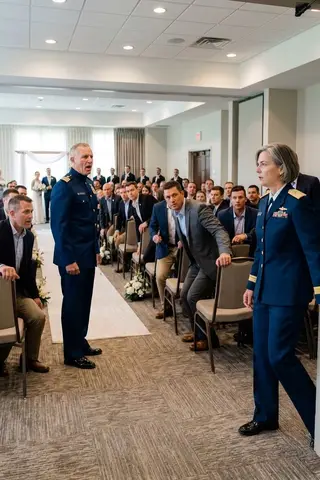
One by one, the men and women who understood what those four silver stars actually represented stood up.
A retired Navy captain in the fifth row stood, his heels clicking together, and saluted.
A former Chief of Naval Operations—attending as a guest of the diocese—rose from his seat near the front, turned around, and brought his hand to his brow.
Within thirty seconds, half the congregation on the bride’s side—lawyers, businessmen, defense executives, and retired service members who knew the hierarchy of the flag—were standing at attention.
My father stood frozen in the middle of the center aisle, his arm still linked with Melanie’s, his face turning an alarming shade of mottled crimson. He looked back toward the rear of the church, his eyes frantically searching for whatever visiting dignitary or foreign head of state had just hijacked his daughter’s wedding.
Instead of a foreign president or a cabinet secretary, his eyes landed on me.
I was sitting calmly by the stone pillar, my hands folded neatly over my lap, my white uniform glowing in the dim light of the historic nave. I didn't smile. I didn't wave. I simply looked back at him with the calm, immovable gaze of someone who had weathered typhoons in the Philippine Sea and stared down hostile delegations across negotiating tables in Geneva.
My mother, sitting in the third row, let out a tiny, audible gasp that sounded like a dry leaf scraping across concrete. She grabbed the edge of the wooden pew so hard her knuckles turned white.
"What is she doing here?" my father hissed under his breath, loud enough for the microphone clipped to the officiant’s lapel to pick up a faint, sharp echo through the church’s sound system. "Who invited her to do this?"
Before anyone could answer, the heavy oak doors at the back of the church—the ones leading out into the bright Charleston sunlight—swung completely open with a heavy, deliberate crash.
The organ music suddenly stopped, cut off mid-measure by the organist, who had turned around on her bench to see what was happening at the entrance.
A cold, salty breeze swept into the nave, carrying the distant smell of the harbor and the unmistakable sound of heavy leather boots hitting the stone steps outside.
One by one, in absolute silence, figures in dark uniforms and civilian suits began pouring through the doorway.
The End









