 She Texted Her Dad Her Retirement Papers After 36 Years
Chapter 4
The Back Pew
St. Michael’s was packed to the wooden rafters. The air was thick with the scent of white lilies and burning candles, and the low murmur of fashionable chatter filled the historic nave like the buzzing of a giant golden hive.
I didn't walk down the center aisle. I wasn't part of the wedding party, and I had no desire to trigger another cardiac event from my mother in the front row. Instead, I slipped quietly through the side door near the back and took a seat in the very last pew, right beside a stone pillar that partially shielded me from the view of the altar.
From my position, I could see the entire congregation spread out before me like a vast, colorful quilt of privilege.
In the third row on the bride's side sat my father. He looked distinguished in his custom-tailored charcoal tuxedo, his silver hair brushed back, leaning over to whisper something to Senator Henderson—a tall, white-haired man with the practiced, benevolent smile of a seasoned politician. My mother sat beside them, her posture stiff as a ramrod, staring straight ahead at the white floral arrangements framing the altar as if willing herself not to look back toward the rear of the church.
A few rows ahead of them sat General Vance, the retired four-star, wearing a dark suit with his old airborne lapel pin catching the candlelight.
The organ music shifted, moving into the triumphant, rolling chords of Clarke’s Trumpet Voluntary.
The congregation rose in a rustle of silk, linen, and wool. Heads turned toward the heavy oak doors at the back of the church as the bridesmaids began their slow, measured march down the central aisle, followed by the groomsmen in their sharp black tuxedos.
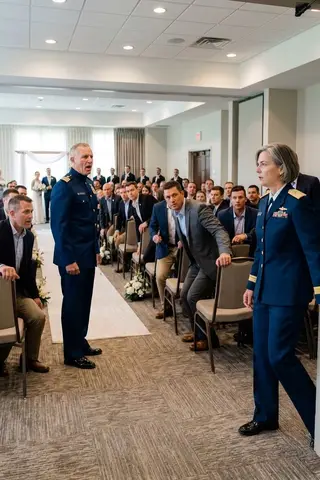
I remained seated by my pillar. At my height and with the white uniform standing out sharply against the dark oak of the pews, I was invisible to the front rows, but anyone turning around to look at the procession would have seen me instantly.
Which was precisely what happened when Melanie appeared at the back of the church on the arm of our father.
She looked radiant. Her lace veil caught the light, and her smile was wide and genuine as she took her first steps down the aisle. My father walked beside her, chest puffed out slightly, playing the proud patriarch of a successful, well-heeled Charleston family.
Halfway down the aisle, a groomsman—a young corporate lawyer friend of the groom—turned his head to check the back rows for late arrivals.
His eyes landed on the white uniform near the back pillar.
He didn't just look; he froze. His military posture, honed during four years at West Point before he traded olive drab for corporate mergers, instantly took over. His hand snapped to a crisp, instinctive salute before he caught himself and dropped his arm, his face turning pale as he nudged the groomsman beside him.
Within seconds, a ripple effect moved through the middle rows of the church.
Senator Henderson turned his head to see what was happening behind him. His eyes scanned the congregation, caught the four silver stars gleaming on my shoulders, and his expression instantly shifted from politician-casual to absolute, unadorned reverence. Without hesitation, the senior senator from South Carolina turned his entire body away from the altar, came to attention in the middle of the aisle, and snapped a sharp, textbook salute toward the back pew.
My father, confused by the sudden movement of his powerful guest, stopped walking.
"Arthur, what are you—" my father muttered, turning to look at the senator.
Senator Henderson didn't answer him. He was looking straight past my father, his eyes locked onto mine.
Then General Vance, standing two rows ahead, spun around, saw the uniform, and immediately came to attention, raising his right hand in a salute that looked like it had been practiced on the parade grounds of West Point forty years ago.
The End









