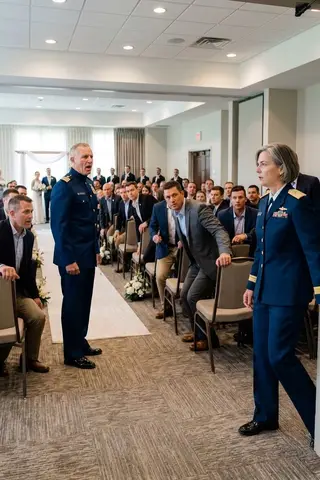
 She Texted Her Dad Her Retirement Papers After 36 Years
Chapter 1
The Weight of Brass
The rain against the reinforced glass of my office at Naval Station Norfolk sounded less like water and more like bird shot. It was a heavy, relentless Atlantic squall, the kind that turned the harbor into a churning mass of gray foam and made every ship at anchor look like a ghost standing in the mist. I sat behind a massive oak desk that had belonged to three admirals before me. On the blotter lay the final document of my professional existence. A single signature in black ink.
My right hand held the fountain pen. It was a heavy thing, solid brass with a brushed steel nib, a gift from the crew of the USS Enterprise when I made captain twelve years ago. My fingers had calluses along the first knuckle from decades of gripping clipboards, heavy weapons, and the rails of bridge wings during high-sea maneuvers. They did not shake. I had steady hands; they were the reason I had survived command during the tense days of the Western Pacific patrols and the midnight flash-traffic briefings in rooms with no windows.
My phone buzzed against the polished wood.
It was a sharp, vibrating rattle that cut through the low, ambient hum of the Navy-issue desktop computer and the howling wind outside. I didn't look up right away. I finished dotting the i in Bennett, making sure the stroke was crisp and deliberate. Thirty-six years. Ten thousand four hundred and ninety days of uniforms, inspections, courts-martial, promotion boards, deployments, and Christmas mornings spent in five-inch combat boots thousands of miles from any tree.
When I finally reached for the phone, the screen glowed in the dim light of the coastal storm.
Dad.
My thumb swiped the screen, expecting the usual awkward pleasantries about weather or the local high school football team's prospects. Instead, six words sat in a pale blue bubble against the dark background:
No one gives a damn about your Navy career.
The sentence didn't hit me like a physical blow. It hit me like cold water dropped down the back of a shirt. It was small, sharp, and entirely familiar. It was the voice I had grown up with at the dining room table in Annapolis, Maryland, forty years ago, back when my father’s ambitions for me consisted entirely of finding a nice lawyer from the Naval Academy faculty to marry and settling down into a four-bedroom colonial with a white picket fence.
I stared at the screen until the display dimmed into blackness.
"Ma'am?"
Commander Vance stood in the doorway, his cover tucked neatly under his left arm, his service dress blue uniform immaculate despite the weather outside. He was thirty years younger than me, sharp-eyed, and carrying a leather folder containing my retirement orders and the folded flag that would be presented during a quiet ceremony on Monday morning.
"Is everything in order, Admiral?" he asked, his voice carefully neutral. He had served under me through two carrier strike group deployments. He knew the look of a commander who had just received bad intelligence.
"Everything is in order, Vance," I said, my voice dropping into that low, flat register that usually made junior officers check their tie knots. I picked up the pen and set it beside the blotter. "The Navy is officially rid of me as of midnight."
"The Navy isn't rid of you, ma'am. They're just losing your phone number," Vance replied with a faint, respectful smile. He stepped forward and laid the leather folder on the desk. "Your car is downstairs. Staff Sergeant Miller is waiting by the sedan. Are you heading straight to Charleston for the weekend?"
Charleston. The historic city of cobblestone streets, magnolias, and, as of tomorrow afternoon, my youngest sister Melanie’s wedding at St. Michael’s Episcopal Church.
"Yes," I said, standing up and smoothing the skirt of my uniform. I was wearing my service khakis for one of the last times. The ribbons above my left pocket—the Legion of Merit, the Defense Distinguished Service Medal, the Southwest Asia Service Medal with three bronze stars—felt heavy against my chest. They always felt heavy when I was around my family. To them, those ribbons weren't milestones of leadership or survival; they were foreign language certificates from a country they had never visited and didn't care to understand.
"Have a good weekend, Admiral," Vance said, offering a crisp, textbook salute.
I returned it, my hand snapping up to the brim of my cover with the mechanical precision of a machine that had been running for nearly four decades. "Thank you, Vance. Keep the ship pointed into the wind."
"Always, ma'am."
I walked out of the office and down the long, linoleum-floored corridor of the command building, my heels clicking a sharp rhythm that echoed off the pale green walls. Every sailor I passed stopped, pressed their backs against the bulkhead, and saluted. I nodded to each of them. They were twenty years old, nineteen years old, kids with wet behind their ears who looked at four-star insignia the way medieval peasants must have looked at a cathedral spire. They didn't know me personally, but they knew the stars. They knew the weight.
My father, however, had known me since I was six years old, and to him, those stars were just tin stuck on wool.
The End









