 She Texted Her Dad Her Retirement Papers After 36 Years
Chapter 2
The Ghost of Annapolis
The drive down to Charleston through the coastal flats of North Carolina and South Carolina was a blur of gray asphalt, pine forests, and weeping willows dripping with Spanish moss. The rain followed me most of the way, drumming a steady, hypnotic rhythm against the roof of the government sedan while Miller kept his eyes fixed on the road ahead. He didn't try to make small talk. Good drivers don't, and good military drivers know when an admiral is running on three hours of sleep and a lifetime of stubbornness.
By the time we pulled up to the curb of the historic boutique hotel off King Street in downtown Charleston, the sun was trying to break through the western clouds, casting a bruised, purple-and-gold light across the old brick facades.
My phone buzzed again as I stepped out onto the damp sidewalk.
This time it was my mother.
Please don’t upset your father this weekend. Melanie deserves peace. Just wear something normal, Claire. Not that... thing.
I stopped with one foot on the hotel’s stone threshold, the brass handle of my suitcase cold against my fingers. That thing. She meant the white wool service dress uniform hanging inside the heavy garment bag stretched across the back seat of the sedan.
When I was seventeen, sitting at the mahogany dining table under the dim glow of a brass chandelier, I had told my parents that I had received my appointment to the United States Naval Academy. I had thought my father would stand up and cheer. I was his eldest child; I had spent my high school years reading naval history, sailing small-hull sloops on the Chesapeake, and running five miles every morning before school just to prove I could keep pace with the boys.
Instead, my father had dropped his fork against his porcelain plate with a sharp clatter.
"Women don’t belong on warships," he had said, his voice cold and flat, the tone of a man who worked forty years in municipal insurance and believed the world operated according to a neat, predictable ledger.
My mother had nearly dropped the CorningWare casserole dish she was carrying from the kitchen. My younger sister, Melissa, who was fifteen at the time and already planning her debutante cotillion, had giggled behind her napkin before coughing into her ginger ale.
"You’ll grow out of this phase, Claire," my father had muttered, picking up his napkin and dabbing at his mouth as if the subject had been thoroughly dealt with and dismissed. "Girls from good families go to Sweet Briar or William & Mary. They don't go play sailor with a bunch of grease-monkeys in Maryland."
I didn't grow out of it. That was my primary flaw, according to the Bennett family registry. I lacked the good grace to fail. When plebe summer nearly broke my hip during an obstacle course run, I didn't quit; I crawled across the finish line and spent the rest of the semester marching with a taped pelvis. When I graduated in the top ten percent of my class, my parents attended the ceremony because it was expected, but they sat three rows back from the other families, looking through their programs as if they were waiting for a boring local theater production to conclude.
Over the next thirty-six years, my career became a series of ghost stories told around family dinner tables during the rare holidays I managed to attend.
“Claire is in the Mediterranean again.”
“Claire missed Thanksgiving because some ship in the Persian Gulf caught fire.”
“Claire is too old to still be running around on those gray boats; she needs to settle down and find a nice man who can support her.”
They never asked about the strategy meetings in the Pentagon. They never asked about the night our destroyer took a near-miss from an anti-ship missile off the coast of Yemen, or the twenty-four hours I spent on the bridge without sitting down while my crew fought a major electrical fire below decks. To them, my life was an inconvenience—a jagged, unpolished stone that didn't fit into the polite, country-club mosaic of their retirement years in Charleston.
I checked into my hotel room, dropped my sea bag by the closet, and unzipped the garment bag.
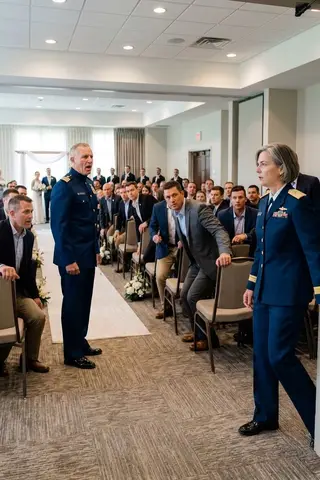
Inside hung the white wool jacket with the gleaming gold buttons, the black trousers with the gold lace running down the outer seams, and the four silver stars pinned meticulously to the shoulder boards. It was a masterpiece of tailoring, designed to look both ancient and modern, a uniform that carried the ghost of every admiral who had ever walked the quarterdeck since the days of John Paul Jones.
My phone rang while I was standing there, the screen flashing the name of Master Chief Jack Hayes, Retired.
I hit speaker and laid the phone on the mahogany dresser.
"Jack," I said.
"You’re in Charleston," he stated. It wasn't a question. Jack had a voice like gravel sliding down a galvanized pipe—the sound of thirty years in Naval Special Warfare, jumping out of C-130s into black water and spending weeks behind enemy lines with a radio and a prayer.
"I just checked into the hotel," I replied, walking over to the window to look down at the horse-drawn carriages clattering past on King Street. "The weather is clearing. Should make for a lovely wedding photo session tomorrow."
"You still planning on wearing the whites?"
I looked back toward the closet. The white jacket seemed to glow in the dim light of the hotel room. "My mother texted me an hour ago begging me not to 'humiliate' the family by showing up in uniform. My father sent me a lovely note yesterday reminding me that no one gives a damn about my career."
There was a long silence on the other end of the line. I could hear the faint sound of waves in the background—Jack lived down in Virginia Beach, right near the Little Creek amphibious base, where the ocean was always a presence.
"Claire," Jack said, his voice dropping into that quiet, gravelly gear he used when he was about to brief a platoon before a high-risk extraction. "You really don't know who's attending this shindig, do you?"
"It’s Melanie’s wedding. Her fiancé is some corporate lawyer from Atlanta whose father owns half the real estate in Georgia. I assume it’s going to be a sea of seersucker suits and pastel dresses."
Jack let out a low, gravelly chuckle that sounded like a diesel engine turning over on a cold morning. "Yeah, the lawyer’s family is there. But your sister’s future father-in-law, old Senator Henderson, is on the Senate Armed Services Committee."
I froze. "Senator Henderson? Arthur Henderson?"
"The very same," Jack said. "And the groom’s uncle is General Vance—the four-star who used to run TRANSCOM before he retired three years ago. Plus, half the defense contractors in the mid-Atlantic are flying down because Henderson is hosting a private reception at the Yacht Club tonight."
My hand tightened on the window frame. "Nobody told me."
"Of course they didn't," Jack snorted. "Your family thinks your job is something you do in a basement with maps, Claire. They don't understand that the world they live in—the cocktails they drink, the property values in Charleston, the safe little bubble where your dad plays golf every Tuesday—is held together by people like you who spent forty Christensens eating cold MREs on steel decks so they could complain about the price of beef."
I looked at the white uniform again.
"Don't walk into that church trying to make them comfortable," Jack said softly. "Your father may not give a damn about your Navy career. But tomorrow afternoon, he’s going to find out exactly who does."
The End









