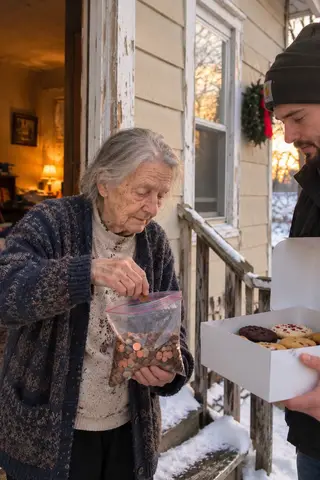
 She Paid For A $14 Pizza With A Bag Of Pennies
Chapter 2
The Pharmacy Receipt and the Hidden Truth
"What’s your name?" I asked, stepping closer.
"Margaret," she replied, taking a small, tentative bite of her slice.
"Margaret, do you have any family nearby?"
Her fragile smile vanished instantly. The air in the room felt even colder. "My husband passed away nine years ago."
"Children?"
"One," she whispered, staring blankly at the steaming pizza box. "My son died before his father."
I immediately cursed myself internally. "I’m so sorry."
She offered a slow, stiff nod. "A car crash. He was thirty-eight years old."
For a long moment, the only sound in the house was the furnace—or what passed for a furnace—clicking uselessly and hollowly beneath the wooden floorboards. Then, Margaret straightened her shoulders slightly and uttered the four most dangerous words in the English language: "I manage."
People say that phrase when they are barely treading water. They also say it when they are actively drowning.
My eyes drifted back to the open kitchen and the pharmacy bag sitting inside the refrigerator. "Did you actually get your medicine, Margaret?"
Her expression shifted instantly, growing defensive. "Yes."
The response came a fraction of a second too fast. It sounded rehearsed.
I took a step past her into the kitchen. "May I?"
"There's no need—"
"Margaret."
She hesitated, looking thoroughly embarrassed and defeated. Finally, she gave a microscopic nod of permission. I walked over and picked up the pharmacy bag from the wire shelf. The staples holding the top shut had never been pierced or removed. A white receipt was firmly taped to the side.
I pulled it closer to the dim kitchen light and read the bold print:
BALANCE DUE: $186.40
The medication wasn't inside the bag at all. The bag contained only paperwork, billing statements, and insurance denial notices. She had walked all the way to the pharmacy, or arranged a grueling ride, only to find out she couldn't afford the co-pay. She had walked home empty-handed.
I spun back around to face her. "You told me you were saving for your heart pills."
"I am," she murmured defensively.
"How much do you actually have?"
She pointed a frail finger toward an old, dented coffee tin sitting on the cluttered counter. I walked over, popped the lid off, and peered inside. Twenty-three dollars and forty cents. Mostly loose change, pennies, and grimy dimes.
A heavy iron weight crushed down on my chest. "How long have you been without them, Margaret?"
"Daniel—"
"How long have you gone without your medication?"
She dropped her gaze to her lap, refusing to look me in the eye. "Five days."
Panic flared in my chest. I didn't know the exact pharmacology of whatever heart condition she had, but combining the phrases "heart pills" and "five days without them" spelled out a catastrophic medical emergency waiting to happen.
"Margaret, I need to call someone right now."
Her eyes widened in absolute terror, flashing with sudden energy. "No!"
"Your doctor, or the pharmacy, or—"
"No ambulance!" she cried out.
"I didn't say anything about an ambulance."
"Young people always start making phone calls, and suddenly old people stop being allowed to make their own decisions!" she snapped back with surprising steel.
That argument stopped me dead in my tracks. She looked straight into my eyes, fierce and dignified. "I’m poor. I’m not confused."
I exhaled slowly, lowering my shoulders. "You're right. That is an important distinction."
"What would you like me to do now, young man?" she asked quietly, looking down at the unopened pharmacy paperwork.
Then, she whispered something that completely broke my heart: "I'd like to eat my pizza while it's still hot."
So, I didn't call anyone. Instead, I pulled an old wooden chair away from the kitchen table, dragged it close to her recliner, and sat down.
She took another small bite of the pizza. Then another. And as she ate, we talked. Ten minutes into our conversation, she dropped a detail about her past that made me look at her, her house, and the entire neighborhood through an entirely different lens.
The End









