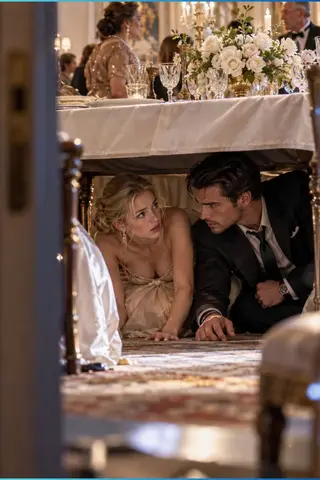
 She hid under a wedding banquet table to escape her matchmaking mother
Chapter 77
The White Hurricane
Two hours after the final titanium anchor was torqued into place, the mountain closed its gates.
The blizzard struck the Gotthard pass with apocalyptic ferocity. Winds exceeding one hundred miles an hour screamed through the peaks, driving blinding walls of whiteout snow that completely erased the valley below. The access roads were sealed under six feet of snowdrifts; the funicular railway was shut down for safety; and the Gotthard Nordwerk was transformed into an isolated island of granite and iron suspended in a roaring ocean of white.
Inside the powerhouse, however, the atmosphere was an astonishing sanctuary of warmth, light, and safety.
The Pelton turbine hummed with smooth, unyielding power, generating abundant electricity that powered the industrial space heaters and bathed the grand hall in a golden, incandescent glow. The newly unblocked drainage adits remained warm, safely carrying the freezing meltwater away from the stabilized viaduct.
In the center of the hall, near the massive cast-iron stove that had been fired with dry birch logs from the lower storage cellars, Director de Montval, his three federal inspectors, and Christian Delacroix sat huddled around a folding timber table.
Delacroix looked utterly defeated. His designer coat was damp and rumpled; his arrogance had evaporated entirely, replaced by the humiliating realization that the only reason he was alive in a sub-zero Arctic hurricane was the sheer technical brilliance of the family he had tried to destroy.
Frankie stood beside the cast-iron stove, casually stirring a large pot of rich, aromatic beef and potato goulash that was bubbling warmly over the wood fire.
“Eat up, Mr. Delacroix,” Frankie rumbled, ladling a generous portion into a tin bowl and setting it in front of the disgraced developer with deadpan hospitality. “It’s real beef and fresh potatoes. Up here at three thousand meters, you don't survive on hedge-fund dividends.”
Delacroix took the bowl with trembling hands, murmuring an embarrassed, quiet thank-you before devouring the stew like a starving man.
Across the room, Clara, Evelyn, and Rocco sat at an antique drafting desk beneath the soaring arched windows, watching the white hurricane rage against the heavy glass panes.
The glass rattled under the howling gusts, but behind the restored timber sashes and the newly stabilized granite walls, the structural integrity of the fortress was absolute.
Rocco leaned his chair back on two legs, his arm draped comfortably over Evelyn’s shoulders, his hand idly playing with the soft waves of her chestnut hair. In his other hand, he held a porcelain mug of strong black coffee.
“Seventy tons of snow on the roof trusses already,” Rocco remarked, his sharp eyes tracking the deflection of the larch crossbeams. “And the rafters haven't deflected by more than two millimeters. The nineteenth-century Swiss knew how to frame timber for snow loads.”
“They built it to carry the winter, Rocco,” Evelyn said softly, resting her hand over his knee, her green eyes reflecting the dancing firelight. “Just like we do.”
Clara looked up from her sketchbook, where she had been drafting the interior layout for the proposed high-altitude climate laboratory. She looked at her parents—at the unforced, beautiful intimacy that had weathered every corporate war, every political ambush, and every hostile storm for twenty-two years.
“Dad,” Clara asked softly, a playful spark returning to her tired gray eyes.
Rocco looked at his daughter, his expression warming instantly. “Yes, sweetheart?”
“When you were twenty-two years old, did you ever imagine you’d be trapped in an Alpine powerhouse during an avalanche blizzard with a Wall Street developer eating stew out of a tin can?”
Rocco chuckled—a deep, rumbling sound that drowned out the shrieking wind outside. He looked at Evelyn, his thumb gently stroking her jawline.
“At twenty-two, Clara, I was convinced my life would never be anything more than concrete highway contracts, warehouse ledgers, and lonely rooms,” Rocco said softly, his voice dropping into that raw, honest register that always took Evelyn’s breath away. “I didn't know what a real life was until a furious woman in a burgundy silk dress crawled under my banquet table and called me out on my half-eaten sandwich.”
Evelyn threw her head back and laughed—a sound so rich, free, and full of pure joy that even Director de Montval looked up from his stew with a soft, appreciative smile.
“And you’ve been paying for that sandwich ever since, Mr. Ventresca,” Evelyn whispered, leaning in to capture his lips in a sweet, lingering kiss that tasted of cedar smoke and eternal devotion.
“Gladly, Mrs. Ventresca,” Rocco murmured against her mouth. “Every single day.”
The End









