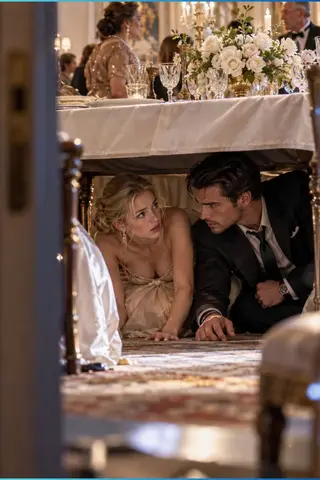
 She hid under a wedding banquet table to escape her matchmaking mother
Chapter 71
The Alpine Dispatch
The Mediterranean summer gave way to the sharp, biting clarity of an early Alpine autumn. In the quiet heights above Lake Lucerne, where the sheer granite peaks of central Switzerland pierced the icy sapphire sky, an extraordinary relic of European industrial ambition stood frozen in time: the Gotthard Nordwerk. Built in 1882 during the heroic era of trans-alpine rail engineering, the high-altitude hydroelectric powerhouse, foundry, and funicular cog-railway complex had once powered the construction of the legendary Gotthard Rail Tunnel. For fifty years, however, the fortress-like granite compound had sat abandoned above the snowline, clinging precariously to a jagged precipice three thousand meters above sea level.
Inside the quiet executive office of the Cantieri Florio in Palermo, where the salty breeze still stirred the linen curtains, Clara unfolded a thick, wax-sealed vellum dossier delivered by courier from Zurich. The dispatch was issued jointly by the Swiss Federal Office of Culture and the Canton of Uri, accompanied by a letter bearing the personal seal of the Swiss Federal Council.
“The Gotthard Nordwerk,” Clara read aloud, her gray eyes narrowing as she studied the crisp topographic contours. “The Swiss Confederation has declared the site an endangered monument of national significance. A devastating rockfall two winters ago sheared through the upper funicular viaduct, threatening to send forty thousand tons of granite masonry tumbling down onto the active international transit lines through the valley below. Private resort consortia want to dynamite the historic powerstation to build a luxury ski retreat for international oligarchs. But the Swiss alpine preservation trust wants a complete structural stabilization, converting the complex into a zero-emission high-altitude climate research observatory and historic apprentice lodge.”
Rocco stepped up behind her, holding two cups of steaming black tea. At fifty-six, the silver threading his dark hair gleamed under the warm Sicilian sun, but the power in his frame was as formidable as ever. He set a cup beside her drafting board and laid his heavy, tattooed hand across the Alpine contour map.
“The Gotthard pass was the graveyard of nineteenth-century engineering,” Rocco rumbled softly, his gravelly voice carrying an instinctive reverence for raw rock and iron. “My father used to tell stories about the northern Italian tunnelers who walked into those granite shafts with hand drills and black powder. They fought freezing groundwater, underground collapses, and sheer mountain pressure. If that viaduct fails, you aren’t just losing historic stone; you’re unleashing an avalanche of debris on the lifeblood of European transit.”
Evelyn entered the room, wearing an ivory linen shirt and dark trousers, carrying a leather cylinder containing original nineteenth-century Swiss funicular schematics that she had spent three days acquiring from the archives in Bern. She leaned down, resting her cheek against Rocco’s broad shoulder before looking down at Clara’s layout.
“The engineering challenge is terrifying,” Evelyn said, her green eyes bright with intense professional focus. “The funicular rail incline sits at a seventy-two percent grade on active permafrost. Traditional heavy diesel construction equipment cannot reach the upper powerhouse without triggering further rockslides. Any structural intervention has to be lightweight, anchored directly into living metamorphic granite, and executed before the winter blizzards seal the pass in November.”
Clara looked up at her parents, her green-flecked gray eyes burning with that unyielding, generational fire that had begun under a wedding banquet table in Saratoga twenty-two years ago.
“We don't bring diesel,” Clara said firmly, tapping the mountain contour lines with her brass drafting compass. “We run electric cog-shuttles powered by the mountain’s own glacial meltwater, exactly as the original engineers planned in 1882. We stabilize the viaduct with post-tensioned titanium rock anchors and high-tensile carbon-fiber mesh hidden behind the original granite ashlar blocks.”
Rocco smiled—that slow, proud, devastating smirk that made him look ready to conquer a continent. He leaned in, kissing his daughter’s forehead.
“Pack your cold-weather gear, Clara,” Rocco said softly. “The Ventrescas are going to the top of Europe.”
The End









