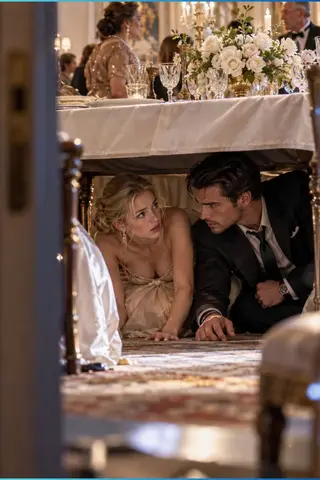
 She hid under a wedding banquet table to escape her matchmaking mother
Chapter 65
Whispers in the Stone
With the ministerial concession secured in Rome, the real battle began on the ancient stones of Palermo.
By late December, the Cantieri Florio had been transformed into an active hive of restoration warfare. Scaffolding rose like an iron forest against the weathered brick facades of the foundry hall, while industrial vacuum systems cleared thirty years of pigeon droppings and marine debris from the historic rafters.
Yet, a profound mystery lingered beneath the surface of the dry dock.
During the preliminary excavation of the central drainage sump—a massive stone-lined cistern thirty feet beneath the harbor floor—workers struck a sealed, vaulted archway constructed of dark, unpolished volcanic tufa that did not appear on any twentieth-century municipal blueprint.
At eight o'clock on a cool Tuesday evening, Clara climbed down the aluminum access ladder into the damp subterranean vault, wearing her hardhat, rubber boots, and a high-intensity headlamp.
Beside her walked Rocco, carrying a heavy structural inspection pry-bar, his sharp eyes scanning the ancient brick ceiling for signs of structural spalling. Behind them, Frankie stood sentry at the base of the ladder, his flashlight sweeping the shadowy corners of the cavernous chamber.
The air in the subterranean vault was cool, heavy with the scent of damp earth, centuries-old lime mortar, and ancient pine tar.
“Look at this keystone, Dad,” Clara whispered, her beam illuminating an immense, hand-carved stone archway sealing off a secondary subterranean corridor.
At the center of the arch sat a heavy stone medallion carved with an intricate relief: a square and compass intertwined with an anchor, flanked by two carved letters: V and M.
Rocco stopped dead in his tracks. He reached out with his bare, scarred hand, his trembling fingers tracing the weathered contours of the carving. The stone was cold, but beneath his touch, a century of family history seemed to vibrate with electric life.
“Ventresca e Muratori,” Rocco murmured, his gravelly voice thick with an emotion so deep it made his chest ache. “Ventresca and Masons. This was my great-grandfather’s personal stonemason’s mark. In 1888, the local maritime history books said the Ventresca shop was burned out by corrupt port competitors. But they didn't destroy his work; they just buried it.”
With careful, reverent precision, Rocco wedged the tip of his pry-bar into the calcified lime mortar sealing the stone door. With a single, measured application of his immense physical strength, the centuries-old mortar cracked like dry bone.
The stone panel swung inward with a heavy, scraping groan that echoed through the subterranean cistern.
Inside lay a forgotten master archive: a dry, vaulted stone chamber lined with zinc-lined cedar chests.
Clara stepped inside, her heart hammering against her ribs. She approached the central chest, unlatching the rusted brass hasp with gentle fingers. Inside, wrapped in oilcloth and preserved by the natural dry climate of the volcanic vault, lay dozens of hand-drawn architectural master blueprints drafted on heavy linen vellum, dating from 1880 to 1910.
She carefully unfurled the top sheet under her flashlight.
It was the complete, original master hydraulic blueprint for the Cantieri Florio dry docks—drawn in the exquisite, hand-inked hand of Matteo Ventresca, Master Mason of Palermo. At the bottom of the page, beneath the precise mechanical drawings of the subterranean sea-gates, was a handwritten inscription in Sicilian:
“Construito per durare contro il mare e contro gli uomini.”(“Built to endure against the sea and against men.”)
Evelyn climbed down the ladder, stepping into the vault just as Clara read the words aloud. Evelyn looked at her husband, seeing the tears glistening in his gray eyes, and wrapped her arms tightly around his waist, burying her face against his broad shoulder.
“He left the answers for us, Rocco,” Evelyn whispered softly. “Your great-grandfather left the foundation keys for his great-granddaughter.”
Clara looked at the ancient linen, then turned to her parents, her green-flecked eyes blazing with an unshakeable, sacred purpose.
“We don't need to reinvent the sea-gates,” Clara said fiercely, holding up the blueprint. “We just have to finish what Matteo started.”
The End









