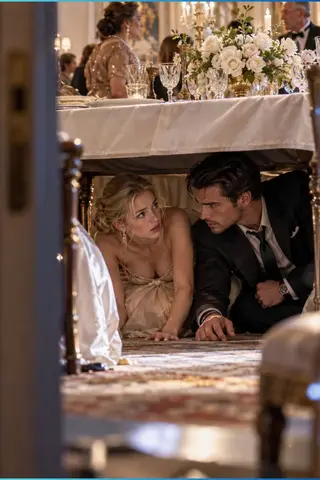
 She hid under a wedding banquet table to escape her matchmaking mother
Chapter 64
The Roman Boardroom
Securing the loyalty of the Palermo dockworkers was an essential tactical victory, but the ultimate authority over the European Heritage Infrastructure Fund lay three hundred miles north, in the palatial Renaissance halls of the Ministry of Cultural Heritage in Rome.
On a rainy Thursday afternoon, Clara, Rocco, and Evelyn entered the Sala dei Marmi at the ministry headquarters overlooking the Tiber.
The chamber was an intimidating display of European bureaucratic supremacy: seventeenth-century frescoes adorned the vaulted ceiling, massive crystal chandeliers hummed overhead, and an imposing horseshoe-shaped marble table seated twenty senior commissioners representing the Italian state, the European Union Cultural Directorate, and the private development lobby.
At the center of the commission sat Undersecretary Vittorio Castiglione—a formidable administrative autocrat whose career had been built on granting lucrative coastal concessions to northern Italian industrial trusts. Seated beside him was Count Morelli, who was whispering animatedly to the lead legal representative of the Milanese superyacht syndicate.
“The commission has received the competing proposals for the redevelopment of the Cantieri Florio,” Undersecretary Castiglione announced, his voice carrying the smooth, condescending cadence of imperial bureaucracy. “The Milanese consortium has presented a fully funded, ninety-million-euro master plan to transform the harbor into the Riviera of the South—complete with private luxury berths, high-end retail galleries, and luxury residences that will bring substantial foreign capital to Sicily.”
Castiglione paused, peering down his spectacles at Clara, who sat between her parents in an immaculate dark charcoal suit with tailored lines that honored her father’s tailoring, her hair swept into an elegant, commanding updo.
“In contrast,” Castiglione continued with an audible sigh, “the proposal from the American partnership seeks to maintain the shipyard as a functional heavy-craft guild and maritime restoration facility. While we appreciate the historical sentimentality of the Ventresca family’s ancestral heritage, the commission must prioritize modern economic viability over dusty romanticism.”
The Milanese attorneys smiled smugly, shuffling their slick leather-bound folios.
Clara didn’t flinch. She rose from her seat, pressing a button on the presentation podium. The room’s lights dimmed, and the massive digital display screen behind the commissioners sprang to life.
Instead of glossy architectural renderings, the screen displayed a high-resolution, three-dimensional hydrological computer simulation of the Gulf of Palermo during a Category 3 Mediterranean tropical cyclone—the dreaded Medicane storms that had become increasingly violent over the past decade.
“Undersecretary Castiglione,” Clara began, her clear, resonant Italian ringing through the marble hall with crystalline authority. “Your luxury marina plan requires the demolition of the 1890 Florio outer storm baffle to create a five-hundred-meter turning basin for private yachts over eighty meters in length.”
She advanced the simulation. A terrifying digital wave model showed a six-meter storm surge roaring into the unprotected basin, completely overwhelming the proposed luxury slips and inundating the low-lying historic neighborhoods of the Kalsa district with four feet of saltwater.
“The Milanese plan removes the primary hydro-dynamic defense that has protected the historic center of Palermo from catastrophic flooding for one hundred and thirty years,” Clara stated, her eyes locking onto Castiglione with lethal precision. “The 1890 Florio baffle was not built for aesthetics; it was engineered by naval hydrologists using submerged cyclopean breakwaters that dissipate eighty-five percent of wave kinetic energy through underwater friction chambers.”
Count Morelli shifted uncomfortably in his chair, leaning toward his engineers, who were frantically reviewing their files.
Clara pressed her advantage without mercy. “If you approve the Milanese proposal, the Italian state will assume civil liability for an estimated four hundred million euros in catastrophic urban flood damages within the next ten years. Furthermore, our proposal integrates zero-emission subterranean tidal turbines into the historic breakwater channels, generating twelve megawatts of continuous renewable electricity—enough to power the entire historic port district and qualify for an additional forty million euros in European Union Green Horizon decarbonization subsidies.”
The room went dead silent.
Undersecretary Castiglione looked down at his files, his hands trembling slightly as he stared at the verified hydrological data stamped with the seal of the National Research Council of Italy.
Rocco stepped forward, joining his daughter at the podium. He placed his large, tattooed hands flat against the marble, his immense presence projecting the terrifying corporate finality that had subdued boardrooms from Albany to Manhattan.
“The Ventresca Foundation has deposited forty million euros in unconditional escrow with the Bank of Italy this morning,” Rocco said, his low baritone cutting through the silence like an iron blade. “We do not ask for a single euro of state debt guarantees. We provide the capital, the green engineering, and the master guild that preserves Italian heritage. If this commission chooses to sacrifice public safety for a casino, we will release this hydrological report to the Italian press and the European Court of Auditors within forty-eight hours.”
Castiglione swallowed hard, looking at the united, unyielding front of the father and daughter. He realized with sickening clarity that he wasn't facing sentimental American tourists; he was facing an empire of unyielding structural steel.
The undersecretary cleared his throat, adjusting his silk tie with nervous haste. “The commission... the commission finds the structural and environmental merits of the Ventresca proposal to be of exceptional national significance. The concession is granted to the Hartwell-Ventresca Partnership.”
The End









