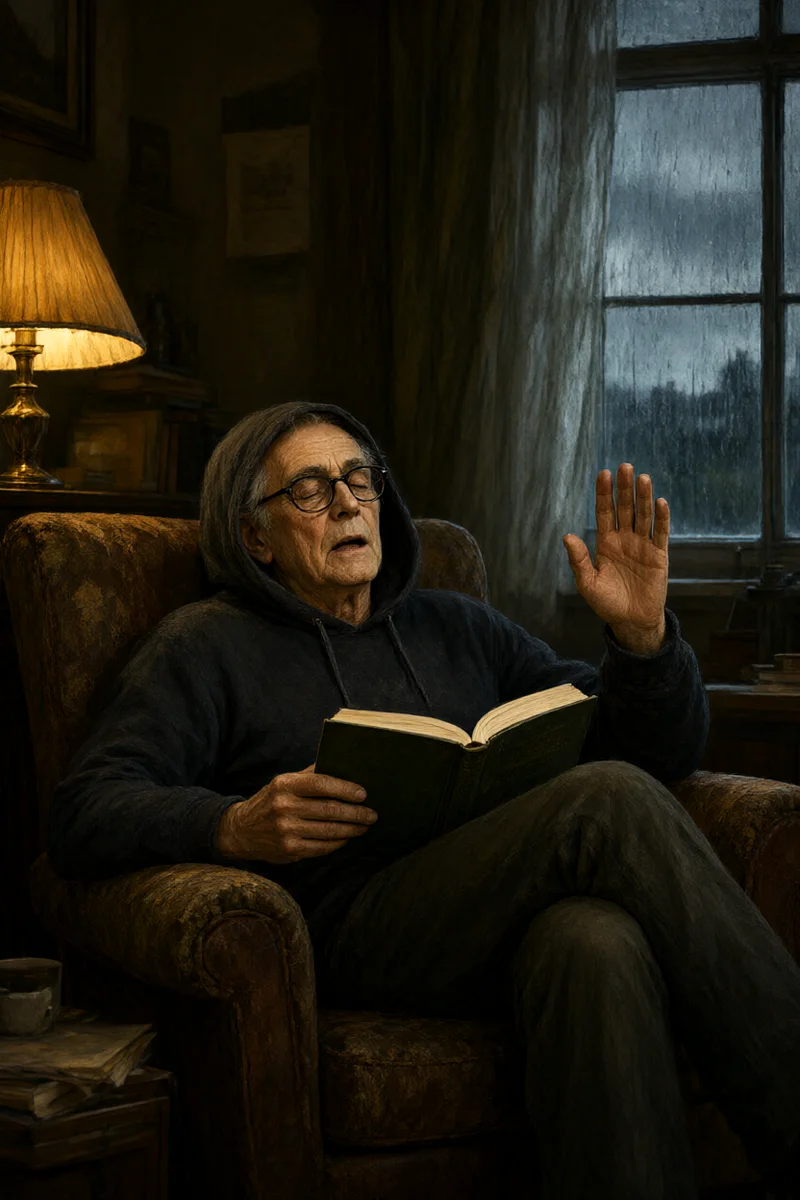
 Reading to Mr. Graff
Chapter 5
The Circle
The circle met in Room B of the community center on a Tuesday at four o'clock. Six plastic chairs, a box of tissues on a stool. Ms. Lindqvist in her big scarf. Ansel's mother in her good blouse, holding her purse on her knees with both hands.
Mr. Graff had asked to come as Ansel's support person. He arrived on his white cane, on Ansel's arm, and took the chair by the window.
Ferenc Szabo came in last. He wore a work jacket with the store's name over the pocket, sat down heavily, and did not look at Ansel at all. He had brought the photograph the police had taken, of his window, in a plastic sleeve, and he laid it face up on his knee.
Ms. Lindqvist said there was no hurry, and that in this room nobody would finish anyone's sentence. Then she looked at Ansel.
He had the index card. He didn't look at it.
He took the soft breath, the one that was almost a sigh, and let it carry the first sound out of him like a boat pushed off a dock.
“My name is Ansel Dunmore.”
He heard his mother make a small noise.
He went on. It was not clean. He blocked on painted and on window and, worst, for six long seconds, on sorry, with his jaw locked and his face burning and the clock ticking on the wall. Nobody spoke. Nobody moved. In the chair by the window Mr. Graff sat with his hands folded on his cane and waited, half a beat ahead of him, saying nothing at all.
Sorry came out.
He told Mr. Szabo about the hinges and the woman who laughed. He said that he had thought he was being mocked and that he understood now that he had been wrong, and that it did not matter whether he was wrong, because you did not get to paint on a man's window either way. He said he would pay for the cleaning, and that he was sorry, again, and this time it came out on the first try.
Then he stopped, because he had finished, and it was the first time in his life he could remember finishing anything that long out loud.
Mr. Szabo looked at the photograph on his knee for a while.
“I s-s-s—” His jaw thrust forward. His eyes closed. He stopped, breathed, and tried again more softly. “I saw your face. That day. I knew what you th-thought. I should have said. I was ashamed. In front of the lady.” He turned the photograph over. “Nineteen years I have the store. Every day I hide it. I say aisle seven instead of aisle s-six, because seven is easier.”
“Ferenc,” said Mr. Graff from the window. “You always did hate your S's.”
Mr. Szabo turned in his chair. He looked at the old man in dark glasses for a long, blank moment, and then something happened to his face that made Ms. Lindqvist reach for the tissues.
“Mr. Graff?” he said, like a boy. “From Fuller Street? With the tape machine?”
“I still have it,” said Mr. Graff. “Under a sheet. You're on one of those reels, I should think, reading about a dog called Biscuit. Very badly.”
Mr. Szabo laughed, a big helpless laugh, and stuttered all the way through it.
The settlement Ms. Lindqvist typed up said forty hours of service and the cost of cleaning the window. It did not say that Mr. Szabo offered Ansel a job on Saturdays, at the counter, starting in January. It did not say that Ansel took it.
That evening at six he knocked on 4C. The voice said, “It's open, Mr. Dunmore.”
“It's Ansel,” he said, coming in, and the name came out on the first breath, with nothing in front of it at all. “You can call me Ansel.”
The End









