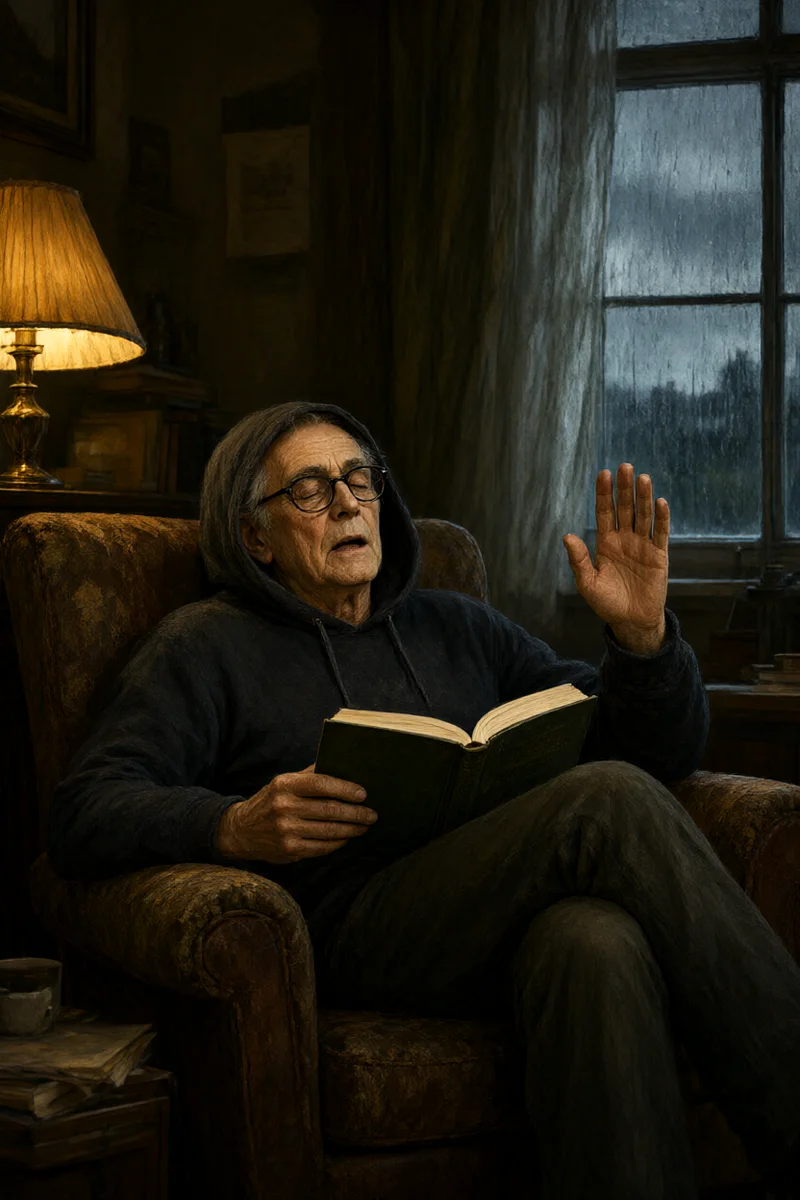
 Reading to Mr. Graff
Chapter 2
Iambs
“I didn't,” said Mr. Graff. “I like that poem. I couldn't help myself. Keep going.”
Ansel did not believe him. But he kept going.
It became a routine faster than he would have thought possible. Six o'clock, a knock, the voice saying “It's open, Mr. Dunmore.” A mug of cocoa, made too sweet, waiting on the side table. Then whatever Mr. Graff had chosen, which never made sense.
Poetry, the first week. Old poetry, with a beat you could tap your foot to. Mr. Graff said he liked the music of it and made Ansel read some lines three times running, faster, then slower, tapping his own knee. Ansel noticed he stumbled less when he leaned into the rhythm, like walking down stairs in the dark by counting.
The second week, plays. Mr. Graff took one part and Ansel the other, and when it was the old man's turn he spoke very slowly and softly, every consonant barely touching the next, and Ansel found himself copying it without meaning to, the way you fall into step with someone on a sidewalk.
“Why are you whispering the P's?” Ansel asked once.
“I'm eighty-one. Everything I do is a whisper.”
The third week, absurdly, the phone. Mr. Graff had a stack of catalogs and wanted Ansel to call and ask questions about things he had no intention of buying. A garden hose. A set of pruning shears. A cruise. Ansel's hands sweated on the receiver. He blocked so badly on the cruise line that the woman hung up on him.
“Again,” Mr. Graff said, and handed him the next catalog by feel.
“You don't even have a garden.”
“Then I shan't be disappointed when the hose doesn't come.”
Ansel called. He got through it. He called the shears people and got through that too, and when he put the phone down his heart was going like he'd run four flights.
At home he lay on his bed and replayed it, the way he usually replayed failures, and found there was nothing to replay.
There were bad nights, too. Nights when the words jammed so hard he threw the book across the room and it hit the dust-sheeted tape machine with a crack, and Mr. Graff said nothing at all for a full minute and then said, “Pick it up when you're ready. I've got nowhere to be.” And Ansel, ashamed, picked it up.
Three weeks to the circle. He had written his statement on an index card. He couldn't get past the first line of it. The first line was “My name is Ansel Dunmore,” and the A at the start of his own name was a wall he had been hitting since he was seven.
On the Thursday of the third week, Mr. Graff went to the kitchen to make the cocoa himself, which took a while, and Ansel stood up to stretch and wandered along the bookshelves, reading the spines for something to do.
Above the desk, between two shelves, there was a frame he had never looked at properly. It had been hung where a sighted man would see it from his chair, a long time ago, before the sight went. The glass was dusty. Ansel rubbed it with his sleeve.
It was a certificate, cream-colored, with a gold seal. A professional association. Certificate of Clinical Competence. Speech-Language Pathology. Awarded to Leopold A. Graff, M.S., in 1971.
Beside it, smaller, a yellowed newspaper photograph: a younger Mr. Graff, with sight in his eyes, sitting on a classroom floor with three small children and a reel-to-reel tape recorder exactly like the one under the dust sheet.
In the kitchen the kettle began to whistle, and the whistle went on and on, and Ansel stood very still and thought about the phone calls, and the poems you could tap your foot to, and the soft P's.
The End









