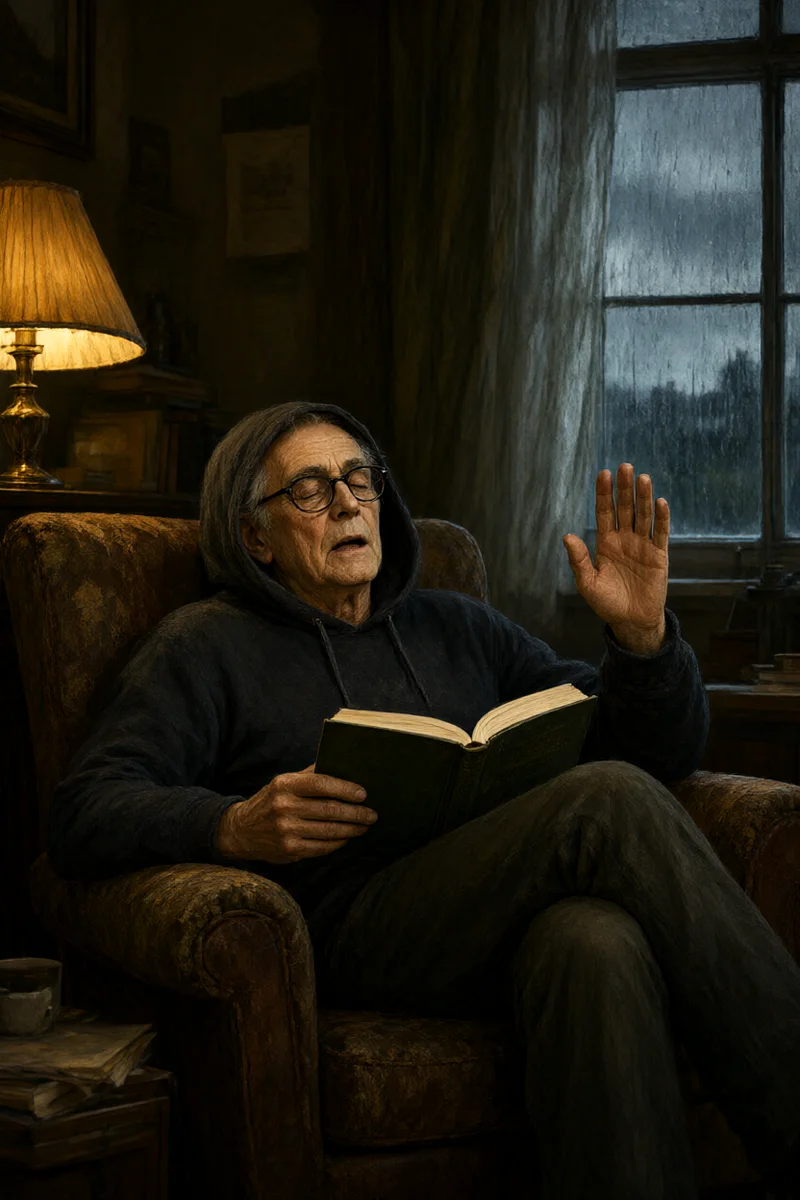
 Reading to Mr. Graff
Chapter 4
Brass Hinges
He knocked on 4C at six the next evening. The voice inside said, “It's open, Mr. Dunmore,” exactly as if nothing had happened, and there was cocoa on the side table, too sweet, and the green book was open to page forty-four.
Ansel sat. He didn't pick up the book.
“Why didn't you just tell me you heard?”
“Because a boy who practices his name for an hour in a locked bathroom,” said Mr. Graff, “does not want to know that anybody heard him.” He turned his face toward the window, the way he did when he was thinking. “I stuttered, you know. Until I was nineteen. My father used to finish my sentences for me at the dinner table, to be helpful. My brothers used to finish them to be funny. I became a speech therapist out of spite, mostly. I wanted to be the one person in the room who never finished anybody's sentence.”
Ansel looked at him for a long time.
“Three weeks,” he said. “Fix it.”
“It doesn't get fixed. It gets managed. Like a bad knee.” Mr. Graff held out his hand for the index card. “Read me what you've got.”
They worked every evening that week and the next, for longer than two hours. Mr. Graff was not gentle when he wasn't pretending to be a man who only liked poems. He made Ansel record himself on his phone and play it back. He made him block on purpose, on easy words, until the block was something he did and not something that happened to him. He taught him to begin the A in his name with a breath so soft it was almost a sigh, and when Ansel said “Ansel” on the eighth try without his head moving, the old man nodded once and said, “Again. Don't celebrate. Again.”
On the Thursday before the circle, Mr. Graff asked him to tell it from the start. Not the statement. The night itself.
“Why did you pick that store?”
Ansel had not told anyone. Not the police, not his mother. He told it to the dark glasses. He had gone into Szabo's Hardware in August for his mother. She needed brass hinges for the kitchen cabinet. He had stood at the counter and blocked on brass, of course, B-b-b-b, a long bad one, with a woman behind him in line clicking her tongue.
And the owner, a heavy man with a gray mustache, had looked straight at him and said, “B-b-b-brass? B-b-brass. Aisle s-s-seven.”
The woman behind him had laughed. Ansel had walked out without the hinges. Three nights later he went back with the paint.
“Say it again,” Mr. Graff said. His voice had changed. “Exactly how he said it. Don't make it worse than it was. Exactly.”
Ansel did. B-b-b-brass. The jaw thrust on each repetition, the little pause before the S, the eyes closing on seven.
Mr. Graff sat very still. Then he took off his dark glasses, which Ansel had never seen him do, and pressed his fingers into the corners of his eyes.
“Szabo,” he said. “Ferenc. Hungarian family. Would be about fifty-five now, fifty-six.”
“How do you—”
“Because I know that block,” said Mr. Graff. “I spent two years on that block, Ansel. In a classroom on Fuller Street. In 1977.”
The End









